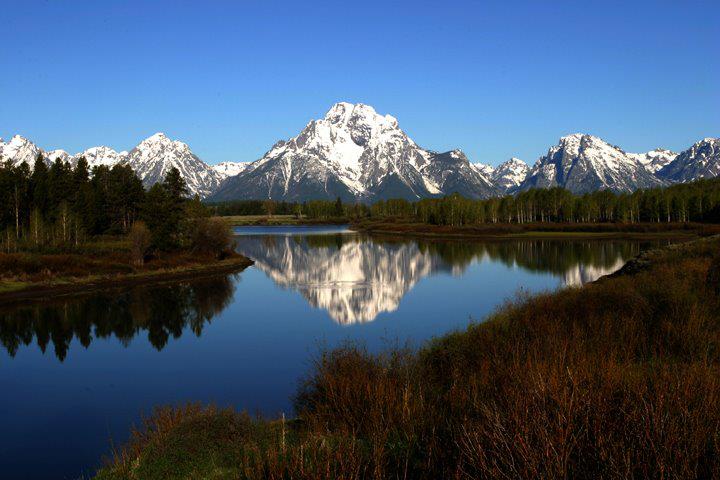
A beautiful day at the Grand Tetons.
And some rain later in the day.
A beautiful day at the Grand Tetons.
And some rain later in the day.
When I was a child and heard “Yellowstone” I thought of Yellowstone National Park or even more specifically its more famous feature, Old Faithful geyser. I found the idea of a geyser unbelievable and sometimes wondered what it would be like to have a geyser like Old Faithful in our local park. A humorous thought given that our park was less than a city block in size. I read about Yellowstone in books and magazines, sometimes saw television shows featuring it, and even associated it with a Hanna-Barbera cartoon series from the early 1960’s, The Yogi Bear Show with Yogi Bear, Boo-Boo Bear, and Ranger Smith who lived in Jellystone Park. While the cartoons were fun to watch, they are not my focus here. Instead, I want to write about the national park
I remember wishing to visit Yellowstone when I was young but that wasn’t practical for our family. So, I could only learn about it in other ways and imagine what it would be like to be there. I finally had the opportunity to visit Yellowstone when I was in my late thirties. Surprisingly, it was much as I had imagined and even more.
Yellowstone National Park is a huge place, over 3,400 square miles, mostly in Wyoming but also in Montana and Idaho. As one might expect in a park of this size, Yellowstone offers many different things for the visitor. Starting with the simple, it offers rivers, lakes, canyons, meadows, and hydrothermal features like the many geysers. According to scientists, the park sits atop the Yellowstone Caldera or dormant volcano. If you visit, you will see some of the most pristine and colorful water features that can be found anywhere. You may also see dynamic waterfalls in steep-sided canyons, mud pots in other locations, and a variety of rock formations.
Yellowstone is also the home of a great variety of wildlife, with an emphasis on “wild”. You can see bison, elk, deer, moose, and a variety of waterfowl and other birds. Where you see them and in what numbers can vary by the time of the year and the weather. You can also see, if you are lucky, cougars, wolf packs, and bears, both black bears and their larger relatives, the grizzly bears. But remember to keep your distance and follow any instructions from the park staff for both your safety and that of the wildlife.
The water features are beautiful. Old Faithful still erupts regularly, although maybe not every hour but even if you cannot get to Old Faithful there are many other geysers with roads or trails leading to them. There are also many pools or other water features to see, just remember the water is extremely hot. And you should resist the urge to throw pennies into the water features. Pennies and other foreign objects can destroy these beautiful works of nature and spoil the future for other visitors.
But all this beauty does come at a price. Like other wild locations throughout the world, there is hidden danger in Yellowstone. Some of the danger is courtesy of Mother Nature and some is the fault of man. As I said earlier, there are rules and warnings at various locations in the park and given by rangers and volunteers in person. Probably one of the biggest things to know is that the trails and boardwalks in the park are there to keep you and the environment safe. It can be tempting to just step off a short way, but you don’t know what dangers may be there or what harm you can cause to the environment. Another big thing is to remember you are visiting the wildlife in their home. Keep your distance from the wildlife. They will protect their young. They will protect themselves. They are faster than you believe, and their horns, hooves, and teeth are far more dangerous than you may expect. This is even more true in the breeding season. While a photo with a bison may look cute on your wall, is it worth your life? If a trail is blocked by a herd of elk, choose another trail and come back later. Stay safe and enjoy your visit.
Remember that the water features in Yellowstone are hot. That means you can get burned by touching it in many locations. Even where you least expect it there can be small, yet hot water features. There have been many fires at Yellowstone. These fires are both beneficial allowing for reforestation, but they can also be dangerous. If an area or a road is closed because of fire danger, then don’t go there.
The winter can also present danger. A large portion of the park is closed in the winter or open only to snow vehicles. Again, this is to protect you, the wildlife, and the park itself. Obey the rules and come back to the park again.
I hope that each of you has the opportunity to visit Yellowstone and can enjoy some of the best nature has to offer. If you do, have a good trip and take a photo for me.
 An Old Man's Thoughts, Memories, & Opinions