Spring

I’m almost afraid to post this because if I do there may be one of those rare, but possible, late season snowstorms that will drop a few inches of snow and ice on mid-America. But rather than plan on the unexpected, I will trust Mother Nature to help us through this season of change with the many challenges and the beauty it brings.

When I look outside this morning, it appears that Spring has sprung. The trees are starting to discard the last few remaining brown leaves from last year and replace them with bright green foliage. The blossoms from the early bloomers have come and gone, replaced by colors of new flowers and trees becoming more abundant. Tulips and daffodils seem to be everywhere with their bright hues covering gardens and lawns where they grow whether tended by homeowners or in wild spaces where planted by gardeners in the past.

The rains and storms that come along with the changing seasons are here in force. Flooding, high winds, and hail seem to be highlighted daily by the weather forecasters. Farmers are challenged to plant this year’s crops to feed the nation. River levees can sometimes handle the extra water and at other times lose the battle against Mother Nature.

Some see Spring as a wonderful time of the year as cold weather departs, either for days or weeks at a time. Others see Spring as a sad time as cool days and nights give way to the heat of the coming Summer. For all, it is a time of change. In many cases it is a time of birth for our wild friends. For others it is a time of breeding with young to enter our world in a few weeks or months. We see migrating birds in their bright colors. We welcome the return of other colors as we are visited by butterflies and hummingbirds.

Alas, it is also the time that brings more work. Things like lawns that must be tended after lying dormant through the colder months. Potholes that must be filled to repair the damage caused by both colder weather and the storms of spring. We must prepare our gardens to grow both vegetables for our enjoyment or flowers needing replanting each year.

It is a time to share with those who are still with us and hope that they will see many more Springs and a time to remember those who are not with us to welcome the new season or year.

I hope you will join me in welcoming the Spring. And for those who dislike the heat of the coming season, remember that the softer days of Autumn and the colder days of Winter are not too far away.
Brr….

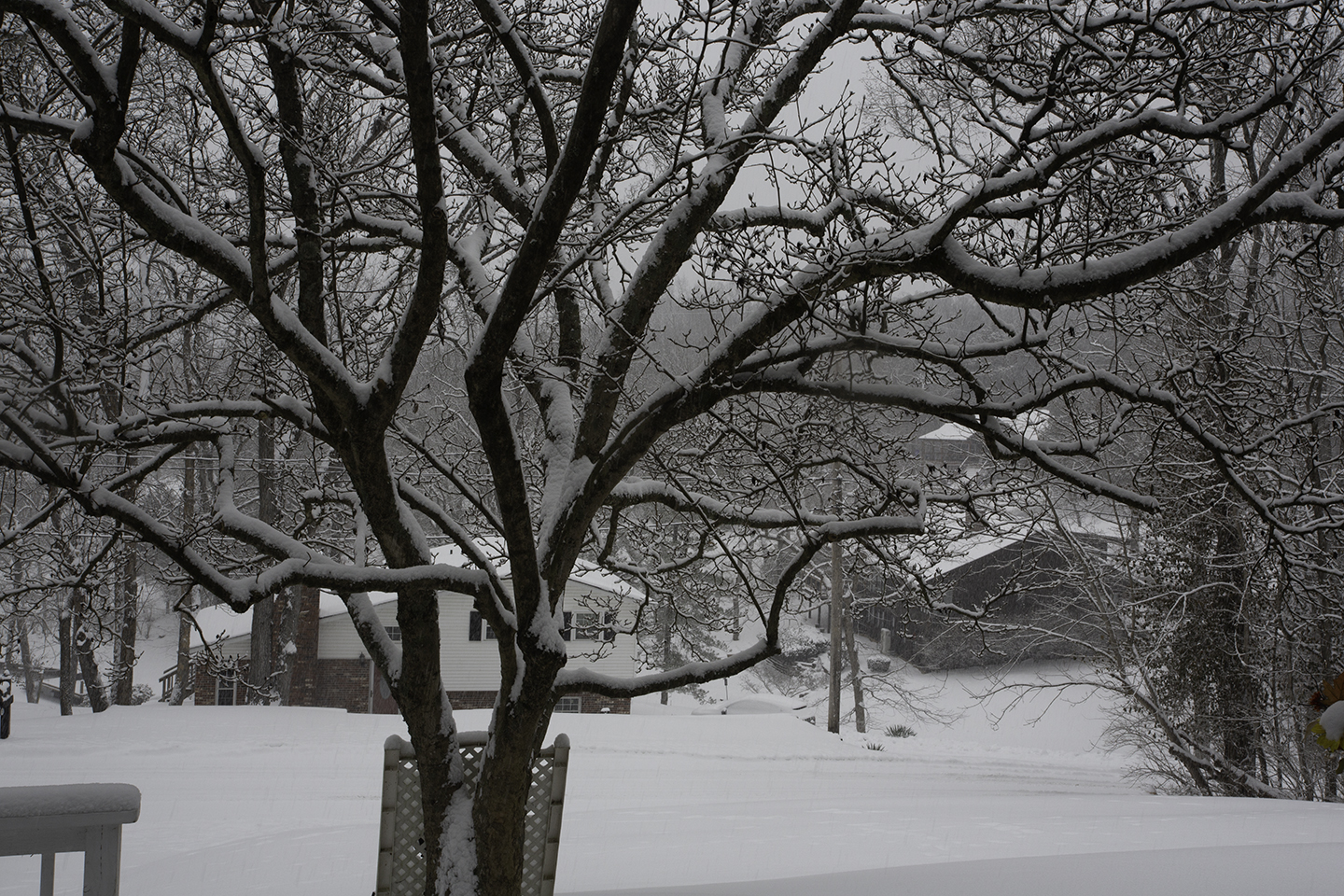
In the last couple of weeks, the St. Louis area has suffered through some strong, at least for here, winter storms. During the first, we were on the border between snow and ice. At our home, southwest of St. Louis, we spent the first two days of the initial storm as a target for freezing rain and sleet. Only the final night gave us some of the snow that had been seen north of us.  As a result, we had a layer of ice on the ground, on streets, and on driveways which was then covered by snow.  A few days later, another blast of winter weather added several additional inches of snow.
While many others, like my nephew who lives a short distance from Grand Traverse Bay and Lake Michigan, have far worse winter weather and far more snow, they are better prepared for what that brings. Still, I wonder if they sometimes laugh about our weather woes or have sympathy for those who rarely have this type of weather.   

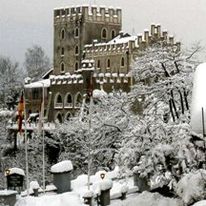
I will admit that I probably have difficulty understanding the reactions to winter weather myself. I grew up in northeast Arkansas. As school aged children, we were usually happy when we had more than one “snow day” in a year. More often, we had none. My second Army assignment was in Germany. There, and like in this photo from Austria, we had much more snow than in Arkansas, but I don’t remember it ever bringing things to a standstill. Instead, communities and drivers there seemed to be prepared for snow and took it in stride. I saw this in multiple assignments in Europe and in the U.S.

But the recent days have made me wonder, why do we not prepare for winter weather and why do react the way we do? Preparation, at least on the surface, seems fairly simple. We should keep enough basic food and other necessities in our homes in case we cannot visit stores for a few days. Instead, it seems that purchasing these basics, particularly food, is never thought about until the last minute. Store shelves are emptied where there should be simple items like bread, eggs, and other everyday items. Little or no thought is given to what will happen if we lose power or if our roads cannot be cleared as rapidly as snow or ice falls.   

Perhaps our businesses should have plans in place to either operate with limited staff or to close for a few days if necessary.  Schools seem to be able to do this, so why not others? Also, our stores should have enough supplies like snow shovels and salt or other ice melting chemicals on hand to meet the needs of the community. This clearly did not occur during our recent bad weather as people needed to call or visit multiple locations, some miles away, to simply get enough salt to clear their sidewalks.

During the first part of our recent bad weather, I had a great deal of sympathy for our HOA president who was receiving email and other complaints in the middle of the storm asking when the streets would be cleared so that someone could go to work or visit a store. He tried to explain that clearing the roads while the snow and ice continued to fall would be of little value. Still the complaints kept coming (along with a variety of reasons for why the roads needed to be cleared immediately). Yet after the main part of the storm had passed and the roads were first plowed, because of the ice the roads rapidly covered over again and driving conditions were no better. Others decided that warnings from area police and highway departments to travel only in emergency did not apply to them so they could travel as usual and create danger for our first responders and others.

All this occurring even after multiple warnings over several days before the storms. I had to wonder, “What would have happened had the winter weather been worse? And how are we teaching our children to be prepared for similar events in the future?”

Snow, Snow, Snow, Snow… and Our Wildlife Friends

Do you remember this song from the movie “White Christmas”? Singing were Bing Crosby and three others on the train heading to an inn in New England where, unfortunately, the snow had yet to appear that winter. As I listened to the weather forecast for this weekend that song came to mind.

We live a short distance southwest of St. Louis and the forecast called for all types of winter weather – snow, sleet, freezing rain, high winds, and low temperatures. In our case, we were expected to be on the line between snow and ice. The forecasters were pretty accurate. The bad weather started with light sleet or freezing rain which began around 10:00 PM, Saturday evening. This lasted until mid-day Sunday when the snow moved in and was mixed with the sleet until early evening. Then the heavier snow arrived and continued until early Monday morning. Driving became dangerous throughout the area beginning Sunday morning and continues even today.

Sunday evening before the heavier snow began, I looked out our rear window and saw two deer run across our backyard. It was dark enough that I really saw only the shadowed outline of their bodies and the bright white flash of their tails. This made me wonder, “How do these wild creatures – deer, squirrels, rabbits, and birds – survive the cold temperatures? If we didn’t have our warm homes, could we humans survive as well?”. It se seems that wildlife can survive, perhaps in nests or other sheltered places. Perhaps, they survive by clustering in groups to share warmth. Or maybe they simply know locations that offer some form of protection. They must because otherwise how could they survive – yet they do. They survive fire and drought, snow and ice, hurricanes and tornados. If they didn’t, we would have no wildlife today.

In this world we live. Humans, the supposed most intelligent species. Humans with technology and science and knowledgeable people who can help us stay safe and survive. But instead of using these tools, we select instead to pay little or no attention to warnings from warnings we are given to avoid travel and stay off the road. We seem to think that driving to the store to pick up a loaf of bread or a six-pack is more important than our safety or that of others, like our first responders. But perhaps we can’t survive without these items. So, we ignore others and try – maybe just to prove we are superior or smarter than those trying to protect us.

Maybe we do survive without problem but often we don’t. We wreck our cars – get hurt or harm others or get lucky and only get stranded. Then what do we do? Do we take responsibility for our actions, or do we do as a person I read about today. This person ignored all the advice and warnings, drove on unsafe roads, and became stranded when stuck in the snow. Their response – claims that there were no warnings (even though warnings were issued days before the storms) and complaints about how long it took first responders to rescue them. They were not injured, or injure others, yet they should have been placed at the top of the rescue list so they wouldn’t get cold. I know I should not judge others but using a quote from a popular movie, “Stupid is as stupid does!”.

This simply, sometimes, makes me wonder, “Who best deserves to survive, our wildlife friends or those who regularly take actions like the above?”