I have long wanted to write a review of one of the works of a favorite author, Stuart Woods. I found this particularly difficult because of Woods’ long writing career including both novels and nonfiction works. Finally, I decided not to delay longer and try to capture the essence of his first novel, “Chiefs”. I would note that while “Chiefs” is his first novel, originally published in 1981, it is not his first book. Before “Chiefs” he wrote a book describing his experiences sailing, including a trans-Atlantic trip from the United Kingdom to the United States, and a guidebook to locations throughout the U.K.
“Chiefs” is loosely based on a childhood experience in Woods’ life when he found an old badge in a relatives’ attic. The badge appeared to be blood stained and damage from some type of firearm. Woods found that this was true, and the badge had been worn by one of his ancestors.
According to Woods, it took many years for the story he was told to transition into a novel and then took about eight years to be written and published. Most of the writing occurred in Ireland where Woods lived, almost as a hermit. Like several of Woods’ early novels the story is not part of any series although it does introduce several characters and locations that appear in his later works. The novel focuses on four individuals who lived in the rural south beginning in the 1920’s and continuing until after the end of World War II. A time when the country, particularly the south, was in transition. Three of these individuals were law enforcement officers in a small Georgia town. The other seemed to believe that he was more qualified than any to hold the position.
The first officer, Will Henry Lee, was a former cotton farmer. Like many other small farmers, he could no longer support his family by farming. Since the town was looking for its first police chief, Will Henry asked for the position and was accepted. He was successful in the position until his untimely, and some would say accidental, death while on duty. His badge, much like that of Woods’ ancestor, suffered the same fate.
The second chief, Sonny Butts, came on the scene years later. He might have been considered a thug had the circumstances been different. He was a motorcycle riding hot head, not afraid to treat the town’s elite in the same manner as it’s poor. He had proven himself a reasonably good police officer and was appointed chief after the death of his predecessor. After becoming chief, simply disappeared, not immediately but after some time.
The final chief in the story was a black man, something extremely unusual in that timeframe not just in the rural south but anywhere in the country. He had experience in the military and was fair to all the residents of the town. Because of his experience and a recent event, he began looking at the history of related crimes in the town’s past. His findings seemed to point to someone in or near the town being guilty of or at least knowledgeable of the crimes. Yet when he tried to report these things to the long-term county sheriff, they were laughed off. Could this be because of the chief’s race or was there some other underlying reason?
The fourth principal character in the book was an odd individual who lived a short distance outside the town. Someone who wanted to be the chief but was never selected. Someone who often appeared dressed as a hero from WW I, although his service was questionable. Someone who lived as a hermit but was known to have a large collection of weapons. A person who, if nothing else, was looked on as odd, quirky, or even crazy. What was his role?
Did any of these characters have a relationship? What role did each play in the growth of the town? Or were all just passing ships in the night? This is for the reader to find out.
I was able to find this novel in paperback form from a 2005 printing. It is unlikely that an copies of the original hardcopy version can be found since there were only about 20,00 copies printed. It is worth the hunt to read the book. Captivating, yes. Hard to put down, yes. And a challenge to try to solve the mysteries before reaching the conclusion. Search for it. Read it. And enjoy.
 The third of three books my wife bought for me on Father’s Day 2024, Kevin Fedarko’s “A Walk in the Park” is by far the longest and the most complex. Kevin’s friend, Pete McBride, suggests that the pair hike the Grand Canyon. Not the rim-to-rim hike that many find challenging, but instead a hike from one end of the Canyon, Lee’s Ferry, to the other, Grand Wash Cliffs, beginning in 2015. Although the distance between these two places is about 277 miles, the walk is closer to 750 miles because of the need to trek through side canyons and grounds with no trails. If the hike is taken in sections, the method used by Fedarko and McBride, the distance is closer to 800 miles because of added distance to take-out and drop-in points.
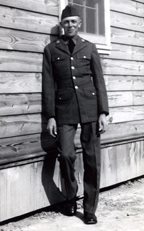 My father before his deployment in World War II. He served in the Army Air Corps, later known as the U.S. Air Force. He served in the Pacific Theater on the islands north of Australia and south of Japan.
 In a recent post, I wrote a short review of the first of these books, Nick Offerman’s “Where the Deer and the Antelope Play …” I’m going to try to do the same for another here, David Nicholls’ “You Are Here.” Nicholls, much like Offerman, has had a varied career as an actor (for which he said he had no talent), a writer, and a screenwriter.

 An Old Man's Thoughts, Memories, & Opinions