Have We Lost Our Way?

I try to avoid political discussion in any of my posts, whether blog posts, email, or even responses to things on Facebook or elsewhere. Why? Because our country was founded on freedom. We all have a right to make choices, to have positions that may sometimes be in conflict, to express views with only reasonable limitation. Yet, things seem to have changed. And maybe there is a need to sometimes look at how politics affect our daily lives. I can still be friends with those who hold opposing views. When I look at our country today, I ask myself if, as a country, “Have we lost our way?”

As a baby boomer, I suspect my parents, and their generation, asked the same question in the late 60’s and early 70’s. Things were certainly in were far different at that time than they were in the 40’s when all healthy adults were willing to make great sacrifices in the safety and security of our country and the world. As the baby boomers grew into adulthood, dodging the draft became acceptable, the use of drugs became common, and the hippie fashion became the trend. It was far different from what was acceptable as our parents moved into the world of adults.

The questions today are, in large part, not the result of young people rebelling against the past but instead seem centered around so-called adults who have not grown up. People who seem to believe that the things we have learned as a country over the past two hundred years plus are no longer important.

Differences are no longer acceptable. The ability to work and live together no longer have value. Instead of focusing on why our country has been viewed as a model for much of the world, little is of no value other than wealth or riches. Opposing views are not respected and systems which have served us well only exist to be destroyed.

While the downward spin has been slowly creeping into our lives for many years, possibly beginning in the 60’s, the beginning of the media named pandemic. During those years, much information was spread with limited research or analysis. We saw jobs lost, families broken apart, friendships destroyed, and nameless other things that were the result of individual choices – get a test or don’t get a test, take an injection, rushed to the market, or trust your personal resistance to disease, wear a mask or don’t wear a mask. These things and many more drove wedges between individuals, families, even medical professionals. Yes, there were deaths during the pandemic but the simple was to classify any death was to say it was the result of the disease in question.

Today things have spiraled even further. During our last presidential election, we had one candidate who refused, and still refuses, to accept the results of any election where he is not the winner. The opponent was a candidate who had never received a single vote in a primary election. Many chose not to vote or voted on the lesser of two evils rather than a candidate’s qualifications.

The result – much the same as the end of the pandemic. No one seems to accept that there is nothing wrong with differing opinions; that negotiation can provide better results than permanent lines drawn in the sand can never be crossed; that loyalty to a political party is far more important than representing the average person in our country. We have leadership, and I use the term very loosely here, that believes the only way to lead is through dictation, not working with others to achieve success. Leaders who are willing, and have voiced, that disagreement with them should result in censorship, loss of rights, and even banishment or jailing in foreign countries. Leaders who search for ways to ignore our Constitution, our laws, and the courts which were created to resolve differences in interpretation and enforcement of these laws.

So, we now have a leader who uses things like executive orders, bullying, and even threats to achieve his desires and ignore the legislative branch of our government. A billionaire who has been given largely uncontrolled power as a so-called advisor even though there are clearly conflicts of interest in the advice he gives (and someone who was neither elected nor did his role receive any review). All the members of one party have decided they will line up and accept this leader’s actions and decisions regardless of how stupid they may look or how their constituents feel. The other party does just the opposite opposing everything with no real justification.

When I step back and look at things today, it seems that we do not have leaders. Instead, we have people in high positions who are acting like three-year-old children playing in an expensive sandbox who will pick up their toys and run home if they don’t get their way. So, I return to my original question, “Have we lost our way?”
Pursue the Impossible

I recently saw a tee-shirt with the organization name on the front and an organizational goal printed on the back. The goal was, “Pursue what’s possible”. On first reading I thought this was a good goal for any organization. But as I reflected on it, the more uncomfortable I became with the goal. Why? Because by pursuing only “what’s possible” today we are accepting that the status quo cannot be improved.

Jules Verne’s writing is often associated with science-fiction, but some sources say that it was based on carefully researched material which existed at the time. If we accept this, then a trip around the world in eighty days was not possible at the time. Similarly, travel from the earth to the moon was not considered. Verne’s works were considered fictional in nature. Comparatively, Hanna-Barbera’s cartoon series “The Jetsons” which aired in the early 1960’ s seemed to be purely fictional and written for entertainment with little relation to things that were available in that era.

So, looking at these two different views of the world, approximately one hundred years apart, if we accepted “pursue what’s possible”, we would not consider either worth pursuit because they presented the impossible, not the possible.

Yet when we look around us today, we see many of the concepts presented as not just possible but common in day-to-day life. We have had airplanes that could travel around the world at the Equator in about eleven hours. We have robots that can clean our homes with minimal human intervention. We have not only travelled to the moon and back safely but are now considering travel to Mars. We have all of this because some have pursued the impossible and not limited themselves to pursuing only what’s possible.

We could apply the same to many other advances we have had over time, not just recently but since Verne’s time and even earlier. If Henry Ford had accepted that making an automobile available to the masses was impossible, would we still be travelling by horse and buggy? Or, if communicating via wire or wirelessly had been accepted as impossible, how would our lives today be without our cell phones? Even something as seemingly simple as cooling food without the physical presence of ice would make today’s food choices impossible.

So, as I look at that shirt today with its simple goal statement, I wonder who would consider it a worth goal. Are they saying that today’s world is acceptable and there is no room for improvement? Or are they saying that pursuing the impossible is of little value?

While my views may not be shared by others, I think the organization which shared this goal is lucky. Those who wrote or approved the goal are no longer there. Perhaps the new leaders view the world and valuable pursuits differently. And perhaps the organization is now trying to make things better, not just accept things as they are.

No Such Thing as Illegal Protest

Last week I had the opportunity to read a short article by a legal professor whose area of expertise is Constitutional Law. It was titled, “There is no such thing as ‘illegal protest’”. I would note that this was presented as “News” and not an “Op-Ed”. While I have no legal expertise, especially in the Constitution, this article raised more questions in my mind than answers. The article was focused on some statements by our current President and was clearly written from the point of view that these statements should not have been made. My questions, however, were more related to how bad things might become were the ideas presented taken to the extreme.

The article started with the definition of a protest and of an agitator and how any limitation on these was a violation of the First Amendments protection of peaceable assembly. A protest was defined as a public assembly, presumably presenting a point of view. Although not specifically included was what constitutes an assembly but one could assume it consists of more than one individual. It was stated that an agitator was not a legal term but was colloquially defined as one who makes noise, disrupts the status quo, and calls attention to a cause. The writer stated that this is also a form of free speech.

Following the article title, then just as there are no illegal protests, there is also no illegal agitation. On the surface, this seems to be reasonable.

In my mind, the questions about this view start with the term “peaceable assembly”. What was not defined is the word “peaceable”. For example, is the brandishing of weapons peaceable? Is occupying a building or the property of another, without permission, peaceable? Is destruction of or damage to property, for example, public vehicles or buildings, peaceable?

Another question that arises is, if we assume that all protests, or assembly are legal, does the same apply to all agitation? Things become more difficult to define here. Looking at recent events, is driving a vehicle through a roadblock because one is unhappy because o inconvenience caused by the closed road the work of an agitator?  If so, are the agitators actions a form of free speech and therefore legal? Does this then excuse the agitator for any subsequent damage or death that may occur? If not, then what actions of an agitator, and one must assume a protest, not legal. But by taking the article and its title as absolute protests and agitation cannot be illegal.

Put more simply, with no clear definition of “peaceable” is anything resulting from a protest or the actions of an agitator excused? Given that the Constitution is the ultimate authority on legality, then one might use this as a defense.

Again, I do not claim expertise in the law or the Constitution. I am simply asking what I consider common sense questions. I believe that we have the right to enact laws and to enforce them. We have systems for challenging these laws and determining when they are not Constitutional. But I do not believe that we should take short articles like the one I read last week as an absolute. They are generally the opinion of someone named as an expert, or a limited group of experts, that are published by or in the media as factual. And, that we are expected to accept them without question.

What happens when a different expert or different media source offers a different opinion? Who should we accept and why?  Just more food for thought, especially in a more and more divided country.

Novels by Toshikazu Kawaguchi (Book Reviews), March 4, 2025

I had a bit of a challenge naming this post. It is a bit of a review of two novels by Toshikazu Kawaguchi, “Before the coffee gets cold” and “Before we forget kindness”. These novels are part of a five (at last count) book set originally written and published in Japan then translated for reading in the United States. I have a bit of concern about calling them novels because, at least in my mind, each book is a small set of short stories. In either case, I found them enjoyable and look forward to reading the other three books in the set in the future.

Rather than review them in detail and spoil the ending for other readers, I instead decided to pose a question to others. A question that is core to the reading of these books. Would you, if given the chance, return to a time or place in the past?

Of course, there are certain rules that you must follow.

  • While you are in the past, you can do nothing that would change the present. In other words, you cannot change events. Everything that happened then and since then will still occur.
  • You can only depart from a specific place and return to that same place within the time limits described below.
  • You will be given a hot cup of coffee before your departure to the past and you must return to the present before the coffee gets cold. If not, you will be cursed from there forward.

There may be other rules, but they will be explained to you before you travel to the past.

If you say you will return to the past your place of departure will be a specific chair in a small coffee shop, or perhaps a tearoom, off the main streets in a city in Japan. You must be sitting in a specific chair and return to the same chair.

It sounds so simple but there is a problem. The chair you must use is constantly occupied by a cursed woman all day, every day. The only time it is empty is when she must get up to use the restroom. So, there is limited opportunity for your travel and others may also be waiting to depart.

If you can be seated in the chair while it is vacant, you will be given a hot cup of coffee. This is the measure of the length of your visit. Remember, you must return before the coffee gets cold.

And then, the travel can begin.

Each of the short stories in the books is centered around someone who has chosen to travel back in time and the results of this travel. If you have the opportunity, they are short reads which you will enjoy.

AI or ACS?

I want to start today’s post with a disclaimer. I am not a Luddite! (Some younger readers may need to look for that word in your online dictionary.) I have worked in the technology field for most of my adult life. I have seen many great things come from technological advances and have also seen times where there were flops or total failures. I do not dislike technology, but I do not love technology that has been created just for the sake of technology or technologists. Having said that, let us move along.

As I have mentioned in previous posts, I grew up in a small farming community. While my family did not own a farm, but like many other teenagers in my hometown, I worked on a farm during summers. I drove tractors, combines, trucks, etc. Some years I worked from planting season until harvest. When equipment broke or failed, I helped do repairs to get things working again.

I am amazed when I read about farming today. Tractors with six or eight drive wheels. Tractors with more onboard computers than we have in our offices. Tractors that drive themselves. Tractors that can’t be repaired without a service call by the dealer in a truck with even more computers but few actual tools and no mechanics. The world has left people like me behind in the dust.

But these advances come at a price. Farmers pay six figure prices for equipment that is used one or two weeks a year and for the other fifty weeks or so sits at the dealer awaiting repairs or sitting in an expensive storage shed on the farm. And then we, those who have no understanding of farming, complain about the high cost of food which we often waste.

You may wonder how this ties into the title of this post. I used abbreviations for the title because that seems to be a trend today. AI is artificial intelligence, the latest and greatest trend in information technology today. A method for us to have all knowledge at our fingertips without any understanding of this knowledge. ACS is a term I coined for the post. It is artificial common sense. It seems to me that intelligence is of little importance without the common sense related to the use of that knowledge and an understanding of the source of this knowledge.

A rather simplistic example of AI versus ACS can be found in these two statements. AI – “Fire is hot. You can get warm near fire.” ACS would add – “While fire is hot and you can get warm near fire, if you get too close you will get burned (or may be consumed by the fire).” Pretty simple, right?

A few days ago, I was rearranging one of my bookshelves and came across a book that I purchased and read in the 1980’s. It was a collection of some humorous articles by an outdoor writer, Patrick F. McManus, between 1968 and 1978. I decided to browse these articles to compare them to what we might see today. One especially stood out and I wanted to quote a short selection here.

McManus wrote, “One of these days they’ll probably come out with a mechanical bird dog that locates pheasants with a special scent detector and radar. A small on-dog computer will record and analyze all available information and give the hunter a report: two roosters and five hens in stubble field – 253 feet. A pointer on the dog’s back would indicate the exact direction…Since no self-respecting hunter would want to be seen carrying his dog around by a handle, all but the cheapest models would be designed to look like nifty attaché cases…”

While this was humorous when originally written, it almost seems like a credible concept today. The question is, “Do we really need something like this?” I suspect that if you ask a pheasant hunter, initially they would laugh but after thinking more they might ask, “Why would you want something like that? Some days when you find no pheasants provide as much enjoyment as the days when they are plentiful.”

When I consider all the AI tools that have burst onto the scene in the recent past, I wonder if having a tool that does all our research (or other work) for us doesn’t present the same dilemma. For example, when doing research in person, “Do I always stay on a single subject? Or do I see something that appears only slightly related that leads me in a new direction?”

Have we, in our haste to make and market a new tool failed by omitting the more difficult, common sense, component? I see articles about how AI tools are being used improperly. I also see articles about how AI tools present security problems or concerns. I wonder if AI tools are really needed or are they like the self-driving tractor that, while a neat (dating myself here) idea has only the benefit of driving up costs?

I have no answers to these questions. I only pose them as food for thought. If we don’t use CS (common sense) or ACS (artificial common sense), is AI (artificial intelligence) really beneficial?

Why the Army?

In the past. I’ve been asked, “Why did you go into the Army?” This is a question I have pondered repeatedly and even today I’m not sure I have a good answer. Perhaps patriotism played a role although I do not consider myself more patriotic than others my age. If I had been a few years older, I could have said it was because of the draft and the Viet Nam War. But this was not true because by the time I graduated from college, the end of the War was near and the draft was, for all intents and purposes, no longer an issue. Or was it something else?

As I was laying in bed this morning this question came to mind again although it has not been asked recently. While I am the son of a World War II veteran, the idea of entering the military was never discussed in our home. Nor was it ever discussed in our school. So why did I even consider it?

Maybe it was something in my childhood. When I was young in most years my family went to the nearby small city of Jonesboro to see their Christmas parade. The parade consisted of a few floats, some marching units, some vehicles, and Santa Claus – a favorite of the children. While I cannot remember many details, there was one unit that I always enjoyed seeing. It was a small military drill team; I believe they were from ROTC unit at the local college and were called the Reng Rifles. They marched proudly in their uniforms, carrying rifles and wearing brightly polished silver helmets. As they went down the street, they twirled their rifles and did other movements that I found fascinating.

Several years later, a young man who I respected graduated from that same college commissioned as a Second Lieutentant after completing ROTC. He was five or six years older than me, and I can’t remember if he went on active duty or became a member of the reserves. I know he never suggested that I follow in his footsteps yet his decision to become an Army officer increased my respect for him.

When I left home and entered college, one of the first classes I asked to enroll was military science, or ROTC. Unfortunately, the only class session that fit my schedule was cancelled because of low enrollment. I could have moved on and no longer considered ROTC or the military as part of my future. Instead, near the end of my sophomore year I learned of a program that allowed those with interest in the military to enter a two-year ROTC program. To do this, you had to attend a summer camp between your sophomore and junior years, enroll in ROTC classes the next two years, then accept a commission. I agreed to do this and thus was commissioned as a Second Lieutenant upon my graduation.

There were several who encouraged me throughout these two years – my roommate who was two years ahead of me in college and in ROTC, others both ahead of me in college and even some following me, our ROTC staff, my parents, and others. One person I especially remember was the head of our ROTC department with whom I shared a first and middle name along with a last initial.

Even with all of this, I’m not sure why I entered the Army. Were I placed in the same position today, I believe I would do the same thing. While there were good times and bad during my Army career, I learned much and travelled to places I would never have seen otherwise. I met people who I remember to this day although I have not seen them in many years. I served our country. I was lucky, I did not have to serve on the battleground. I knew many who did. I have no respect for those who dodged the draft, nor can I respect those who criticize our military today yet have never served.

So, if you ask, give me a few moments to gather my thoughts and try to provide you a good answer. There are too many things that affected my decision both to enter the Army and remain there for a career.

Brr….

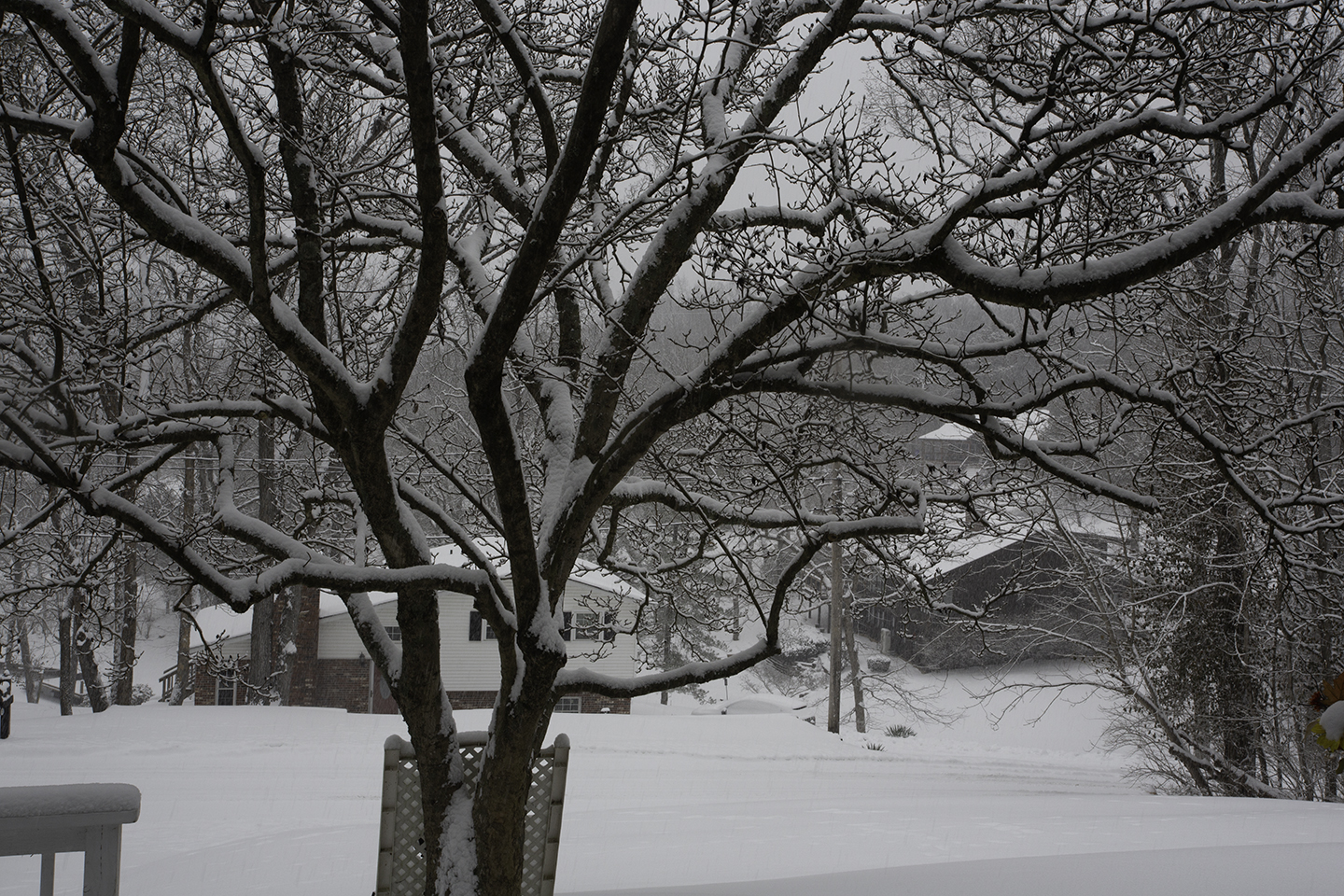
In the last couple of weeks, the St. Louis area has suffered through some strong, at least for here, winter storms. During the first, we were on the border between snow and ice. At our home, southwest of St. Louis, we spent the first two days of the initial storm as a target for freezing rain and sleet. Only the final night gave us some of the snow that had been seen north of us.  As a result, we had a layer of ice on the ground, on streets, and on driveways which was then covered by snow.  A few days later, another blast of winter weather added several additional inches of snow.
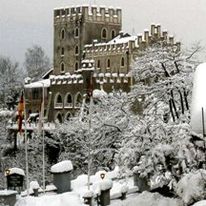
While many others, like my nephew who lives a short distance from Grand Traverse Bay and Lake Michigan, have far worse winter weather and far more snow, they are better prepared for what that brings. Still, I wonder if they sometimes laugh about our weather woes or have sympathy for those who rarely have this type of weather.   

I will admit that I probably have difficulty understanding the reactions to winter weather myself. I grew up in northeast Arkansas. As school aged children, we were usually happy when we had more than one “snow day” in a year. More often, we had none. My second Army assignment was in Germany. There, and like in this photo from Austria, we had much more snow than in Arkansas, but I don’t remember it ever bringing things to a standstill. Instead, communities and drivers there seemed to be prepared for snow and took it in stride. I saw this in multiple assignments in Europe and in the U.S.
But the recent days have made me wonder, why do we not prepare for winter weather and why do react the way we do? Preparation, at least on the surface, seems fairly simple. We should keep enough basic food and other necessities in our homes in case we cannot visit stores for a few days. Instead, it seems that purchasing these basics, particularly food, is never thought about until the last minute. Store shelves are emptied where there should be simple items like bread, eggs, and other everyday items. Little or no thought is given to what will happen if we lose power or if our roads cannot be cleared as rapidly as snow or ice falls.   

Perhaps our businesses should have plans in place to either operate with limited staff or to close for a few days if necessary.  Schools seem to be able to do this, so why not others? Also, our stores should have enough supplies like snow shovels and salt or other ice melting chemicals on hand to meet the needs of the community. This clearly did not occur during our recent bad weather as people needed to call or visit multiple locations, some miles away, to simply get enough salt to clear their sidewalks.

During the first part of our recent bad weather, I had a great deal of sympathy for our HOA president who was receiving email and other complaints in the middle of the storm asking when the streets would be cleared so that someone could go to work or visit a store. He tried to explain that clearing the roads while the snow and ice continued to fall would be of little value. Still the complaints kept coming (along with a variety of reasons for why the roads needed to be cleared immediately). Yet after the main part of the storm had passed and the roads were first plowed, because of the ice the roads rapidly covered over again and driving conditions were no better. Others decided that warnings from area police and highway departments to travel only in emergency did not apply to them so they could travel as usual and create danger for our first responders and others.

All this occurring even after multiple warnings over several days before the storms. I had to wonder, “What would have happened had the winter weather been worse? And how are we teaching our children to be prepared for similar events in the future?”

Snow, Snow, Snow, Snow… and Our Wildlife Friends

Do you remember this song from the movie “White Christmas”? Singing were Bing Crosby and three others on the train heading to an inn in New England where, unfortunately, the snow had yet to appear that winter. As I listened to the weather forecast for this weekend that song came to mind.

We live a short distance southwest of St. Louis and the forecast called for all types of winter weather – snow, sleet, freezing rain, high winds, and low temperatures. In our case, we were expected to be on the line between snow and ice. The forecasters were pretty accurate. The bad weather started with light sleet or freezing rain which began around 10:00 PM, Saturday evening. This lasted until mid-day Sunday when the snow moved in and was mixed with the sleet until early evening. Then the heavier snow arrived and continued until early Monday morning. Driving became dangerous throughout the area beginning Sunday morning and continues even today.

Sunday evening before the heavier snow began, I looked out our rear window and saw two deer run across our backyard. It was dark enough that I really saw only the shadowed outline of their bodies and the bright white flash of their tails. This made me wonder, “How do these wild creatures – deer, squirrels, rabbits, and birds – survive the cold temperatures? If we didn’t have our warm homes, could we humans survive as well?”. It se seems that wildlife can survive, perhaps in nests or other sheltered places. Perhaps, they survive by clustering in groups to share warmth. Or maybe they simply know locations that offer some form of protection. They must because otherwise how could they survive – yet they do. They survive fire and drought, snow and ice, hurricanes and tornados. If they didn’t, we would have no wildlife today.

In this world we live. Humans, the supposed most intelligent species. Humans with technology and science and knowledgeable people who can help us stay safe and survive. But instead of using these tools, we select instead to pay little or no attention to warnings from warnings we are given to avoid travel and stay off the road. We seem to think that driving to the store to pick up a loaf of bread or a six-pack is more important than our safety or that of others, like our first responders. But perhaps we can’t survive without these items. So, we ignore others and try – maybe just to prove we are superior or smarter than those trying to protect us.

Maybe we do survive without problem but often we don’t. We wreck our cars – get hurt or harm others or get lucky and only get stranded. Then what do we do? Do we take responsibility for our actions, or do we do as a person I read about today. This person ignored all the advice and warnings, drove on unsafe roads, and became stranded when stuck in the snow. Their response – claims that there were no warnings (even though warnings were issued days before the storms) and complaints about how long it took first responders to rescue them. They were not injured, or injure others, yet they should have been placed at the top of the rescue list so they wouldn’t get cold. I know I should not judge others but using a quote from a popular movie, “Stupid is as stupid does!”.

This simply, sometimes, makes me wonder, “Who best deserves to survive, our wildlife friends or those who regularly take actions like the above?”

Resolutions

January 1 has come and gone. Now we look forward to a, hopefully, better 2025.  Did you make any New Year resolutions? If you did, how many of them have you broken already? Do you regret any of them? Are there other resolutions you wish you had made and kept?

What are resolutions? Are they wishes for the future? Are they goals we hope to achieve? Are they simply something we make because our family or others expect from us? Can they be shared with others or are they like birthday wishes which can only come true if kept secret? I’m not sure I have an answer for any of these questions. Perhaps the answers are different for each person or for each resolution. Perhaps there is no need for answers.

When I was a child, each year it was important to make resolutions. Sometimes they were to correct things that had been done wrong the previous year. Sometimes they were new hopes for the new year. Sometimes they were meaningless to anyone except me. And, regardless of what they were, they were often broken within a few days or weeks.

As I look back, I cannot remember any specific resolution that I made. I can’t remember any resolution that was shared by a family member or friend. Yet it always seemed that making resolutions could not be missed.

When I grew older the value of making resolutions at the end of each December or in early January became unnecessary or unimportant. I’m not sure why. Maybe it was I recognized that resolutions were broken almost as quickly as they were made. Perhaps it was because I became more cynical although I probably didn’t even know the meaning of the word. Or could it have been that the time spent was considered wasted.

Even today, I don’t make resolutions. Now my reasons are more easily defined. I do not make resolutions because I don’t really believe I can keep them. Maybe this is a recognition that one of my human weaknesses is the inability to set long term goals. And, for me, a goal for an entire year is long term.

I’ve never asked others, apart from young children, about their views on making resolutions. I suppose some do and that they can succeed in accomplishing whatever they hoped for. I know some who make resolutions that do not last even a few days into the new year. Some may make resolutions as a form of humor. In any case, if you or someone you know makes a resolution, I hope you can achieve your goal whether in a single year or even a longer time.

Who knows? I may make a resolution or two at the beginning of 2026 or I may continue with my tradition of making none. Or maybe I should make a 2025 resolution to make new resolutions in all future years.

Waterfowl

As the first cold snap of 2025 approaches, it reminds me of the days of my youth. My hometown was in the middle of farmlands where the summers saw rice and soybeans growing if fields large and small. In the autumn was harvest leaving bare fields behind. In the winter, it was a stop along the Mississippi Flyway, a traditional migration route for waterfowl and other birds from breeding grounds in Canada to wintering grounds along the Gulf Coast.

Depending on the weather, both in the north and along the Flyway, waterfowl became abundant in our area from mid-October until sometime shortly after the start of the new year. The waterfowl, mostly ducks, could be seen could be seen in huge V-shaped flocks passing high over in the sky or in smaller feeding groups in the recently harvested fields. Perching ducks could be found along bayous and rivers while puddle ducks were more often seen in lakes and ponds.

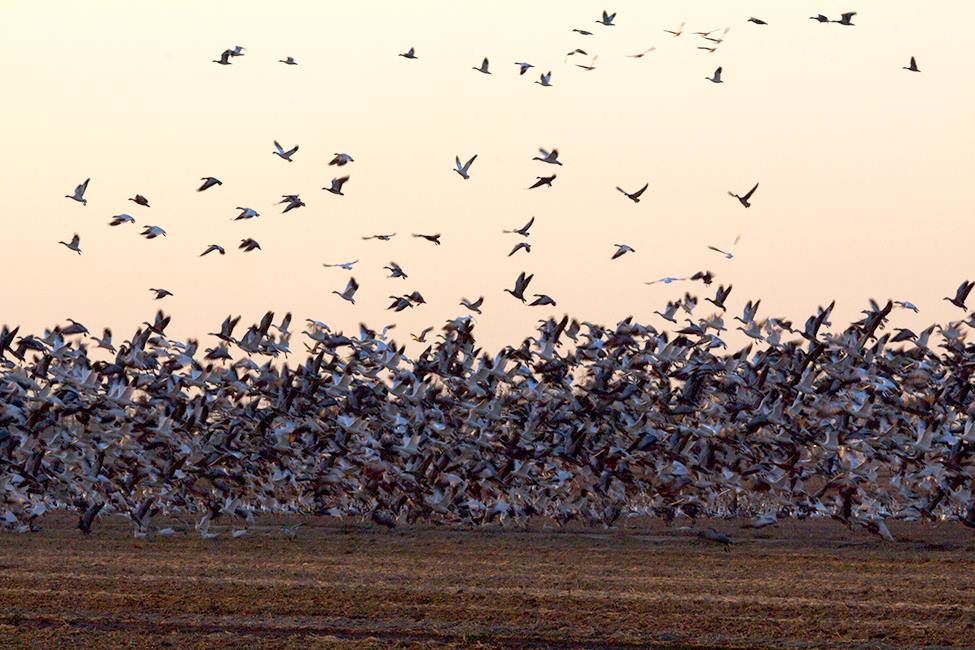
Our town had a moment of fame just before Christmas in 1956 when ducks on Claypool Reservoir were highlighted on the Wide World of Sports. A clip of this show can be found on the web along with images of a picture and poster showing thousands of ducks taking to the air.

While geese were sometimes seen, ducks were far more common. This has changed over time as has the number of waterfowl seen passing through each year. If you compare the Claypool photo from 1956 and it to these from 2013, you can still see large numbers of waterfowl on the Flyway, just different types.

When I read of “advances” in farming today, I often wonder if we learn from the past. In the early 1900’s waterfowl were much more abundant. Over hunting and habitat destruction reduced populations to dangerous levels. Only through wildlife management and conservation efforts were waterfowl and other wildlife protected and even restored. But then man stepped back on the scene. There were rains and storms that cause short term flooding, so we drained and cleared bayous and woods replacing them with straight ditches. Again, habitat was lost. Habitat that could not be replaced. But even today, the flooding still occurs. Now I read of how farm equipment is so much more “efficient”. There is no “waste”, no residue left behind. But if this is true, what will our waterfowl do for food?

I wonder who the advances and efficiency have benefited. The costs of farming today are unbelievable, so it would seem there has been little gain for farmers. Food prices continue to climb so I don’t see much benefit for the consumer. So, the advances appear to only serve the manufacturers and their investors who care only for the dollar.

I live in a semi-rural area today. Not in the city yet not in a farm community. I wonder how many of those around me appreciate what life hear offers. We share our community with deer, squirrels, and rabbits. In winter we see ducks on our lake, not lifetime residents but those passing through. I’ve even taken photos of wild turkey in my backyard. Yet there are those who complain about wildlife eating their flowers. If it is so bad I want to ask, “Why did you move here? The wildlife was here first. If it is so bad, why do you stay?”  But, perhaps, my thoughts are straying.  

My memories are of enjoying seeing the waterfowl and appreciating their beauty. Mornings in freezing cold duck blinds sharing great time with others. Contributing to conservation groups like Ducks Unlimited or the Rocky Mountain Elk Foundation who protect waterfowl and wildlife for future generations to enjoy. I hope that you have enjoyed similar times and that we humans can learn to share with our wildlife neighbors who were here before us.