Veteran’s Day 2024

On this Veteran’s Day 2024, I thought I should write a short post honoring those who have served. Many, like me served during peacetime or were lucky enough to not be deployed to a battle zone. I say lucky because anyone who is a veteran made a commitment to serve our country. They agreed to possibly make the ultimate sacrifice to ensure the freedoms and rights of all Americans – even those who refused to serve our country and those who refused to honor the service of those serving.

I’m not sure how many veteran’s there are, or were, in my extended family. I know that my father (pictured below) served, I served, and my son served. I also had uncles who served along with cousins. I don’t believe that either of my grandfathers served, not out of a lack of patriotism but instead because they were to young for some times of crisis or too old for others. Even so, they made sacrifices because their children served.

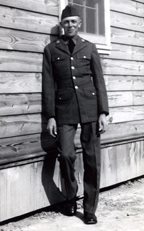
My father before his deployment in World War II. He served in the Army Air Corps, later known as the U.S. Air Force. He served in the Pacific Theater on the islands north of Australia and south of Japan.

I also have many friends who are veterans. Many served at the same time I did. Others served either before or after I served. We expected nothing special for our service nor do we expect nothing today. I suspect this is true for those serving today.

Veterans share common bonds, no matter when they served, where they served, or their branch of service. When they gather, they may talk about their service, places they shared, and the trials and tribulations they may have faced – separation from loved ones, injuries they or others may have experienced, and things they learned. Seldom do they share feelings or thoughts about those who refused to serve – at least not publicly.

So while I did not get this posted by the exact time, let us all honor those who have served or are serving today, especially at this the 11th hour of the 11th day of the 11th month, the official end of World War I – what was then known as Armistice Day and is now known as Veteran’s Day.

Castles

When I was a child we did not have castles in the United States, something that is still true today. For most of us, castles were something that was read to us in fairy tales, fables, and, later, in a few books. A castle might be this beautiful building in the clouds or high on a mountain top. Or they might be strong fortresses built for protection or battles. Castles often had evil queens and beautiful princesses. They had a strong king and a handsome prince. There were gorgeous and glamorous ballrooms and dark and dirty dungeons. And every castle had two common features – a large moat surrounding the castle and a huge bridge and door to protect each entrance. We could only use our imaginations to see these castles. A lucky few might have been able to see the “castle” at Disneyland while most of us only saw it on television with Tinkerbelle in the foreground.

When I reached my mid-twenties I was lucky enough to live in West Germany for a few years. There I was able to see several actual castles there along with an opportunity to actually stay in an Austrian castle for a few days. I saw my first castle when a fellow soldier invited me for a day of photography of a castle near Stuttgart. I don’t remember much about the castle other than it was a bit of a disappointment – nothing like the fairy tale castles of the past. In fact, it was only the ruins of an ancient castle. It was perched on a small hill overlooking a German village. I’m not sure why it was in ruins – age, a victim of war, or some other cause. But there were enough ruins that you could tell what it was and get some reasonably good photos.

My next opportunity was far better. I was able to see two of King Ludwig’s castles – Schloss Neuschwanstein and Schloss Linderhof. Neuschwanstein is said to be the model for the Disneyland castle and there are many similarities. It is posed on a wooded mountain in the Bavarian Alps. A beautiful white castle with golden roofs on its towers. It is within sight of Ludwig’s boyhood home, Schloss Hohenschwangau. Linderhof on the other hand, has a more subtle beauty. There are no huge towers and it is not posed on top of a mountain. It has wonderful gardens and fountains but is built lower to the ground. One of the best parts is in Ludwig’s bedroom where the windows open to a fantastic view of a cascading, man-made, waterfall that looks like it could flow directly into the room. There is also a grotto where swan shaped boats rest. Both Neuschwanstein and Linderhof have tours for the public on most days.

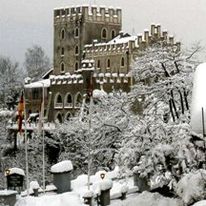
In the winter of 1977-1978 I was able to take a ski trip to Austria with the base recreation services department and other soldiers. One of the best parts of this trip was the opportunity to spend a night in Schloss Itter pictured above, near the village of Itter in the Austrian Alps. At that time, the Schloss had been converted into a hotel. It was decorated with artifacts of the past including suits of armor, weapons, and other things which we seldom see today. Given that it was winter, the snow highlighted both the Schloss and the village.

While I was near several other castles during my time in Germany, duty other demands did not allow visits to them all. I was also unable to visit castles in other countries like France and the United Kingdom which I now wish I had done

There were two things missing from all of the castles I visited or even viewed from a distance – there were no moats nor any huge gates and doors. I wonder where they went.

Sand Boxes

Originally posted in June 2024.

Today’s youngsters have lives filled with technology.  What started with simple things like Atari games has grown into cell phones, iPads and iPods, and all sorts of new and more complicated technology. Don’t think of me as anti-technology.  I have worked in the field for over thirty years, more if you count the “data processing” years in the military.  At the same time, I wonder if all of these new “toys” have caused today’s youth to miss out on things that are important – things like sand boxes.

While this may not be true in large urban areas, in rural America almost every family had a sand box if they had young children.  The sand box could be as simple as four boards nailed together into a square or rectangle or as complex as a metal square with seats on the sides, an umbrella over the top, and a way to drain any water from the bottom.  The only common feature was they were all filled with sand.

Sand boxes were places where one could play alone or one could play with family, friends, or neighbors.  They were places where the only limit to play was imagination.  Children could have toys like trucks, tractors, dolls, or almost anything in their sand boxes.  Sand boxes were places where we learned sharing, cooperation, and how to deal with others.  Perhaps most importantly, they were places where we learned that disagreements were not the end of the world.

Sure, there were arguments.  We got mad at those who didn’t say or do what we wanted. We yelled at each other. We occasionally had fights. Sometimes we were so mad that we took our toys and went home.  Even so, after we calmed down, we usually ended back in the sand box playing with the same friends again. No one needed to go home and get a gun to shoot someone. No one needed to tear down a beloved sand box. No one had to prove that he or she was better than everyone else.

Perhaps that is what is missing today. Our technology has taken away the need to work and play with others.  We can live in an isolate world where we make the rules and not care about anyone else. Violence is the answer to everything.  Personally, I have problems with this. Bring back the sand boxes.
Today’s youngsters have lives filled with technology.  What started with simple things like Atari games has grown into cell phones, iPads and iPods, and all sorts of new and more complicated technology. Don’t think of me as anti-technology.  I have worked in the field for over thirty years, more if you count the “data processing” years in the military.  At the same time, I wonder if all of these new “toys” have caused today’s youth to miss out on things that are important – things like sand boxes.

While this may not be true in large urban areas, in rural America almost every family had a sand box if they had young children.  The sand box could be as simple as four boards nailed together into a square or rectangle or as complex as a metal square with seats on the sides, an umbrella over the top, and a way to drain any water from the bottom.  The only common feature was they were all filled with sand.

Sand boxes were places where one could play alone or one could play with family, friends, or neighbors.  They were places where the only limit to play was imagination.  Children could have toys like trucks, tractors, dolls, or almost anything in their sand boxes.  Sand boxes were places where we learned sharing, cooperation, and how to deal with others.  Perhaps most importantly, they were places where we learned that disagreements were not the end of the world.

Sure, there were arguments.  We got mad at those who didn’t say or do what we wanted. We yelled at each other. We occasionally had fights. Sometimes we were so mad that we took our toys and went home.  Even so, after we calmed down, we usually ended back in the sand box playing with the same friends again. No one needed to go home and get a gun to shoot someone. No one needed to tear down a beloved sand box. No one had to prove that he or she was better than everyone else.

Perhaps that is what is missing today. Our technology has taken away the need to work and play with others.  We can live in an isolate world where we make the rules and not care about anyone else. Violence is the answer to everything.  Personally, I have problems with this. Bring back the sand boxes.