Grandpa

He was never Grandfather, or Grandpop, or Gramps, or even Papa. To me, and my many cousins I assume, he was always Grandpa. My paternal grandfather outlived my grandmother by a few years, passing away when I was thirteen years old. He was the only grandfather I had since my maternal grandfather had died before I was born. He had been born in eastern Illinois in the late 1800’s and moved to Arkansas sometime after my father was born in 1908.

As was the case with my grandmother, I don’t remember a great deal about his life. Perhaps this is because almost all the men in our family didn’t talk much about their past. Or, maybe, it was because I was too young to believe that the past was important. The few things I remember are experiences we shared or that I saw him share with others.

My grandfather was a farmhand after he moved to Arkansas. He was not, as far as I know, a sharecropper but simply someone who worked on a local farm for some unknown wage. At that time, the work was hard. There was little mechanization but lots of manual labor. He did this work until he was unable. In my early life, I remember only couple of things. The first was that he worked from early morning until late in the evening – work hours defined by dawn and dusk. When he came home at night my grandmother would have supper ready to eat and then he would often sit on his front porch until time for bed. In the summer, this was often with my father and uncle as they listened to St. Louis Cardinals baseball on the radio. I never remember my grandfather saying a cross word in those days. About the only time I remember him being at home during the day was when the weather prevented farm work. One clear memory I have was sitting on his porch one day as he sharpened his shovel for the next day’s work. I don’t remember what we talked about, if anything, but sitting with him was important to me.

As he became older and no longer worked on the farm I spent a bit more time with him, especially during the summer. I remember walking to the Post Office with him each morning (about a half mile each way) where we waited for the mail to be delivered. Then walking back home where he worked in his garden. The garden was important because it kept him busy and supplemented the family’s food. The garden was small when compared to many but the care it was given could not be compared.

After my grandmother died, his health went downhill. With no one able to provide daily care he moved to a nearby nursing home where many of his friends also lived. My father and I went to visit every two weeks or so as did my uncles who lived nearby. Unfortunately, his time there was short and soon he was laid to rest, by my grandmother’s side and near other family members. He and my grandmother had few of the things that we take for granted these days. They heated their home with an old wood burning stove. A four-room house that was home to their sons, at times very crowded I’m sure. And for many years, on an unpaved street. Still, I believe they were happy and hope they are still together and happy now.

Donuts or Doughnuts, if you prefer

When we hear about doughnuts today most of us probably think of the sweet treats sold at stores like Dunkin’ D, or maybe DD, or even at our local grocery in the bakery section. They are sold singly, or by the dozen, with so many toppings you often feel that you often have more frostings or stuffings than you have actual doughnut. Many only have them with coffee or hot tea.

But these are not the donuts that I’m talking about. My donuts are those made on occasion by my late paternal grandmother many years ago. My grandmother, Martha Jane Truitt Fryman, passed away in 1962 when I was ten years old. We lived next door to my grandfather and her for about seven or eight of my young years and she babysat for me when my parents weren’t home. Even so, my memories of her are quite few.

Two of the fondest and most clear were that if I wasn’t a good boy (fat chance) she would get out her black belt and use it on me and the donuts she made a few times each year. She never needed that black belt. In truth I never saw it as often as I searched. The threat was enough to keep me in line.

But the donuts were different, and I loved them each time. Even though I was young and had no interest in cooking or being in the kitchen, when donuts were fixed, I watched and waited intently. Even today, I often wonder if the method has been lost to our demand for convenience and sweetness.

The recipe was simple. One opened a can of simple biscuits from the local store. Each biscuit was stretched in to bit larger circle and then the thumb or a finger was used to make a hole in the center. They were then deep-fried in a large pot of hot lard (never cooking oil or butter) until they were browned. Then the browned donuts were dropped in a brown, paper grocery sack which held a mixture of sugar and cinnamon, the only coating ever used. The sack was shaken quite well giving the donut a slightly sweet coating, all that was needed. The finished donuts were then placed on a plate to cool.

For me as a child the cooling took far too long, but the one donut treat I received was always a great reward for the wait. I always remember that the fresh donuts never came often enough but the memory of them sounds great even today.

Why she made these donuts, so good, I never knew. I suspect they were for my grandfather to have with his lunch when working on the nearby rice farms. I’m sure they were much appreciated in those days when farm work was largely manual, not mechanized, and summer temperatures were high.

I wish that I could have told my grandmother how much these donuts meant to me, how hard it was to wait for the next batch, and how I remember them so many days later. Perhaps she can look down on me from her final home and see this short memory of things so simple yet so wonderful.

Skipping Christmas

As I was scrolling through posts on Facebook a few minutes ago I saw a post from author, John Grisham. It was about a book he had originally published in 2010 titled “Skipping Christmas”. I suspect I read the book at that time since I was an early fan of Grisham’s work although I no longer have a copy. The book was not politically focused nor was it even published in the year of a presidential election. Instead, it was about a family that decided to skip Christmas and take a cruise instead. They found that skipping Christmas was much easier said than done.

Unfortunately, since 2010 things have changed greatly in our country. I wish I could say this was for the better but I’m do not think this is true. I find it unbelievable that here we are, almost two months after the election and celebrities and so-called media experts continue to pound us with how the country is doomed and the majority of American’s are stupid (along with multiple other insults) because of the person who was elected.

Even today, I read an opinion article on the front page of USA Today’s online edition where the writer stated he still believed in Santa Claus. While the title seemed positive, even there he could not put aside political opinions although he claimed he was doing so. I, too, believe in Santa Claus or at least the spirit of Christmas, whether Santa Claus, St. Nicholas, or any of the others recognized at this time of year.

A few weeks ago I asked on line if for the holiday season we could put our differences aside and try to unite as a country. I guess that is too much to ask of the self-appointed experts with access to the media. But one can always hope. So instead, I ask again that instead of skipping or cancelling Christmas can we put aside our differences and try to act like the “United States” for just one day – tomorrow, Christmas Day.

And to do my part, I want to wish everyone, even those celebrities and media experts, a very Merry Christmas (or whatever holiday you celebrate) and a Happy New Year.

Thoughts of Christmas Past

Perhaps I am not being politically correct, or woke, by using the words “Christmas Past” as opposed to saying, “Holidays Past.” If this is correct, I apologize to those who may be offended. No, I don’t offer apologies. My past is full of celebrations of Christmas. We recognized that some religions celebrate in different ways and respect that. But, for me and my family, we celebrated Christmas. Holidays had many meanings with Christmas, birthdays, and several other days being recognized as holidays for most Americans.

My thoughts here focus mainly on days, events, activities, and more which mostly occurred when I was a young child although some also occurred in my teen years. Things then were different than today. Life seems as though it may have been much simpler, but when I say this, it may be because it was viewed through a child’s eyes. Your memories may be different because each of us had unique lives. I was raised in a small town in rural Arkansas where the focus was agriculture. Many events that we enjoyed were in a small city a few miles away. I suspect the lives of children in large cities were vastly different from mine. The memories here may change over time but reflect what is important to me today.

Family – Family was important at Christmas. Early on Christmas morning, we arose and opened presents in our living room where the Christmas tree was located. This was followed by a trip to my maternal grandmother’s home. While some of my uncles lived far away and could not be there each year, those who lived locally were always there. We typically had a large, pot-luck dinner and then opened presents near the Christmas tree. We returned home late in the afternoon. I don’t remember visiting my paternal grandparent’s the same way. Perhaps this was because they lived next door. Or maybe it was because my paternal grandmother passed away when I was ten years old followed by my grandfather when was fourteen. Still, we tried to see them and my uncle’s family who lived just down the street on either Christmas Eve or Christmas Day.

Christmas was one of the few holidays that we could be sure my father would be with the family. He never had work on Christmas Day. Other holidays, which might fall during the busy agriculture season might require him to work but never Christmas. This made it even more special.

Santa’s Helpers – Like almost every child of my age, I was taught about Santa Claus from my earliest years. He was this nice gentleman with a white beard, a red suit, who came down your chimney each year to leave presents for good little girls and boys. He had innumerable elves who worked for him creating the presents and he travelled by a flying sleigh pulled by eight tiny reindeer. It never occurred to us that many of these things were illogical. How could he visit everyone on a single night? What would happen if your home did not have a chimney? And, if his sleigh could fly, why did he need those reindeer?

Each year, our town had a community Christmas gathering that was held in the high school gymnasium. Adults had the opportunity for social interaction and the children went home with gifts from Santa. Yes, Santa was there each year – red suit, white beard, and all. But we never saw the sleigh.

This event made me realize that to do all the things he was credited with Santa must have needed helpers. Helpers who dressed like him and brought presents to good boys and girls. I was only about four or five at the time. What caused this realization? My parents were driving us to the celebration and running a few minutes late. As we entered the parking lot, we saw a neighbor’s pickup truck just ahead of us. And who should get out of the truck? No less that Santa. And I recognized the truck and told my parents that it could not be Santa driving that truck. How could that be? I give my mother credit for quick thinking since she explained to me that Santa could not be everywhere at one time so he had helpers that took his place delivering gifts and they borrowed trucks or cars from older families with grown children so they would not need sleighs. This didn’t answer the many other questions about Santa but for a young child it was enough. I was simply happy enough to go inside, meet Santa’s helper, and get my gift. But even today, I wonder how Santa, or one of his helpers could get into a house with no chimney.

Trees – The first Christmas trees I remember were live trees. I don’t remember if they were purchased at a local store or farmer’s market or if they were cut from a local forest.  While my memory is not clear about this, they were small, probably no more than four or five feet tall. The number of ornaments was probably not large but there were many lights and lots of tinsel. The first artificial tree was quite different. It was about the same height but had branches made from wood and thin pieces of something like aluminum foil very similar to tinsel although a bit larger. There was no green to be seen. While the ornaments were still used but the electric lights were now a fire hazard and stayed in their boxes. For light, a spinning wheel of four colors was used with a spotlight behind it. This was placed on the floor near the tree and shined up into the tree. When I looked today, I still saw trees like this available online. I don’t remember ever having another live tree although the first artificial tree was replaced with an artificial green tree and lights were purchased that could be used.

Gifts or Presents – Presents were never large but were selected and given with love and with care. When I was very young, they were often toys but as I aged the toys were commonly replaced by clothes or things more useful. Some of my favorite toys were tractors and attachments from the local John Deere dealer where my father worked. These toys were sturdy, or maybe a better word is rugged, and spent many hours being played with both indoors and in the outdoor sandbox. Similar toys can still be purchased today in almost any large department store, but the quality is not the same. Oh, how I wish I had kept those toy tractors given the prices that toys of that vintage command today.

Trains – Like many young boys, and maybe some young girls, I loved trains. A railroad ran through our town, and I was always happy to watch the trains as they passed by. Just like real trains, toy trains were always fun whether pull toys, wind-up toys, or electric trains. Even trains in books. Do you remember “The Little Engine That Could”? In the nearby city, the Firestone tire dealership sold Lionel trains (yes, Lionel has been around that long). Each year for a few weeks before Christmas they installed a Lionel layout at the front of the store. It was simple, just a loop of track, or maybe two, on a table. In the center of the loop, there were a few shelves for displaying individual train cars or accessories. But the exciting part were the trains that ran around the circle. After what seems to be years of wishing, I got my first train set. It was simple – an “diesel locomotive, a couple of cars, and a caboose along with a loop of track. Rather than an actual railroad name, the cars were labelled as “Lionel Lines”. I played with it for years until it finally wore out from use.

Parades – Our town was so small that we did not have a Christmas parade. Instead, we went to the nearby city to see their parade. It probably wasn’t a huge parade although it seemed that way to a small child. A few high school bands marched in the parade along with the band from the local college. There were also a few floats and some other marching units. While all was enjoyable, the thing I remember most is the ROTC Drill Team from the college. They had brightly polished helmets and carried military rifles. They twirled their rifles and did other drill moves that fascinated those watching them.

Snow – I can only remember once or twice in my childhood when we had a white Christmas. It really wasn’t expected but always wished for. There was nothing unique about this. It was true across much of the south. If we had snow, it usually came late in January or even later. I can, however, remember one Christmas that was white. It was not necessarily because of the snow itself but because of a family visiting some friends. Their kids were about the same age as I was, and they had never seen snow. Of course, that should have been expected because they had lived in Florida their entire lives.
A Day in the Life of Our Family Cats (An Edited Repost From Facebook)

When I originally posted this in July 2024, it was after several more serious posts and was written to reduce stress, both mine and that of my readers, as something a bit off the wall, and something with a bit of humor.

I’m usually up somewhere between 5:30 and 6:30 each morning to do my daily chores. To our cats, the most important of these chores is feeding them and refilling their water bowl. Next in line is cleaning their litter box. I don’t need an alarm to wake me up in the mornings because the cats ensure that I know it is time to get out of bed. If I am not awake, they sit on the dresser and stare at me. If that doesn’t work they resort to racing from one side of our bedroom to the other, at full speed, often jumping on or over the bed with their favorite landing point being my legs or back.

Once I arise, they follow me step-by-step to ensure that I take their food bowls into the kitchen for filling. While I am filling their bowls, they again stare at me so that I don’t waste time or perform any unnecessary tasks like starting the coffee machine. After their bowls are filled, they follow me to make sure the bowls are returned to their proper place for eating. I dare not do anything prior to this.

Our day then proceeds in one of two ways. Most common is for them to eat, find a hiding place, curl up, and go back to sleep. The second is for one or both to jump on my desk and watch me use the computer to type posts like this or to work. There really isn’t enough space for both cats and the computer on the desk so they arrange themselves in whatever manner they prefer and often assist me by putting paws on the keyboard or moving the mouse so that it is not where I want it to be.

After deciding that they cannot both be on the desk simultaneously, either one or both leave the desk and move to a nearby window to look outside. Of course, this necessitates walking across the computer keyboard and adding their personal comments to anything being typed. Throughout the day, they alternate which, if either of them, sits or sleeps on the desk.

If their food bowls become empty (which means the bottom of the bowl can be seen in any way) they will let me know by again starting the racing game along with a loud “meooow” or two.

At the end of the day, they both disappear, back to their favorite hiding places for more sleep so that the races can begin again about the time we are ready for sleep, or more likely around midnight. After zooming around the room, they normally settle down and sleep so that the entire process can begin again the next morning.

Yesterday the cats were very confused. When I left for work my wife moved over to my side of the bed and went back to sleep. She rarely sleeps there. She said when she awakened one of the cats was simply staring at her. Then, he would move close to get petted and then back away and look at the place where she normally sleeps, as if to say, “Why aren’t you here, where you belong?” After a short time the cycle would repeat. Later in the morning, the second cat reacted about the same way. Seems that they don’t like change unless they approve ahead of time – LOL. By the way, two cats, brothers from the same litter, two totally different personalities, very independent, a little over a year old and full of energy.

The Old White House in the Country (A Short Story of My Past)

This is not a work of fiction. Instead, it is written by a seventy-two-year-old man based on memories of his childhood. As a result, some things may be off regarding time, size, and other details. All rights to these materials are reserved although readers may share them provided they are appropriately attributed to the author.

After my wife and I had our Thanksgiving dinner last evening I thought about how much things had changed since I was young. A time when the holidays meant for families to gather and have conversation, played together, maybe even enjoyed a football game on either the radio or on television. When political events were not the subject on conversation, or at least, were no reason to end friendships or enjoy time together. Yes, things have changed, but not always for the better.

The old white house was located about four miles from the nearest town, in the center of fields and farmland used primarily for cotton but not anything even close to Tara or the other plantations so romantically described in literature and movies. It was a four-room house with attached porches on both the front and the back. I know little about the old house other than it, at some point, may have been inhabited by the landowner. I say this because the outbuildings around the house included sheds for storing seed and for smoking meat, a large building for chickens, and a mid-sized barn.

The white house was in a big yard with several really large white oak trees along with a few cedar trees. There were flowers of all types, from the tall, multi-colored hollyhocks to small daffodils, some in beds and some just scattered through out the yard. There were peach trees between the house and the large vegetable garden which was shared by the family each summer. From my earliest memories until the late nineteen-sixties, the house was inhabited only by my grandmother.

While there was electrical service to the house, there was no running water and, as a result, no indoor plumbing facilities. Heat, in the winter, was provided by a single, wood burning stove located in the living room. I also remember cooking being done on a wood burning kitchen stove in my early years although that stove was replaced by an electric range sometime in my childhood. The house was of simple design. It was basically a square, or perhaps a rectangle, divided into four smaller squares, the rooms. Each room was connected to the two adjacent rooms and the two front rooms opened onto the front porch while the two backrooms opened to the back porch. Each exterior wall had two windows, one in each room on that side of the house.

The house sat atop several concrete peers thus offering an open space about eighteen inches high under the house. Like I said earlier, there was no running water in the house. Instead, there was a hand pump a few feet outside the back door and water was pumped and carried into the house in buckets. Similarly, wood for the stoves was carried in a few pieces at a time from wood stored on the front porch or from wood stacks a bit farther away.

My grandmother’s family would be considered large today but at that time was probably common. She had four daughters, one who died early in her life, and four sons. All of her children were born in Tennessee, but the family moved to Arkansas when my mother was young. I never knew the reason but suspect it was because they could find work there. On holidays, it was common for the majority of my grandmother’s children to visit for at least one meal and often for the entire day. As the family grew older some were not able to visit every holiday because they had moved away but they were always welcomed when they could visit.

On these holidays not everyone could fit into the kitchen for eating so the children were often relegated to eat in another room or to eat later than the adults. One cousin and I were close to the same age, so we tended to play together. Most other cousins were several years older, so they also tended to visit together.

Near the white house, beside or amid the cotton fields were a large pecan tree and another large nut tree (I can’t remember the variety) where the men often collected nuts during the harvest season.

I will always remember the holidays as a great time for visiting with family. While we all had different lives, lived in different places, and had different friends, we were also family and could share things with each other. I remember times that were not so great and times that were truly celebrations. And from these things, we became closer as a family. I even remember some funny events, like the time when an in-law brought an apple pie for the holidays. When she arrived, she asked who had brought the ice cream to go with it. When no one answered, she said, “Well, I’ll just put my pie back into the car since you can’t eat pie without ice cream!” Of course, this led to many jokes as the story was repeated for many years after.

The old white house is no longer there. Nor are the fields where cotton, and later soybeans, grew. If fact, the area is no longer in the country. The city has grown, and all of this space has been absorbed. The old gravel roads have been paved and now have now have street names. But the memories remain, at least for the few of us who were around then and are still around now. But our numbers dwindle, just as do the memories. Hopefully, today’s children are building there own memories to share with those who follow and not all memories will be left forever on machines and in social media.

I hope that readers and their families had a chance to get together on Thanksgiving. If not, I hope you still had a happy holiday. And, with some luck, you had ice cream to go with your pie. Enjoy the holiday season and many more.

Travel or Just Moving Around

I’ve often thought about the differences between actually living in a small town and what we often see as small-town life on television or in movies. While I would not trade my small- town years for living in a large city, I wonder if those who spent their lives in larger cities realize how different rural lives are from their own. Over the next few days (or maybe weeks) I plan to share some thoughts on my early life in a small-town as well as what I know from experiences shared by my parents or others. Sometimes this will be the same as what we have seen or heard and at other times it will be far different.

Today I want to share a bit about travel, or moving around, to and from a small-town. In the first few years of my life there were four ways to travel from my hometown to other places – by train, by bus, by auto and walking.

The simplest to discuss are by train and by bus. They offered similar options. Travel by train was offered for the shortest period – if my memory is correct, passenger service was offered until I was about six or seven years old. There were two passenger trains daily, one northbound and one southbound and both trains passed through our town late at night or very early in the morning. While they offered transportation to larger cities with more connections, this was not always convenient and could not always get you to your destination.

Travel by bus was very similar. I remember two buses each day, again one going north and one going south. If your destination was not on their route, you had to make connections in other towns or cities with larger bus depots. And, just like train travel, not all destinations had bus service. Bus service to my town ended when I was in my teens.

Travel by auto was a bit different. There were two options in my hometown. The first was travel on a state highway, the same highway used by buses and paralleling the route of the railroads through most of its length. Most highways were paved or at least had a tar and gravel surface over the roadbed. In some locations shoulders were provided while in others ditches or tree rows came right to the edge of the roadway. Roads like that today would be considered very unsafe. And travel speed on these highways was often limited to about forty to forty-five miles per hour for any of a variety of reasons.

The second method of auto travel was over local graveled roads. These were mainly farm roads maintained by the county. They were occasionally graded, but any smoothness provided by grading was lost after a few days, especially if there was any rain. Speed here was also limited, both by the roughness of the road and for safety. While we only had one state highway passing through our town, we had more options in graveled roads – one going northwest from town, one going west, one going south, and, I believe, one going east. They had many connections allowing travel not only a route to local farms but also to other nearby small towns.

Of course, walking was always an option, along with hitchhiking which was relatively safe then. At the same time, it was also the slowest form of travel and did not provide an easy way to carry things you might need like food and water.

Looking back further into the past, travel was typically by wagon or horse over unimproved roads and trails. Personally, I have trouble even imagining how uncomfortable travel was. Slow speeds, steel or wooden wheels, rough surfaces – it could not get much worse. And a trip to or between towns might take hours or even a full day.

When I look at my hometown today things have changed a bit. Train service, for passengers, has long been gone. Bus travel is also an option that no longer exists. Traveling by auto is mostly the same although the roads are improved, and travel speeds are faster. Other than better shoes and less safety, walking is unchanged.

Even so, things in the small town are far different than the romanticized version that we see on television and in the movies.

Oh, What a Night…

It was one of those nights. I must have gone to bed way too early. It was 1:49 AM and I was wide awake. I cuddled my wife with on one side and petted my cats with the other. I couldn’t go back to sleep. While I wanted to go back to sleep, there was also some good. I had no worries and I was comfortable. Life was basically good. So, my thoughts wandered and I dreamed even though I wasn’t asleep.

I wished I could waste a day in Margaritaville, listening to the Piano Man, as he sang and played about his love, the Uptown Girl. While it might have been a Rainy Night in Georgia, things were good in Missouri. Maybe I could get the Ole Hound Dog and hop aboard the Continental Trailways bus to Winslow, Arizona. Once there I could stand on the corner and hope the girl in the flatbed Ford would stop and give me a ride to the Hotel California. The next day I could sit on the Dock of the Bay with Otis and hope The Little Old Lady From Pasadena could take me to Surf City where we could have fun, fun, fun ’til her daddy took the T-Bird away. And after the fun ended, I caught the Midnight Train to Georgia where I spent many days with Memories of the trip.

This was probably just a waste of time but it did allow me to go back to sleep and when I awoke I thought more about my childhood where things were so much better, or were they really. If my parents were still with us, their views might be different but as a child the memories that linger are mostly good. My big worries seemed to be whether there was air in my bicycle tires and if it was going to rain. I was too young to know anything about the war in Korea and Viet Nam was far in the future. Important things were which friends would be able to play, and with what, later that day or early evening. Before bed time we usually sat on the front porch of my grandparent’s home and listened to baseball on the radio – spring, summer, and fall – or sat near the wood heater and talked about when the weather would be warm again if it was winter.

My family was by no means rich but we also never went hungry. When I was about three or four, my father built a house next door to my grandparents where we lived until I was out of college and they continued to live until their health made it impossible. Not a large house but one that met our needs. Costs were low but so were wages. There were no gangs, at least outside large cities like New York or Los Angeles, no drive by shootings, and minimal crimes. As children, we learned respect, courtesy, sharing, and cooperation. We learned that not everyone was a winner and for each winner there was a loser. But the loser could come back and might be the next day’s winner. Memories of that time are good.

I wish our children could have experienced the same but somewhere along the way we failed them. Perhaps it was when entitlement became the important thing. Maybe it was when toys took the place of reality. Maybe it was something else. One can hope that one day we return to the past but somehow I think that moving back to that world is no longer possible. It is a shame.

The Little Car

When I was young my hometown had three small grocery stores. These stores were all good for immediate needs, sandwiches at lunch time, sodas and candy. They were not, however, even mid-sized chain stores like Kroger or Safeway. As a result, my family usually made a weekly trip to a larger city about twenty miles away to do most of our grocery shopping.

Even then, we did not always shop at the chain stores and instead shopped at a larger, independent grocery. This store, much like the chains, often had promotions. These were sometimes focused on things used in the kitchen or things associated with holidays. They might be discounts or even give aways for some items. But one special promotion holds a special place in my mind.

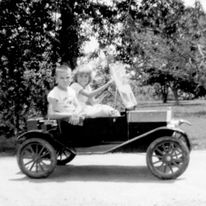
I cannot remember the exact year but I must have been around eight or nine years old. The store was giving away a large item, a miniature 1910 Model T car. It would hold two young passengers and was powered by a two-horsepower gas engine. Children visiting the store with their parents were allowed to submit one entry for each visit.

The promotion went on for several weeks and each trip to the store typically included groups of children standing by the display of the small car, staring at it in wonder and hoping that it might someday be theirs. I was one of those children and made sure I submitted my entry each time we were in the store to buy groceries.

Finally, the night arrived when the winner would be chosen. My uncle took my cousin and I to the drawing so that we could see who would win. When we arrived, a small group was gathered in front of the car awaiting the drawing. The store manager came out of his office with a large container holding all of the entries. After thanking all of the parents for shopping in his store, it was time to draw the winning ticket. He asked me if I would like to draw the ticket. I thanked him but declined telling him I was going to be the winner instead. Everyone had a good laugh about that.

He then asked my cousin if he would like to draw the winning ticket and my cousin agreed. My cousin then dipped his hand into the container, stirred the tickets once again, and made the draw. He handed the ticket to the store manager who, to my great amazement, announced my name as the winner. I couldn’t believe it. After having my picture taken with the car and probably doing a few other things, the question became, “How do I get it home?” While my father had a pickup, neither he nor my mother were in attendance. So my uncle took us back to my grandmother’s house where we told everyone of my good luck.

We then went back to the store to pick up my prize and take it home. At first, I was only allowed to drive the little car in our yard. As my skills improved, I was allowed to drive it on our block and later to other places in my hometown. I learned a lot with that little car like sharing and safety. But my biggest memory was learning not to touch the spark plug on a running engine – funny now but not so funny then.

The photo above shows me riding in the passenger seat while allowing the girl next door to drive the “little car.” I’m not sure how old we were but with both seemed to be enjoying the ride. Apologies for the blurriness but this is a scan of a photo that is probably somewhere between sixty and sixty-five years old and taken with an Instamatic or similar camera.

I kept the little car and used it until I was old enough to purchase a small motorcycle. Then I sold the car to another child who used it for many years afterwards. I’m not sure where the little car spent its final years, the red, wooden spoked wheels were not very strong and the fiberglass fenders already had cracks when I sold it but I hope it served many well.

I’ve seen photos of many similar little cars since that time but mine will always be special to me.

Quilting

I saw a post on another social media site this morning titled “Murphy’s Laws of Quilting.” This post reminded me of my late grandmother and how things were in her home.

My grandmother passed away in 1970, just a few weeks after I started college. Unfortunately I was unable to attend her funeral services because I could not make the trip home. But I remember much about her. One of the earliest pictures that I have of me as a child is one standing in her yard with her. She lived in a small, four room home on a cotton farm a few miles outside the nearest town until just a few months before her death. The home did not have running water and was heated by a wood stove. She had an electric stove for cooking her last few years there but I can remember when she also had a wood stove for cooking. On most days she lived alone although she was visited almost every evening by one or more of her children and most of the family visited on one, or both, days each weekend.

While she had an old pedal driven Singer sewing machine, most of her sewing was on quilts and done by hand. The majority of her living room space was covered by a quilting frame below the single light hanging on an electric wire providing light for the entire room. The frame was suspended from the ceiling by ropes at each corner. She would start her quilting on one side of the quilt and as she proceeded across the quilt the frame could be adjusted so that she worked close to her chair. The final step was for her to sew hems on each side of the quilt. When visitors came, the frame could be raised to make more space in the living room and to protect the quilt from damage.

As far as I know, she did not make the tops of the quilts. Other members of the family made these and took them to her to be quilted which could be a lengthy process depending on how many were waiting to be completed.

I still have one or two of the quilts made on this frame today although age is beginning to take its toll. These quilts were used, not put away for posterity. I think back on spending nights with my grandmother, sometimes alone and other times with cousins. We knew not to disturb the quilts while they were being completed.

I always remember visiting my grandmother as an enjoyable time although I’m sure there were at least some visits that may have been less so. The biggest challenges I remember were pumping water by hand and having to use the “outhouse”, especially in the winter.

I hope you have similar memories of times with your grandparents.