Summer

Summer seems to be rapidly approaching. While one expects showers in April, it seems that this year they are interspersed with days nearing the 90’s. This seems a bit unusual to me but maybe that is only because of childhood memories.

Growing up in a small grain-farming community, I remember summer always beginning in mid-May. This wasn’t because of a date on the calendar or because of a meteorological event but instead because it was the end of the school year. For a few weeks, we no longer needed to worry about lessons or exams but could instead spend our days playing with friends and neighbors. Important things were whether our bicycles had flat tires, or which sandbox we would use, or who we would visit.

In the evenings we might sit on the porch with our parents or grandparents listening to a baseball game on the radio or play in the yard while the “old folks” did that. We also helped in the garden since fresh produce was a part of life. On really special evenings we might have a treat like homemade ice cream over a fresh baked pie. Because our town was so small we didn’t have some of the things that “city kids” could enjoy, like swimming pools or large parks and playgrounds, but summer was still a fun time.

That changed a bit when I was about eleven or twelve and started mowing yards to earn a bit of “spending” money. The time for “kids” play was a bit less but it was still summer, and school was still not important, at least for those few weeks between the school years.

Things changed even more by my mid-teens when summers meant getting a job. In a small town like my home there were few opportunities and most summer work was on the local farms. The two busiest times were right after the school year ended and, unfortunately, a few weeks after the next school year began. Like others, I spent parts of many summers working on the farms – preparing fields for planting, helping plant crops, and other tasks. There were many long days in the hot sun (no air-conditioned tractors in those days) or doing other work. This even continued through my college years.

Even though the summer days seem much hotter now, summer is still a nice season, but I enjoy spring and fall, or autumn, much more. I hope you have good memories of the summers of your youth and enjoy them now and in the future.

The Comet

No, not the bright light in the sky with a tail; instead, my first car.

I turned sixteen that year. I had my new driver’s license. I no longer needed to mow yards in the summer to earn money. I had a job working on a local farm.

My father decided it was not safe for me to ride my motorcycle the seven or eight miles from my home to the farm. So, the motorcycle was sold. But the money was put into the bank along with left over money from several years of mowing yards in the spring, summer, and fall. It was to be used to buy a car.

Mowing yards in those days paid from two dollars to eight dollars per yard depending on their size. There was not much money in the bank even with the money from the motorcycle. This was not going to be a new car. Nor was it going to be a hot rod or even a sporty car, not even a pickup with a gun rack in the back window like some of my farm friends had. Think instead of a reliable, greatly used four door sedan. Still, it was going to be my car.

Shopping for the car took several weeks which seemed like years. First, my father talked to auto dealers he had purchased from previously. No luck there – they either had nothing suitable or the price was too high. Then came trips to other dealers, only on Saturdays when Dad was not working.

Finally, as a last result, we went to a nearby Mercury dealer and found the car that met Dad’s standards. A used Mercury Comet. I think it was four or five years old. It was not my first choice, but it was a car. There were at least three models of the Comet. The top of the line was the Caliente – not mine. Then there was the Cyclone, the sports car version – again, not mine. And, at last, there was the basic Comet – yes, mine.

Nothing fancy, no deluxe features, it had four doors, an AM radio, cloth bench seats, and an automatic transmission with the shifter on the column. It also had a six-cylinder inline engine, or a straight six. I probably could not have gotten in trouble with that car even if I tried.

The paint job was good, but describing the color is a bit difficult. It wasn’t blue nor was it green. Nor was it turquoise. Looking back, I suppose it could be best described as a dark aqua with some sort of frosted look.

The car did, however, get me back and forth to the farm where I worked and the six or seven blocks to school during the school year. The car was reliable with one exception. At times, unexpectedly and with no prior warning, the engine would simply quit. The poor thing must have simply been tired. After sitting for an hour or two, the engine could be restarted and would run like there had been no problem. I was lucky. When it did this, I was usually near home and could pull off the road to avoid accidents.

My cousin was not quite as lucky. He was about fourteen years older than me and came for a visit one winter. He borrowed my car to visit another relative for the day. As he was returning the engine decided it needed a rest about five miles from home. He managed to get the car out of the road but could not get it to restart. He also could not get a ride, so he had to walk the last few miles. After my mother arrived home from work, we drove to the Comet and, as expected, it started without problem and drove home with no other issues. He did not ask to borrow the Comet again.

 Even with the occasional engine problems and the strange color, the Comet served me well until I graduated from high school. It was traded for a new car for me to attend college on the other side of the state and held its value, bringing a trade value almost equal to its cost to me. It was not a show car nor a sports car but I will always remember it as my first car – The Comet.

The Special Place

We all have special places in our lives. Places where we love to go or want to be. Memories of good times, some old and some new. Things that stand out in our minds. Some of these places are real and others are imagined. Some of them were things that we possessed and some that belonged to others. For most of us, we could name many of these special places. But do you have one that you identify as The Special Place?

The Special Place is one that is constantly in your mind. Nothing that interferes with your daily life or replaces other special places but instead one that stands out. The Special Place may be one that you have visited often, rarely, or not at all. It may be possessed or forbidden. It might be a home, a building, a location, or even an imaginary location. You may have only seen it in passing but The Special Place is always there in some form.

The Special Place is sometimes very specific, like a house at a certain address, or it may be more general, sitting in the mist at the bottom of a waterfall or on the top of a mountain. Sometimes it is a place where you can relax or think about the meaning of life. Other times it is a place of wonder. And at other times the wonder is why you consider it to be The Special Place in your life. While a place may be The Special Place for more than one individual, the things that make it special for them are probably different.

In the movie “Under the Tuscan Sun” there is a bit character. I don’t believe the character was ever identified and may not have even been given credit. The character was an older gentleman who was shown several times walking down a road in front of Diane Lane’s home. Each time he appeared; he stopped at the same location along the road and approached a stone wall where he paused for a few minutes. Why he paused was never told. Perhaps, there was a Madonna in a niche in the wall and he was visiting her. Perhaps there was something else there. It was never visible to the viewer. Was it something sad, or something celebrated? Diane’s character watched him and tried to connect to him, this did not occur until near the end of the movie. Was this simple location The Special Place for him?

For some, The Special Place may be a place they visit often while for others it may be a place that they have only glimpsed in passing. This does not make it less special. Perhaps, we will one day visit The Special Place or it may always be there, just out of reach. Sometimes, The Special Place disappears, at least physically, yet it remains in our minds. Other times, The Special Place does not exist other than in our minds, or maybe it exists, and we have yet to find it. In either case, it is still special to us.

Does The Special Place exist for all? Maybe or maybe not. Is it something we share or is it very private? Again, is this important, and does it change how special it is? Does The Special Place exist for you?

Let’s Communicate

From the time of our birth, we have always tried to communicate. Sometimes we do it well. At others we need to improve. And, unfortunately, at times we fail, either by choice or by chance.

As babies, we were often able to communicate very effectively with our parents. We could tell them when we were hungry, when we were sad, when we were happy, and when our diaper needed to be changed. We did this by nature. We did not need to use words. Our voices, our expressions, our actions communicated our needs.

As we grew older, we learned how to use simple syllables and words to communicate our needs. We sometimes didn’t understand what we were communicating but by imitation of others or achieving results, our communication skills grew.

In a few years, we learned our alphabet and how to put these letters together to create ever more complex words and to use these words to communicate the same things we expressed more simply as babies. Sometimes we learned words or phrases that caused us to “have our mouths washed out with soap” (not really, but another form of communication).

For those of us who are defined as “baby boomers”, our communication skills were further enhanced by family gatherings, often for dinners on weekends or overnight stays. This seemed to be common since families often lived nearby. This is, perhaps, more difficult today with families spread far and wide.

While the physical separation of families has presented challenges, it has also provided opportunities to introduce new technologies for communicating. One of the early methods for communicating was the telegraph. Using a combination of “dots and dashes” we discovered we could send electrical signals over long distances making written communication possible – something much faster than sending a letter.

This was followed by the introduction and then widespread use of the telephone. With this new technology, we could send our voice across the country over wire. It was truly a miracle. One that could not be easily understood but was appreciated by all.

These two technologies opened many doors for communication. Things like television with a wide selection of channels – the baby boomers probably remember having only three or four channels that were only on air for a limited number of hours each day. Things like today’s cell phones, email, and text messaging. Things that are not limited by borders. Who knows what the future may hold.

But as I said earlier, we are unfortunate that communication also faces some of its biggest challenges today. We could possibly blame this on chance. Technology is changing so rapidly that not all are able to keep abreast of the new ways to communicate. This may be because it is so difficult for us “old folks” to learn how to use new technology. Perhaps it is because it is too costly to own the “latest and greatest” things or even to see the need for these things. It might be something else that holds us back. But I find this difficult to accept because I know of many people of my generation that are just as likely to use the latest technology as are those of today’s generation.

Instead, I look at the world around us and wonder if we no longer communicate well because we do not want to communicate. Perhaps we see communication as a way for others to demand our help in solving their problems. Or maybe we see our time as “too valuable” to waste on sharing with others. Maybe politics is the cause, with communication forcing us to see that others may have valid or valuable opinions that may not match our own.

I see a world where parents are not communicating with their children because one group is more liberal or more conservative than the other. A world where life experiences seem to have no value or where “woke” viewpoints are discounted out-of-hand. A world where so-called media stars and other elites somehow see themselves as smarter than others in our country. A world where the opinions of the majority are lumped into a single, disagreeable group that can be blamed for everyone’s problems. A world where it has been suggested that family holiday gatherings, a prime location for communication, be cancelled because of political differences.

One hopes that we can begin communicating with others again; that we can have a world where families come together and resolve differences; maybe even a world where we can return to the simpler time when communication is a way to achieve our needs while recognizing those of others.

Let’s start to communicate and use our communications to resolve our important differences. If there is one thing that we all should have learned early in our lives is that no one is perfect but that does not prevent our living together. Communication is the key.
Donuts or Doughnuts, if you prefer

When we hear about doughnuts today most of us probably think of the sweet treats sold at stores like Dunkin’ D, or maybe DD, or even at our local grocery in the bakery section. They are sold singly, or by the dozen, with so many toppings you often feel that you often have more frostings or stuffings than you have actual doughnut. Many only have them with coffee or hot tea.

But these are not the donuts that I’m talking about. My donuts are those made on occasion by my late paternal grandmother many years ago. My grandmother, Martha Jane Truitt Fryman, passed away in 1962 when I was ten years old. We lived next door to my grandfather and her for about seven or eight of my young years and she babysat for me when my parents weren’t home. Even so, my memories of her are quite few.

Two of the fondest and most clear were that if I wasn’t a good boy (fat chance) she would get out her black belt and use it on me and the donuts she made a few times each year. She never needed that black belt. In truth I never saw it as often as I searched. The threat was enough to keep me in line.

But the donuts were different, and I loved them each time. Even though I was young and had no interest in cooking or being in the kitchen, when donuts were fixed, I watched and waited intently. Even today, I often wonder if the method has been lost to our demand for convenience and sweetness.

The recipe was simple. One opened a can of simple biscuits from the local store. Each biscuit was stretched in to bit larger circle and then the thumb or a finger was used to make a hole in the center. They were then deep-fried in a large pot of hot lard (never cooking oil or butter) until they were browned. Then the browned donuts were dropped in a brown, paper grocery sack which held a mixture of sugar and cinnamon, the only coating ever used. The sack was shaken quite well giving the donut a slightly sweet coating, all that was needed. The finished donuts were then placed on a plate to cool.

For me as a child the cooling took far too long, but the one donut treat I received was always a great reward for the wait. I always remember that the fresh donuts never came often enough but the memory of them sounds great even today.

Why she made these donuts, so good, I never knew. I suspect they were for my grandfather to have with his lunch when working on the nearby rice farms. I’m sure they were much appreciated in those days when farm work was largely manual, not mechanized, and summer temperatures were high.

I wish that I could have told my grandmother how much these donuts meant to me, how hard it was to wait for the next batch, and how I remember them so many days later. Perhaps she can look down on me from her final home and see this short memory of things so simple yet so wonderful.

The Path Not Chosen

I will admit it – no denial. Today’s post is a rant! I look around and see things that worry me. I care about our country, our people, and, yes, about myself and my loved ones. I see a divided country and media stars and celebrities who benefit by encouraging this divisiveness. I would like to change this and maybe this post can help. You don’t need to agree, but try to give it some thought.  

I’m not sure this is true for everyone, but as I have become older, I look back at decisions I have made in the past and wonder how things might have changed had I taken a different path. Some of these choices were made in my youth and some as an adult. Yet choices, whenever made, always have an impact because there are always multiple options with multiple results.

I say that some choices were made in my youth and when I look back at those, I think that perhaps I should not have needed to make an important choice. Our childhood, and even our teens, should be a time for learning and even experimenting. We should not need to make choices or decisions that cannot be reversed as we age. At the same time, we should have this time to try different ideas and learn from the results. Unfortunately, it seems that today’s youth, even those in their very early years, are expected to make choices with no opportunity to change as they age. And we, the supposed adults, continue to push our children to make important choices at earlier ages. Have we taken away childhood in our efforts to control the future? And are our children forced into choices not based on their thoughts or beliefs but instead imitating those of their parents?

Things have changed, for both better and worse, since my youth. Those of my generation faced war in Viet Nam, the increasing prevalence of drugs, changes in culture as power moved from WW II veterans to the Baby Boomers. Those who believed like their parents were often ridiculed while the counterculture did not offer a strong strategy for the future. We faced the draft and associated choices to avoid the risks associated with war. We demanded, and were given, an earlier voting age. Yet we were not willing to take out choices seriously. Still our country survived and moved forward. Can we say this today? Or is the divisiveness we face today our fate? No one can say for sure, but we probably cannot go back to the past.

Our youth of today, and even those who are a bit older, no longer have the need to think. They can get all the information they need from their electronic devices, from unreliable sources, and from political pundits and media stars who are more interested in an attention-grabbing sound bite than the truth. People with multimillion contracts and eighth grade educations who claim to be “working class Americans”. People who, over a month after the recent elections, are still whining at every opportunity and suggesting they know more than the majority of American voters. And politicians who refuse to accept any blame for their losses and not recognize that their candidate had never received a single vote before the election.

For our future, when us old folks are no longer around, one must hope that the path chosen is the best. That it is chosen carefully, not because someone told us it was “cool” or “woke” or “progressive”. And not because it was “the way we have always done things” or because it is “convenient” or driven by “politics” or “money”. We can’t all be rich or superstars or have those million-dollar contracts. Nor can we all be losers. There should be a balance. And there should be opportunities. Let’s not force decisions on our successors but instead let’s teach them how to make good decisions. And then, let them make those decisions. We have been successful doing this in the past and can do so in the future.

Entitlement

I believe that most of us who are parents recognize that this role encompasses many things. We must take care of our children’s needs, especially when they are young. We should teach them right and wrong. We should teach them about responsibility. We should teach them many other things.

And at some point, we should teach them what it means to be an adult and especially what they will need to do for their children should they too become parents. Even if they choose not to be parents, their role as adults will be far different from that of children.

For many, both parents and children, both teaching and learning seems to be simple. While I am sure they face challenges, these challenges are more simple than they are for others. And, although they can be simple, some parts are more important than others.

Unfortunately, I believe that parents from my generation have failed in some areas. While we learned that life would have challenges, that there would be winners and losers, and that just becoming an adult did not automatically afford privilege equally. Instead of teaching this, we fell into the trap of teaching entitlement. Our children were taught that they were entitled to simple things like the best toys, the best clothes, everything that their friends possessed. They were not taught that not every parent could afford, monetarily or otherwise, the same things.

They were taught that in sports everyone was entitled to be on the team. And because they were on the team, everyone was entitled to equal playing time regardless of talent. They were taught that there were no winners or losers. Instead, everyone deserved the same trophy or reward. This sounds good on the surface but when you look at it more closely it does not reflect the real world they would live in as adults.

As our children grew older, they continued to feel entitled. And they wanted to give their children the same or more than was given to them. This continues even today. The problem has become that while everyone feels entitled in their youth, they seem to expect this in adulthood which is unrealistic.

An example is the current administration’s effort to eliminate student debt. When I went to college, my parents and I paid for my schooling. I worked during the school year and in the summers. I did not study abroad – I could not afford that. And yet today, as an American taxpayer, I am being expected to pay for the education of those who elected to incur indebtedness and now cannot repay that debt. Not everyone is entitled to go to college. Not everyone is entitled to a student loan. These are things that one must earn.

In another situation, a person who was working at a low-level job decided that they were entitled to a trip to Hawaii, not because they had enough money to afford the trip, but instead because one of their friends had taken a similar trip. This person then expected someone else to pay for the trip including of their personal expenses.

So, perhaps, our generation has contributed to the issue by creating this environment of entitlement. But at the same time, our children are old enough now to recognize that entitlement comes at a cost and the world is not always fair. For most of us, this means accepting what life throws at us and living within those constraints. If our children decide to live a different lifestyle, then that was their choice, but they should not expect us to support that lifestyle. We supported them as children, they need to support themselves now.

The Little Car

When I was young my hometown had three small grocery stores. These stores were all good for immediate needs, sandwiches at lunch time, sodas and candy. They were not, however, even mid-sized chain stores like Kroger or Safeway. As a result, my family usually made a weekly trip to a larger city about twenty miles away to do most of our grocery shopping.

Even then, we did not always shop at the chain stores and instead shopped at a larger, independent grocery. This store, much like the chains, often had promotions. These were sometimes focused on things used in the kitchen or things associated with holidays. They might be discounts or even give aways for some items. But one special promotion holds a special place in my mind.

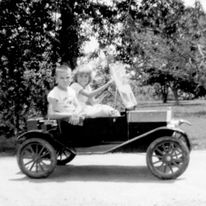
I cannot remember the exact year but I must have been around eight or nine years old. The store was giving away a large item, a miniature 1910 Model T car. It would hold two young passengers and was powered by a two-horsepower gas engine. Children visiting the store with their parents were allowed to submit one entry for each visit.

The promotion went on for several weeks and each trip to the store typically included groups of children standing by the display of the small car, staring at it in wonder and hoping that it might someday be theirs. I was one of those children and made sure I submitted my entry each time we were in the store to buy groceries.

Finally, the night arrived when the winner would be chosen. My uncle took my cousin and I to the drawing so that we could see who would win. When we arrived, a small group was gathered in front of the car awaiting the drawing. The store manager came out of his office with a large container holding all of the entries. After thanking all of the parents for shopping in his store, it was time to draw the winning ticket. He asked me if I would like to draw the ticket. I thanked him but declined telling him I was going to be the winner instead. Everyone had a good laugh about that.

He then asked my cousin if he would like to draw the winning ticket and my cousin agreed. My cousin then dipped his hand into the container, stirred the tickets once again, and made the draw. He handed the ticket to the store manager who, to my great amazement, announced my name as the winner. I couldn’t believe it. After having my picture taken with the car and probably doing a few other things, the question became, “How do I get it home?” While my father had a pickup, neither he nor my mother were in attendance. So my uncle took us back to my grandmother’s house where we told everyone of my good luck.

We then went back to the store to pick up my prize and take it home. At first, I was only allowed to drive the little car in our yard. As my skills improved, I was allowed to drive it on our block and later to other places in my hometown. I learned a lot with that little car like sharing and safety. But my biggest memory was learning not to touch the spark plug on a running engine – funny now but not so funny then.

The photo above shows me riding in the passenger seat while allowing the girl next door to drive the “little car.” I’m not sure how old we were but with both seemed to be enjoying the ride. Apologies for the blurriness but this is a scan of a photo that is probably somewhere between sixty and sixty-five years old and taken with an Instamatic or similar camera.

I kept the little car and used it until I was old enough to purchase a small motorcycle. Then I sold the car to another child who used it for many years afterwards. I’m not sure where the little car spent its final years, the red, wooden spoked wheels were not very strong and the fiberglass fenders already had cracks when I sold it but I hope it served many well.

I’ve seen photos of many similar little cars since that time but mine will always be special to me.