Wind in My Sails – A Short Story

This is a work of fiction. It reflects my personal thoughts which are reserved and does not in any manner suggest truths about sailing or any other water activity. It is loosely based on my readings of some materials written by Stuart Woods interspersed with my suppositions, experiences working with others, and, possibly, humor. It should not be considered too seriously or used as a basis for any outdoor activities.

———-

Good morning. My name is Joe. And I recently participated in a sailing competition, a trans-Atlantic trip by sailboat. A competition with all types of craft starting at a single point and ending at a common point in the shortest time possible. I did not try for speed but only to see if I could complete the trip. I owned a sailboat, but I really wasn’t an experienced sailor. But I wanted to share some experiences with you.

As I lay in bed last night, listening to a storm, I asked myself if I was insane. Not because I feared the thunder and lightning or even the winds alone. Instead, it was because of the combination of wind, water, and my intent to join others sailing across the Atlantic. I thought of the rocky coastline and how the waves crashed against it. Throwing water twenty, thirty, forty or more feet into the air followed by the water falling is smaller droplets back into the sea. What would these same forces do to the unfortunate human caught in their path?

I could be that human. For an unknown reason, I had taken up the sport of sailing. After a few short years, I now owned a boat and had decided that I was expert enough to join a group in a trans-Atlantic crossing. Did I really have the skills, ability, and knowledge to do this?

A few days later, in a small group of friends gathered in a nearby pub. All were intent on crossing the Atlantic capturing the power of the wind in our sails. Talk centered on those who had done so in the past along with those who were not successful. Some safely returned to port, others were lost at sea and never found, still others lost their lives. The group could not define what motivated them to try.

As I sat, listening to this group, I asked myself the same question. Why was I here? An American in a foreign country. A person who grew up not on a coast, not with a history of sailing, not even dreams of sailing as a child. What enticed me about this adventure? I did not know even half of what these others knew. Perhaps I would know more when the trip started of even decide, sanely, that I should not make the attempt.

The trip was scheduled to start the next morning, but the sea was calm. There was no wind. Nothing to power the ships out of the bay, much less across the ocean. The preparations were not wasted. All simply had to wait for the wind. Those with small boats and those with the large, expensive craft were equal that morning. No wind meant no sailing. Perhaps another day would be spent in the pub. Or better, in last minute double checking of all preparations. The same happened the two following days.

Was God or Karma trying to tell me something? Was there a reason for the delays? I did not have an answer. All I knew was that each passing day was causing me to have more doubts and more anxiety.

The weekend arrived and along with it, light breezes. Enough wind to make sailing possible. The result was a traffic jam that would match any on the freeways of America’s largest cities. The difference was that the traffic was a huge number of sail craft, all trying to escape the bay through limited space with less ability to avoid other craft trying to do the same. The bay was a madhouse. At last, all were at sea and moving toward their selected route to America. Voyages like that of Columbus or the Vikings. Powered not by modern technology but only by the wind.

Common sense seemed to have evaded me. Here I was, amid this confusion and rush to start a dangerous journey from the U.K. to the U.S., not by plane or by cruise ship but alone in my small sailboat.  Would I be successful, or would I be one of the many who did not?

As each intrepid traveler left port they had a choice, they could follow the shorter northern route across the Atlantic. While shorter, this route was the riskiest because of the potential for storms, much like those that kept me awake a few nights earlier. Stormy conditions were not good in any ship but were especially dangerous for sailing craft. Travelers could also choose the southern route which was longer but did not have as great a risk for storms. But there was some risk on both routes and no matter which was chosen there was limited opportunity to turn back.

While I was not averse to risk, I selected the southern route. This seemed to better fit my skills, and it also provided the opportunity to stop at islands along the way should stress or other problems arise.

The days of travel began for all. Unlike land travel, there was little scenery to distract one. Once one had sailed out of sight of land, there was only water until the next port came into sight. Or perhaps one should say there was only water and the boat. Just as in a home, there were daily chores that needed accomplishment. But on a boat, they could not be delayed. These were things like maintenance, navigation, and care for oneself. A sick crew like a sick boat would only cause failure.

As I approached the trip, I spent many hours wondering what would be involved. For a boat the size of mine on a good day (no storms, no equipment failures, no sickness, etc.) I believed daily chores would take more than six hours. Sleep would take about eight hours. So how would I occupy myself for the other ten hours each day? Would part of this time be spent on introspection or perhaps contemplation of things like the meaning of life? Could part of the time be spent reading? And, if so, how much added weight would be added to the boat for books or other reading materials? Could time be spent writing? Would communication with relatives and friends be possible? I really didn’t know the answers to these questions. What supplies, including food and drink, would accompany me? And, again, how much weight would be added and where would it be stored? What would happen if I became sick? Again, no real answers were apparent. So, what did I do? I spent hours talking to those who had made the trip previously. Possibly, no, probably, making a pest of myself but taking their advice and hoping to learn. Now this preparation would be put to the test.

For those following the southern route, the first possible stopping point came several days later. Some arrived at this point quickly, restocked, and went back to sea quickly. Others spent a few days on land resting before continuing. Still others decided that the trip was not important, or maybe not possible, and returned to the U.K. The trip had been safe with gentle breezes and mostly good weather. While here, travelers could share information about those on other routes or in other places. Unfortunately, this was not always good news. The northern route had been hit by many storms and lives had been lost. Some were unaccounted for. In many ways, this was typical of previous voyages.

Although there were only a few of those making the trip who were familiar to me, I did find that some were lost. I could only offer my sympathy to their families. But in their honor, I continued. I also received good news about those who had passed through ahead of me. While I was not the fastest traveler, I felt good that I had be successful to this point and hoped that things would continue to go well. After a short rest stop, I continued my trip.

 The trip continued for many and after days at sea or at islands along the way, the U.S. came into sight. For the fastest it was a great success and a time of reward. For others, success was a more personal thing. They had set out on a voyage that presented a challenge and whether they were among the fastest or amid the “also rans”, they had achieved something done by few others. Some might return the following years to try yet again, perhaps for speed or to follow a different route. Some might look for other challenges, in either sailing or other activities. Others might simply enjoy whatever life presented them.

In my case, I am in the latter group. My boat has been sold. I am now a “land lubber.” I enjoyed my time at sea yet, I’m not sure I could enjoy a similar experience now or in the future. I remain friends with many I met on or through this adventure. And I miss greatly those who were lost because of the trip. But to all, I wish gentle breezes, smooth water, and great sailing.
Oh, What a Night…

It was one of those nights. I must have gone to bed way too early. It was 1:49 AM and I was wide awake. I cuddled my wife with on one side and petted my cats with the other. I couldn’t go back to sleep. While I wanted to go back to sleep, there was also some good. I had no worries and I was comfortable. Life was basically good. So, my thoughts wandered and I dreamed even though I wasn’t asleep.

I wished I could waste a day in Margaritaville, listening to the Piano Man, as he sang and played about his love, the Uptown Girl. While it might have been a Rainy Night in Georgia, things were good in Missouri. Maybe I could get the Ole Hound Dog and hop aboard the Continental Trailways bus to Winslow, Arizona. Once there I could stand on the corner and hope the girl in the flatbed Ford would stop and give me a ride to the Hotel California. The next day I could sit on the Dock of the Bay with Otis and hope The Little Old Lady From Pasadena could take me to Surf City where we could have fun, fun, fun ’til her daddy took the T-Bird away. And after the fun ended, I caught the Midnight Train to Georgia where I spent many days with Memories of the trip.

This was probably just a waste of time but it did allow me to go back to sleep and when I awoke I thought more about my childhood where things were so much better, or were they really. If my parents were still with us, their views might be different but as a child the memories that linger are mostly good. My big worries seemed to be whether there was air in my bicycle tires and if it was going to rain. I was too young to know anything about the war in Korea and Viet Nam was far in the future. Important things were which friends would be able to play, and with what, later that day or early evening. Before bed time we usually sat on the front porch of my grandparent’s home and listened to baseball on the radio – spring, summer, and fall – or sat near the wood heater and talked about when the weather would be warm again if it was winter.

My family was by no means rich but we also never went hungry. When I was about three or four, my father built a house next door to my grandparents where we lived until I was out of college and they continued to live until their health made it impossible. Not a large house but one that met our needs. Costs were low but so were wages. There were no gangs, at least outside large cities like New York or Los Angeles, no drive by shootings, and minimal crimes. As children, we learned respect, courtesy, sharing, and cooperation. We learned that not everyone was a winner and for each winner there was a loser. But the loser could come back and might be the next day’s winner. Memories of that time are good.

I wish our children could have experienced the same but somewhere along the way we failed them. Perhaps it was when entitlement became the important thing. Maybe it was when toys took the place of reality. Maybe it was something else. One can hope that one day we return to the past but somehow I think that moving back to that world is no longer possible. It is a shame.

The Little Car

When I was young my hometown had three small grocery stores. These stores were all good for immediate needs, sandwiches at lunch time, sodas and candy. They were not, however, even mid-sized chain stores like Kroger or Safeway. As a result, my family usually made a weekly trip to a larger city about twenty miles away to do most of our grocery shopping.

Even then, we did not always shop at the chain stores and instead shopped at a larger, independent grocery. This store, much like the chains, often had promotions. These were sometimes focused on things used in the kitchen or things associated with holidays. They might be discounts or even give aways for some items. But one special promotion holds a special place in my mind.

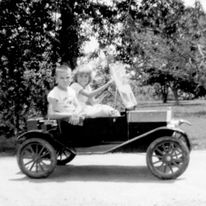
I cannot remember the exact year but I must have been around eight or nine years old. The store was giving away a large item, a miniature 1910 Model T car. It would hold two young passengers and was powered by a two-horsepower gas engine. Children visiting the store with their parents were allowed to submit one entry for each visit.
The promotion went on for several weeks and each trip to the store typically included groups of children standing by the display of the small car, staring at it in wonder and hoping that it might someday be theirs. I was one of those children and made sure I submitted my entry each time we were in the store to buy groceries.

Finally, the night arrived when the winner would be chosen. My uncle took my cousin and I to the drawing so that we could see who would win. When we arrived, a small group was gathered in front of the car awaiting the drawing. The store manager came out of his office with a large container holding all of the entries. After thanking all of the parents for shopping in his store, it was time to draw the winning ticket. He asked me if I would like to draw the ticket. I thanked him but declined telling him I was going to be the winner instead. Everyone had a good laugh about that.

He then asked my cousin if he would like to draw the winning ticket and my cousin agreed. My cousin then dipped his hand into the container, stirred the tickets once again, and made the draw. He handed the ticket to the store manager who, to my great amazement, announced my name as the winner. I couldn’t believe it. After having my picture taken with the car and probably doing a few other things, the question became, “How do I get it home?” While my father had a pickup, neither he nor my mother were in attendance. So my uncle took us back to my grandmother’s house where we told everyone of my good luck.

We then went back to the store to pick up my prize and take it home. At first, I was only allowed to drive the little car in our yard. As my skills improved, I was allowed to drive it on our block and later to other places in my hometown. I learned a lot with that little car like sharing and safety. But my biggest memory was learning not to touch the spark plug on a running engine – funny now but not so funny then.

The photo above shows me riding in the passenger seat while allowing the girl next door to drive the “little car.” I’m not sure how old we were but with both seemed to be enjoying the ride. Apologies for the blurriness but this is a scan of a photo that is probably somewhere between sixty and sixty-five years old and taken with an Instamatic or similar camera.

I kept the little car and used it until I was old enough to purchase a small motorcycle. Then I sold the car to another child who used it for many years afterwards. I’m not sure where the little car spent its final years, the red, wooden spoked wheels were not very strong and the fiberglass fenders already had cracks when I sold it but I hope it served many well.

I’ve seen photos of many similar little cars since that time but mine will always be special to me.

“You Are Here” by David Nicholls (A Book Review)

Previously posted on Facebook.

My beautiful and loving wife gave me three books for Father’s Day this year. Those of you who have seen my previous posts may remember that I have loved reading since my early days and I suspect I have read hundreds, if not thousands, of books since then. Any time I receive books as a gift it is wonderful.

In a recent post, I wrote a short review of the first of these books, Nick Offerman’s “Where the Deer and the Antelope Play …” I’m going to try to do the same for another here, David Nicholls’ “You Are Here.” Nicholls, much like Offerman, has had a varied career as an actor (for which he said he had no talent), a writer, and a screenwriter.
“You Are Here” has been described in many ways by others – an outdoor story, a journey, a love story, by Nicholls himself as funny, and more. I could agree with any of these. The book presented a bit of challenge at the beginning because of differences between the typical American novels I read and the British style of Nicholls. But this disappeared after only a few pages.

While trying to not spoil your enjoyment of the book, it centers on a hiking trip primarily involving a man, Michael, and a woman, Marnie, with seemingly little in common.  He was a geography teacher; she a book editor. Both were coming out of unsuccessful relationships. Both were somewhat isolated, by choice, as a result. They did have one friend in common, one who kept pushing them to get out of their isolation. The friend was finally successful by organizing three day hiking trip with several other people.

“You Are Here” follows the trek and the decision by Marnie to extend her hike to accompany Michael for several additional days of his planned, longer trip. Up and down hills, through the countryside, the trip continues until an evening when Michael meets with his former wife. Unfortunately, Michael had not told Marnie about this meeting until the day it was to occur Obviously Marnie’s feelings were hurt. While the meeting occurred, many surprises and unexpected results ensued.

What would happen next? Would Michel and Marnie reconcile and live happily ever after? Would they never meet again? What really happened when Michael met his ex-wife?

A few months later, when the man, the woman, and the friend who started the whole adventure met again, the meeting will be a surprise to all who read the book.

This book was a Barnes & Noble Book Club Selection and it is easy to see why. It can be enjoyed by anyone who reads it no matter how they categorize it. While my initial reason for reading it was as an outdoor book, the other views came through as well.  I would strongly recommend it to all.

Good reading.

“Starter Villain” By John Scalzi (A Book Review)

Originally posted November 3, 2024

This is a “must read”. Whether you are a fan of science fiction, humor, fantasy, or mystery you will find something here for you. From the cover of the hardback book to its end cat lovers will also find it fascinating. I found this book easy to read but difficult to put down.

Poor Charlie. A young man with no real job, no career hopes, barely enough money to live day to day. Charlie’s only dream is to purchase a local pub and have a future in the community.  But Charlie has no assets other than his share of a trust. Then, out of the blue, an uncle who has only contacted him once since he was five years old dies and leaves Charlie an unbelievable fortune. But it comes with strings attached.

This is the story of Charlie’s move from outside the poorhouse door to wealth so great one cannot imagine it. Along the way he meets thugs and killers, typing cats, talking dolphins, death, either real or faked, and whales that are spies. Charlie also sees his home explode and burn to the ground, is nearly the victim of a huge explosion, and sees The real question is can, or will, Charlie become a villain? Or will the other villains outsmart, outthink, or even kill Charlie?

While much of the book focuses on things that we may find unbelievable today, it also makes you wonder whether these things are either real today but hidden from us or if they are predictions of the future. Interspersed with this are occasional glimpses of reality such as a discussion of why war exists that is included in Chapter 15.

Do villains exist? Or could the name “villain” be misused? Each of these questions must be explored as you read Scalzi’s 2023 novel. And, at the end of the book, will Charlie become a “villain” or will he, instead, somehow become the owner of his local pub?