The Comet

No, not the bright light in the sky with a tail; instead, my first car.

I turned sixteen that year. I had my new driver’s license. I no longer needed to mow yards in the summer to earn money. I had a job working on a local farm.

My father decided it was not safe for me to ride my motorcycle the seven or eight miles from my home to the farm. So, the motorcycle was sold. But the money was put into the bank along with left over money from several years of mowing yards in the spring, summer, and fall. It was to be used to buy a car.

Mowing yards in those days paid from two dollars to eight dollars per yard depending on their size. There was not much money in the bank even with the money from the motorcycle. This was not going to be a new car. Nor was it going to be a hot rod or even a sporty car, not even a pickup with a gun rack in the back window like some of my farm friends had. Think instead of a reliable, greatly used four door sedan. Still, it was going to be my car.

Shopping for the car took several weeks which seemed like years. First, my father talked to auto dealers he had purchased from previously. No luck there – they either had nothing suitable or the price was too high. Then came trips to other dealers, only on Saturdays when Dad was not working.

Finally, as a last result, we went to a nearby Mercury dealer and found the car that met Dad’s standards. A used Mercury Comet. I think it was four or five years old. It was not my first choice, but it was a car. There were at least three models of the Comet. The top of the line was the Caliente – not mine. Then there was the Cyclone, the sports car version – again, not mine. And, at last, there was the basic Comet – yes, mine.

Nothing fancy, no deluxe features, it had four doors, an AM radio, cloth bench seats, and an automatic transmission with the shifter on the column. It also had a six-cylinder inline engine, or a straight six. I probably could not have gotten in trouble with that car even if I tried.

The paint job was good, but describing the color is a bit difficult. It wasn’t blue nor was it green. Nor was it turquoise. Looking back, I suppose it could be best described as a dark aqua with some sort of frosted look.

The car did, however, get me back and forth to the farm where I worked and the six or seven blocks to school during the school year. The car was reliable with one exception. At times, unexpectedly and with no prior warning, the engine would simply quit. The poor thing must have simply been tired. After sitting for an hour or two, the engine could be restarted and would run like there had been no problem. I was lucky. When it did this, I was usually near home and could pull off the road to avoid accidents.

My cousin was not quite as lucky. He was about fourteen years older than me and came for a visit one winter. He borrowed my car to visit another relative for the day. As he was returning the engine decided it needed a rest about five miles from home. He managed to get the car out of the road but could not get it to restart. He also could not get a ride, so he had to walk the last few miles. After my mother arrived home from work, we drove to the Comet and, as expected, it started without problem and drove home with no other issues. He did not ask to borrow the Comet again.

 Even with the occasional engine problems and the strange color, the Comet served me well until I graduated from high school. It was traded for a new car for me to attend college on the other side of the state and held its value, bringing a trade value almost equal to its cost to me. It was not a show car nor a sports car but I will always remember it as my first car – The Comet.

How to Train a Cat

This is a work of fiction, with maybe a little humor thrown in. Any mention of people, places, or things other than my cats and me is purely coincidental and means nothing. It is based on personal experiences and has not been veterinarian approved. As far as I know, it hasn’t even been seen by a vet (Oh, wait. I’m a vet, just not an animal doctor.). Feel free to share, with credit given.

Our friends, household cats, are descendants of great beasts. Beasts like the guy above who is sticking out his tongue and telling you he is called the king for a reason.  Predators by nature. But they have many other traits, both in common and different. Their day-to-day life can really be divided into a few simple things. They eat (“I can see the bottom of my food bowl. I’m starving!”). They sleep (“What do you mean. I need at least sixteen hours of sleep a day!”). They visit the litter box (“It hasn’t been cleaned in the last two hours. Clean it!). They stare out the window (“The world is beautiful. I want to be out there!”). They zoom (“Just try to catch me. I’m faster than a speeding bullet!”). And they are mischievous (“It’s three AM. Let’s see what we can do now!”).

Most of these things come naturally and require no training so let’s concentrate on the last. Mischief is good. We’ve all heard the term, “Curiosity kills …”. We really don’t wan that to happen. So maybe we can do something to control it, or at least control when it happens. Let’s talk about a typical night and what we need to do. It is 2:00 AM. We hear a crashing noise. Who was it? Where was it? What was it? The spouse is still in bed with us, so it must be the cat (first question answered). To answer the others:

  1. Uncover ourselves and sit up (can’t answer the other questions from the bed).
  2. Turn on the lamp (flashlights just don’t work for this.).
  3. Try to find the source of the noise (by the bed, in another room, etc.)
  4. Is anything broken? (No=Good; Yes=Bad, especially if glass. Must be cleaned up now – before the spouse steps on something and gets mad at me)
  5. Is the floor or furniture wet? (No=Good; Yes=Bad. Must dry things immediately. Paper towels, mop, towel – any or all. Just get things dried and fast.
  6. Find what made the noise (put it back where it belongs or in a safe place).
  7. Now, find and catch the culprit (the cat thinks hide-and-seek is the game for now).
  8. Put the culprit in his kennel (both cats if they were both guilty).
  9. Turn off the lamp (the light woke up the spouse).
  10. (Optional) Have a glass of wine (or maybe something stronger) and put the glass away.
  11. Get back into bed.
  12. (Optional) Go back to sleep.
  13. IMPORTANT If the cats are in the kennel remember to get them out the next morning.

After all of this is complete, you may have trained a cat (or maybe you are the one who has been trained) and it won’t happen again (at least until the next night).

So, from my spouse, our cats – both past and present, and me, “Have a great day and try to see how you can train a cat!”

Resolutions

January 1 has come and gone. Now we look forward to a, hopefully, better 2025.  Did you make any New Year resolutions? If you did, how many of them have you broken already? Do you regret any of them? Are there other resolutions you wish you had made and kept?

What are resolutions? Are they wishes for the future? Are they goals we hope to achieve? Are they simply something we make because our family or others expect from us? Can they be shared with others or are they like birthday wishes which can only come true if kept secret? I’m not sure I have an answer for any of these questions. Perhaps the answers are different for each person or for each resolution. Perhaps there is no need for answers.

When I was a child, each year it was important to make resolutions. Sometimes they were to correct things that had been done wrong the previous year. Sometimes they were new hopes for the new year. Sometimes they were meaningless to anyone except me. And, regardless of what they were, they were often broken within a few days or weeks.

As I look back, I cannot remember any specific resolution that I made. I can’t remember any resolution that was shared by a family member or friend. Yet it always seemed that making resolutions could not be missed.

When I grew older the value of making resolutions at the end of each December or in early January became unnecessary or unimportant. I’m not sure why. Maybe it was I recognized that resolutions were broken almost as quickly as they were made. Perhaps it was because I became more cynical although I probably didn’t even know the meaning of the word. Or could it have been that the time spent was considered wasted.

Even today, I don’t make resolutions. Now my reasons are more easily defined. I do not make resolutions because I don’t really believe I can keep them. Maybe this is a recognition that one of my human weaknesses is the inability to set long term goals. And, for me, a goal for an entire year is long term.

I’ve never asked others, apart from young children, about their views on making resolutions. I suppose some do and that they can succeed in accomplishing whatever they hoped for. I know some who make resolutions that do not last even a few days into the new year. Some may make resolutions as a form of humor. In any case, if you or someone you know makes a resolution, I hope you can achieve your goal whether in a single year or even a longer time.

Who knows? I may make a resolution or two at the beginning of 2026 or I may continue with my tradition of making none. Or maybe I should make a 2025 resolution to make new resolutions in all future years.

Bart and the Cabin

This is a work of fiction. Names, characters, places, and incidents are either the product of my imagination or are used fictitiously. Any resemblance to actual persons, living or dead, businesses, companies, events or locales is entirely coincidental.

All rights reserved. No part of this story may be used or reproduced in any manner without written permission except in the case of brief quotations embodied in critical articles and reviews.

Though now in his late sixties, young Bart he is still called. He was named for his great-great-grandfather, Bartholomew. Those who have heard tales or seen photos of both say young Bart is the spitting image of the old man. This is definitely true in their love for the cabin. Bart and his wife now share the cabin with his father Bradford who is now nearing one hundred but still loves the place especially each year as the holidays approach.

In early autumn, the preparations for Christmas begin. All the rooms are made ready with a deep cleaning and new linens all around. Followed by the Christmas lights both indoors and out. Then come the wreaths, small artificial trees in many rooms, and other decorations. Food and drinks are purchased, much more each year. Some will be made soon while more can wait for the arrival of family. His wife enjoys the baking of cookies for family and friends, some delivered ahead of the holidays and others carefully stored for the first to arrive for the family celebration. The main tree selected to go in the main room but left uncut until right before Christmas to ensure it is fresh.

While this may seem too early to some. Bart’s work may keep him on the road for some of the time. But he ensures that his calendar is kept open from Thanksgiving ‘til New Years so all can be done. Bart loves the cabin and wants to be sure that it will be ready for all who will join together at least this one time each year. Bart sends reminders to all family members and asks them when they expect to arrive. That way none will feel they are intruding or staying too long.

Christmas cards are prepared and mailed early so none will be missed. Some contain the formal invitations to stay or to visit. And yet it never fails that some arrive unexpected but even so will be welcome with a place of their own.

Bart asks each family member what their children or grandchildren enjoy. And with the list given he selects and purchases some of these and makes sure there is plenty of space for play. The hope is always for a white Christmas so snow can be seen, especially for those coming from warm places afar.

Then comes the day when the first family arrive. Bart goes out with the adults and older children to harvest the tree and move it to the cabin. Decorating may wait a day or two but all who have arrived can help. The little ones add small ornaments to the lower branches while those older climb ladders to decorate the top. And once the tree is almost ready, Bart holds a drawing to see who gets the honor of placing the angel up on the top. Carefully assisted by all to ensure they are safe.

Once all have arrived, Bart takes a moment to rest and look back hoping all has been done right. While each year seems better in so many ways, Bart always thinks more could be done. Until Dad Bradford congratulates his son.

And though not mentioned earlier in this story, Bart’s son Barry looks forward to the day he and his family can move to the cabin. He, too, knows the cabin is where he should be, to carry on the traditions of his ancestors and family. Barry’s children too know the cabin is special for all who come and so the traditions look to go on.

More About the Cabin

This is a work of fiction. Names, characters, places, and incidents are either the product of my imagination or are used fictitiously. Any resemblance to actual persons, living or dead, businesses, companies, events or locales is entirely coincidental.

All rights reserved. No part of this story may be used or reproduced in any manner without written permission except in the case of brief quotations embodied in critical articles and reviews.

As earlier told, the old cabin had been expanded and improved over its life but by the late 1940’s Benjamin decided that it was time for replacement rather than further improvement. He knew some men who, after returning from the war, had started a business to build homes and cabinets around the lakeshore. His ideas were bit strange but fit the location, a new home from logs rather than bricks or stone. And to retain a connection with the past, he wanted to somehow incorporate the old cabin into the new. This could be done with small parts and pieces, but his biggest hope was to retain the original one room shack as part of the new home.

Much to his surprise, the new large cabin was completed in late 1949. Even the old cabin had a place in the home as an office for Ben attached out back. This meant that a family tradition, Christmas at the Cabin, could be held that year. On that day and the evening before the entire family celebrated with feasting and fun. The children, grandchildren, parents, and more gathered together from far and wide. Although members of the family were welcomed all year, Christmas at the Cabin was not to be missed.

Ben knew that his remaining days were not too long, he wanted this tradition to live on and on. So, he visited his attorney and asked what to do. And the lawyer said, “I have an answer for you.” Let’s take the cabin and the surrounding land, put them in a trust with a few small demands. While some of the demands were not very big, two stood out as ways to ensure the traditions would remain. The first, and most important, was that all of Ben’s heirs were expected to visit on Christmas each year. Failing to do so would mean the loss of any claim to all or a portion of the trust and estate. But Ben also recognized that some things might make this impossible some exceptions were added in exceptions to this rule. If family members were serving the country in times of war, they could be excused from the celebration. Similarly, the birth of a child on or near Christmas was a reason for missing as was the death of a close relative of one or their spouse. Ben and the attorney that these rules could be tested for Ben’s remaining life and changed if needed which ever occurred. And these rules remain in place to this day. As do the traditions of the family gatherings.

Each year as the family gathers, other traditions continue as they had in the past.  The gathering starts on Christmas Eve with food and drink served buffet style and no formal meals. In the evening all go to the local church to celebrate with family and friends old and new. Returning to the cabin there are stories and memories from the days past and the evening concludes with a reading of “the night before Christmas” for all to enjoy. The younger children are all put in bed to await Santa’s visit during the night. The older children are allowed to stay up longer with the adults to ensure Santa’s visit goes smoothly and all is in place for early Christmas morning. As the dawn breaks the next day someone is posted close to the stairs so no child awakens early, and no child is late to see what gifts from Santa for them may await. After presents are opened and there is some time for fun, then off to breakfast for everyone. As the day goes on, some start to drift off to homes of their own. Others may stay for a day or two. But they all begin planning for what next year may offer when all gather at the cabin next year. The cabin has changed from Barthlomew’s day but it still remains in the hearts and lives of all.

Views of Christmas Present

This is the second of three posts regarding the Christmas season. As stated in yesterday’s post, “Thoughts of Christmas Past”, these posts were inspired by the visits of ghosts in Charles Dickens’ “A Christmas Carol’ which was originally published in1843. In his novella, Dickens told of Christmas Past, Christmas Present, and Christmas Yet to Come. My titles vary slightly as do the thoughts, memories, and opinions. Perhaps yesterday’s post could have been titled “Memories of …” instead of “Thoughts of …” because it was based on memories of my childhood.

Whether right or wrong, I decided to title today’s post “Views of …” to reflect that these are not memories nor opinions but are more at how I look at the world outside my door today. It is a bit harder to write because yesterday’s blog was based on my youth in a very small town – a place where I have not lived since the 1970’s. Instead, this is what I see daily in the large city, not my home but near enough that it affects my daily life. I hope you can forgive this and will think about the differences as they might affect both you and others. I have attempted to retain the same sub-themes for consistency may not always be successful.

Family – The family, as a unit, has undergone many changes since my childhood. Perhaps, these changes began before my birth as soldiers returned from WW II and found the country different from what they had left only a short time before. While this may be true in large cities as well, it became more apparent in rural America. Mechanization and other advances led to the demise of many small farms and the businesses that supported them. Many were forced to flee to cities for jobs. This all in the face of the “baby boom” – larger families, a need for better economic opportunity, and the ability to provide housing for families.

The result could have been predicted. As physical separation of families grew more common, the ability for large family gatherings on Christmas and other holidays decreased. At the same time, views of the world around us became more diverse.

These changes are continuing today. Demands for time have become greater. While it was simple to have a weekend gathering of family in the past, it is much more difficult today.  Family activities, work, friends, and other things all challenge us to balance where we can be, when, and for how long.

Recently, a new challenge has faced families – political realm. This can involve things like political correctness where things that were taken for granted in the past now have become a basis for judgement. This seems most prevalent when comparing the views of progressives, or the so-called “woke”, with those of the more conservative. Even more significant is the hatred or mistrust, instilled by or encouraged by the media, based on voting for or against a candidate or an issue. Things have deteriorated to the point where some families have cancelled holiday gatherings because they believe political arguments may degrade the gathering into fights, either intellectual or physical. These views have been encouraged by the media through such proposals as “cancelling Thanksgiving” which will probably happen to Christmas as well and refusing to “break bread” with anyone who votes differently. I have yet to see any media suggestion that the Christmas season should be a time to come together rather than time to pull apart.

So where does this leave the family? Today, it is far from anything I saw as a child. Can the family unit even survive? Survival is dependent on recognizing that these things are not as important as those around us, our families and our friends. Perhaps it is time to take a break and step back, yet the media and its self-proclaimed experts on life cannot or will not allow this to happen.

Santa and His Helpers – I seldom see “Santa” today. He sometimes appears in a parade or possibly in a store, but he really seems to have disappeared or has at least elected to be elsewhere. This, too, I blame on our seemingly endless more toward political correctness. Never should anything exist or occur which might hurt someone’s feelings, whether justified or not.

I wonder if today’s children have heard the simple poem that we know as “The Night Before Christmas.” Although the poem was first published over 200 years ago, it is suddenly something bad. Why? It must be evil because it tells a story of an imaginary person or event. Or maybe it is because it tells of an event that could only have occurred in the home of a wealthy family. Or, hopefully, I am worrying too much and our children still get to hear or read this quaint poem written in a far different time with little or no editing for “correctness”. The same could be said for many of the works of Charles Dickens. After all, “A Christmas Carol” focuses on a man who was an evil miser and only changed his ways after visits from three ghosts.

Trees – Trees seem to be one of the few things that have changed very little. There are still those who love a live tree, or even a tree that can be replanted after Christmas. And there are those who enjoy having a green or white artificial tree, often with lights that do not need to be removed each year. There are apparently still a few who like the older “aluminum” trees, at least enough to justify advertising these trees online. At the same time, there are also those who want your tree to go away. People who say the trees contribute to the decline of our environment, or that the trees add to pollution because of electrical demand, or even that the trees discriminate because they are not fair to those who do not celebrate Christmas.

Gifts or Presents – I wonder if the entire concept of gifts at Christmas has lost its meaning. When I was young, gifts were given not of obligation, but instead as a way of showing love or friendship to another. Gifts were often small, but they still had meaning to both the giver and the recipient. Today gifts are given more from obligation. If we give gifts to two family peers, for example a son and a daughter, then we carefully take steps to ensure that the cost is the same. We worry when we do not provide a costly gift as opposed to a family heirloom. And, when asked for a gift suggestion or when we ask someone, “What might you like?”, we are often told of an item that is far outside what we are able to provide. Yet we will do everything we can to offer this gift even if we really feel it is not appropriate.  

Trains – I don’t believe that trains mean as much to our children today as they did in the past. This may be because trains today are far different from those of the past. Their role, other than in places like the northeast corridor have moved from a mixture of freight and passenger service to a role of freight only. In may places, passenger service has been gone for many years, replaced by better roads and automobiles. Even the romanticized little red caboose is rarely, if ever, seen other than in a museum. As a result, there is little to draw the attention of children. Electronics have also played a role; cell phones and games have become an integral part of day-to-day life for today’s children. So, what is there to draw them to trains.

Parades – Parades, much like trees, remain a part of traditional Christmas events. Yet these too have changed. While small town parades may have seen little of this change, the larger parades have become even more complex. I sometimes watch these larger parades and wonder how much more they will change. It seems that those in large cities have become more entertainment “events” catering to the broadcast media rather than parades catering to attendees? Also, since the parades are often held in downtown areas, has safety for attendees been considered?

Snow – Even today I suspect that children hope for a white Christmas. At the same time, I suspect that the adults often wish for the opposite.

So, as I close this post on Christmas present, I wish anyone who reads a happy holiday season no matter how you celebrate and for those of us who celebrate Christmas, a very merry one.

“The Cat Who Saved Books” By Sosuke Natsukawa (A Book Review)

I read for enjoyment. Sometimes I start a book and then stop because I am not enjoying the read although this does not happen often. More commonly I tend to take the time to savor what I am reading. This may include reading a short passage, a page or two or even a chapter, then taking a break to ponder what I have read. Occasionally I start a book and read it quickly then return to read selected passages that I found more interesting than others. But rarely do I find a book that it is very difficult to put down.

“The Cat Who Saved Books” was one of those rare treasures. The story was captivating. The translation by Louise Heal Kawai was excellent. The cover artwork by Yuko Shimizu was beautiful. I find it hard to say anything bad about this novel other than it was far too short.

I was visiting our local Barnes & Noble a few days ago browsing for a new book. Something that could be read for pure pleasure. I slowly cruised the “new releases” aisles in this quest. Initially I was having difficulty finding what I desired. During my first pass, I couldn’t seem to find what I wanted although Shimizu’s cover caught my eye. Even during a second trip around this area, there was no strong draw other than the same cover. As a cat lover, my thought was that the draw was the cat on the cover. But as I started a third trip through the “new arrivals,” I decided to pick up the book and read the synopsis. When I did, I found something there that told me I had to read this book. I am so glad that I did.

Back at home, I put the book on my nightstand for later reading. There it sat for a few hours. Then I began reading. Little did I expect that I would not put the book down, except for a few very short breaks, until it was finished.

The book opens with a young man, Rintaro, standing sadly at the funeral of his grandfather. The grandfather owned a used bookstore. A store with only a single aisle where books were shelved floor to ceiling, seemingly in no order at all. Yet his grandfather seemed to have known every book there and where it could be found. He had passed much of this knowledge to his grandson. Now, the grandson was expected to give up the bookstore to live with his aunt until he became an adult.

Little did anyone know that this was not to happen nor why. And they probably would not have believed it had they been told.

After the funeral, the boy returned to the bookstore to contemplate what had happened and what his future would be. As he sat, the bell outside the door rang. When he answered, no one was there, nor had anyone entered. Then he heard a deep voice talking to him. He looked for a person but instead saw only a cat. Could it be? A talking cat? Surely not, yet it was. The cat told the young man that it needed his help. There were books to be saved and only the young man and the cat could do it.

Once the cat convinced the young man to join him, the solid wood wall at the back of the bookstore opened and the adventure began. Through the book, the cat, Rintaro, and at least one other go to four labyrinths to save books. Each labyrinth is more challenging than the previous.

Will Rintaro and the cat succeed? How will this affect Rintaro’s future? Will the bookstore survive? Is this really a prediction of the end of books? To answer all these questions, you must read this book. As you read, be sure to watch for the words of wisdom, sometimes offered by the late grandfather and at others offered by Rintaro as his knowledge grows. I think you, too, will find the story enchanting and hard to put down. And you may find it exceptional as I did.

Another Day in the Lives of Cats

Here I sit, a snowy morning two days after Thanksgiving. The elections are over, there was no need to cancel Thanksgiving as some had suggested. The world, and hopefully most families survived. The holiday season has begun. As we look forward to Christmas, or other holidays that you may celebrate, I thought I would take a look at the past few months and the lives of our cats since my last post about them.

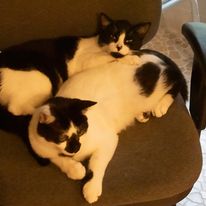
In the earlier post, I reflected on a day in the lives of Joe and Leo, our two cats. At that time they were just over one year old and had lived with us for about a year. Today, they are nearing their second birthday, but otherwise much is the same.

The added year of their lives is not readily apparent although they each continue to develop distinct personalities. As littermates one might expect them to be quite similar but instead each is unique. Leo is the explorer and very rambunctious. Seeming to have little fear, he is ready to jump to or from great heights. One of his favorite “games” is to run out of our bedroom any time I open the door, then lay on the floor, expecting me to rub his tummy, pick him up, and return him to our room. He will zoom about the room with his brother or alone if no one wants to run with him. Joe is the more cautious of the two. While he enjoys many of the same things as his brother, he contemplates them before joining in. He loves to watch television, especially shows with other cats or dogs. We often wonder if he actually sees the shows or is simply responding to the sounds or the changing light. Joe is also a bit skeptical, often shying away when one tries to pet or cuddle him. Joe is, however, the most curious. He wants to explore and, often, toss to the floor things on our nightstands.

Oddly, neither of the two is highly loveable. They will often share our bed, but that does not include petting in the evening. They pick their space and we must adapt to that, otherwise they will leave. Yet they will return later, hoping to be unbothered by their humans.

As they continue to grow it will be interesting to see how they will change or stay the same. According to some charts they are now in the equivalent of a human teenager. In many respects this can be seen in their personalities – loveable yet sometimes disobedient; daring but cautious; sleepy but always ready to get up and zoom. Such are days in the lives of our cats.

A Day in the Life of Our Family Cats (An Edited Repost From Facebook)

When I originally posted this in July 2024, it was after several more serious posts and was written to reduce stress, both mine and that of my readers, as something a bit off the wall, and something with a bit of humor.

I’m usually up somewhere between 5:30 and 6:30 each morning to do my daily chores. To our cats, the most important of these chores is feeding them and refilling their water bowl. Next in line is cleaning their litter box. I don’t need an alarm to wake me up in the mornings because the cats ensure that I know it is time to get out of bed. If I am not awake, they sit on the dresser and stare at me. If that doesn’t work they resort to racing from one side of our bedroom to the other, at full speed, often jumping on or over the bed with their favorite landing point being my legs or back.

Once I arise, they follow me step-by-step to ensure that I take their food bowls into the kitchen for filling. While I am filling their bowls, they again stare at me so that I don’t waste time or perform any unnecessary tasks like starting the coffee machine. After their bowls are filled, they follow me to make sure the bowls are returned to their proper place for eating. I dare not do anything prior to this.

Our day then proceeds in one of two ways. Most common is for them to eat, find a hiding place, curl up, and go back to sleep. The second is for one or both to jump on my desk and watch me use the computer to type posts like this or to work. There really isn’t enough space for both cats and the computer on the desk so they arrange themselves in whatever manner they prefer and often assist me by putting paws on the keyboard or moving the mouse so that it is not where I want it to be.

After deciding that they cannot both be on the desk simultaneously, either one or both leave the desk and move to a nearby window to look outside. Of course, this necessitates walking across the computer keyboard and adding their personal comments to anything being typed. Throughout the day, they alternate which, if either of them, sits or sleeps on the desk.

If their food bowls become empty (which means the bottom of the bowl can be seen in any way) they will let me know by again starting the racing game along with a loud “meooow” or two.

At the end of the day, they both disappear, back to their favorite hiding places for more sleep so that the races can begin again about the time we are ready for sleep, or more likely around midnight. After zooming around the room, they normally settle down and sleep so that the entire process can begin again the next morning.

Yesterday the cats were very confused. When I left for work my wife moved over to my side of the bed and went back to sleep. She rarely sleeps there. She said when she awakened one of the cats was simply staring at her. Then, he would move close to get petted and then back away and look at the place where she normally sleeps, as if to say, “Why aren’t you here, where you belong?” After a short time the cycle would repeat. Later in the morning, the second cat reacted about the same way. Seems that they don’t like change unless they approve ahead of time – LOL. By the way, two cats, brothers from the same litter, two totally different personalities, very independent, a little over a year old and full of energy.

The Old White House in the Country (A Short Story of My Past)

This is not a work of fiction. Instead, it is written by a seventy-two-year-old man based on memories of his childhood. As a result, some things may be off regarding time, size, and other details. All rights to these materials are reserved although readers may share them provided they are appropriately attributed to the author.

After my wife and I had our Thanksgiving dinner last evening I thought about how much things had changed since I was young. A time when the holidays meant for families to gather and have conversation, played together, maybe even enjoyed a football game on either the radio or on television. When political events were not the subject on conversation, or at least, were no reason to end friendships or enjoy time together. Yes, things have changed, but not always for the better.

The old white house was located about four miles from the nearest town, in the center of fields and farmland used primarily for cotton but not anything even close to Tara or the other plantations so romantically described in literature and movies. It was a four-room house with attached porches on both the front and the back. I know little about the old house other than it, at some point, may have been inhabited by the landowner. I say this because the outbuildings around the house included sheds for storing seed and for smoking meat, a large building for chickens, and a mid-sized barn.

The white house was in a big yard with several really large white oak trees along with a few cedar trees. There were flowers of all types, from the tall, multi-colored hollyhocks to small daffodils, some in beds and some just scattered through out the yard. There were peach trees between the house and the large vegetable garden which was shared by the family each summer. From my earliest memories until the late nineteen-sixties, the house was inhabited only by my grandmother.

While there was electrical service to the house, there was no running water and, as a result, no indoor plumbing facilities. Heat, in the winter, was provided by a single, wood burning stove located in the living room. I also remember cooking being done on a wood burning kitchen stove in my early years although that stove was replaced by an electric range sometime in my childhood. The house was of simple design. It was basically a square, or perhaps a rectangle, divided into four smaller squares, the rooms. Each room was connected to the two adjacent rooms and the two front rooms opened onto the front porch while the two backrooms opened to the back porch. Each exterior wall had two windows, one in each room on that side of the house.

The house sat atop several concrete peers thus offering an open space about eighteen inches high under the house. Like I said earlier, there was no running water in the house. Instead, there was a hand pump a few feet outside the back door and water was pumped and carried into the house in buckets. Similarly, wood for the stoves was carried in a few pieces at a time from wood stored on the front porch or from wood stacks a bit farther away.

My grandmother’s family would be considered large today but at that time was probably common. She had four daughters, one who died early in her life, and four sons. All of her children were born in Tennessee, but the family moved to Arkansas when my mother was young. I never knew the reason but suspect it was because they could find work there. On holidays, it was common for the majority of my grandmother’s children to visit for at least one meal and often for the entire day. As the family grew older some were not able to visit every holiday because they had moved away but they were always welcomed when they could visit.

On these holidays not everyone could fit into the kitchen for eating so the children were often relegated to eat in another room or to eat later than the adults. One cousin and I were close to the same age, so we tended to play together. Most other cousins were several years older, so they also tended to visit together.

Near the white house, beside or amid the cotton fields were a large pecan tree and another large nut tree (I can’t remember the variety) where the men often collected nuts during the harvest season.

I will always remember the holidays as a great time for visiting with family. While we all had different lives, lived in different places, and had different friends, we were also family and could share things with each other. I remember times that were not so great and times that were truly celebrations. And from these things, we became closer as a family. I even remember some funny events, like the time when an in-law brought an apple pie for the holidays. When she arrived, she asked who had brought the ice cream to go with it. When no one answered, she said, “Well, I’ll just put my pie back into the car since you can’t eat pie without ice cream!” Of course, this led to many jokes as the story was repeated for many years after.

The old white house is no longer there. Nor are the fields where cotton, and later soybeans, grew. If fact, the area is no longer in the country. The city has grown, and all of this space has been absorbed. The old gravel roads have been paved and now have now have street names. But the memories remain, at least for the few of us who were around then and are still around now. But our numbers dwindle, just as do the memories. Hopefully, today’s children are building there own memories to share with those who follow and not all memories will be left forever on machines and in social media.

I hope that readers and their families had a chance to get together on Thanksgiving. If not, I hope you still had a happy holiday. And, with some luck, you had ice cream to go with your pie. Enjoy the holiday season and many more.