Temporary Buildings

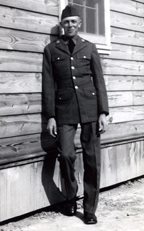
On Monday I saw a photo online of an old barracks building on the grounds of Fort Chafee, Arkansas. This building, like others on military bases across the country, was erected before or after the beginning of World War II. These barracks (like the one behind my father in this photo) provided housing for soldiers during their initial training and before they were deployed throughout Europe and the Pacific. Later they would serve the same purpose during the Korean and Viet Nam conflicts and even in peacetime.
A typical barracks had two floors and could accommodate about 40 soldiers on each floor. Privacy was non-existent. The soldiers were provided a bunk and a locker, typically a footlocker, for their possessions. The buildings were erected quickly with limited insulation, minimal heating or cooling, and either wood or asbestos floors.

Along with the barracks buildings, a number of single-story support buildings were erected. These buildings might house hospitals, mess halls, supply rooms, or other administrative operations.

Most were built in the early 1940’s and were designated as “temporary buildings”, a term never clearly defined but thought by many to mean until the end of the war.  Many of these buildings not only survived but were in use in the 1970’s or 1980’s, and even rarely into the 1990’s on some military posts. They were not luxurious by any stretch of the imagination. They were utilitarian – designed to house and train our military. Civilians arrived here by train, bus, and automobile. A few weeks later trained soldiers, sailors, and marines departed. For most, these were the best places they would live until the end of their service. Many of the thousands who passed through would never return to our country. These temporary structures were also used for housing immigrants after the Viet Nam War and, unfortunately, as internment camps housing people because of their place of birth or names. I, personally, lived in one of these temporary buildings at Camp Forsyth, Fort Riley, Kansas, in 1973. Our mess hall was also in one of the single-story buildings.

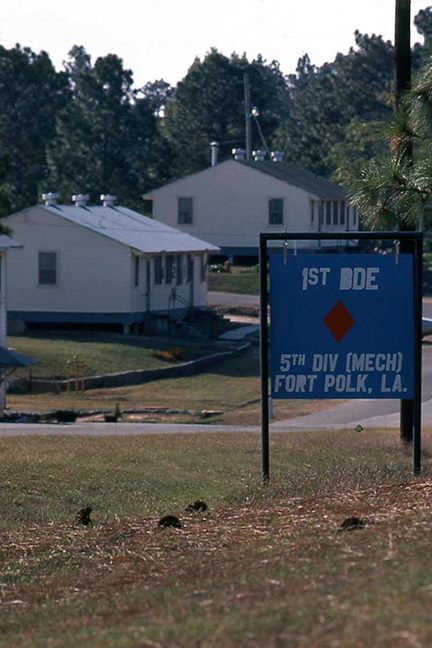
In 1974, many of these buildings were still in use for housing soldiers during basic and advanced training after enlistment. Some of the administrative buildings are shown in this photo from Fort Polk, Louisiana in 1974. Many of these buildings and barracks on South Post were torn down and replaced with new, “permanent” buildings in the mid-1970’s as the 5th Infantry Division (Mechanized) was activated. At the same time, many of “temporary” buildings on North Post were retained for training of new soldiers. Similar things occurred at forts and bases across the country.
In some locations, forts and bases were turned over to the National Guard to meet training and other needs. This happened at Fort Chafee, Camp Shelby, Mississippi, and Fort McCoy, Wisconsin, among many others. In some cases, the “temporary” buildings were demolished, in others sold, and sometimes abandoned. Some may still exist today.

When I think about these “temporary” buildings today, I wonder if those who were involved in erecting them ever believed that their work would continue in use for so long into the future. When new soldiers passed through the buildings on their way to war, did they believe the buildings would remain if or when they returned? Were these “temporary” structures better or worse than the homes they left behind to fight for our country?

I also wonder if builders today were tasked to create temporary structures to rapidly meet the needs of a country going to war, not just smaller engagements but war on the scale of World War I or World War II, could today’s builders meet the demand. If so, what shortcuts would be taken? How could we do this fast? And would today’s temporary structures still be usable 30, 40, or even 50 years in the future?

I have no answers for these questions. They are just food for thought. What could, would, or might happen?

Why the Army?

In the past. I’ve been asked, “Why did you go into the Army?” This is a question I have pondered repeatedly and even today I’m not sure I have a good answer. Perhaps patriotism played a role although I do not consider myself more patriotic than others my age. If I had been a few years older, I could have said it was because of the draft and the Viet Nam War. But this was not true because by the time I graduated from college, the end of the War was near and the draft was, for all intents and purposes, no longer an issue. Or was it something else?

As I was laying in bed this morning this question came to mind again although it has not been asked recently. While I am the son of a World War II veteran, the idea of entering the military was never discussed in our home. Nor was it ever discussed in our school. So why did I even consider it?

Maybe it was something in my childhood. When I was young in most years my family went to the nearby small city of Jonesboro to see their Christmas parade. The parade consisted of a few floats, some marching units, some vehicles, and Santa Claus – a favorite of the children. While I cannot remember many details, there was one unit that I always enjoyed seeing. It was a small military drill team; I believe they were from ROTC unit at the local college and were called the Reng Rifles. They marched proudly in their uniforms, carrying rifles and wearing brightly polished silver helmets. As they went down the street, they twirled their rifles and did other movements that I found fascinating.

Several years later, a young man who I respected graduated from that same college commissioned as a Second Lieutentant after completing ROTC. He was five or six years older than me, and I can’t remember if he went on active duty or became a member of the reserves. I know he never suggested that I follow in his footsteps yet his decision to become an Army officer increased my respect for him.

When I left home and entered college, one of the first classes I asked to enroll was military science, or ROTC. Unfortunately, the only class session that fit my schedule was cancelled because of low enrollment. I could have moved on and no longer considered ROTC or the military as part of my future. Instead, near the end of my sophomore year I learned of a program that allowed those with interest in the military to enter a two-year ROTC program. To do this, you had to attend a summer camp between your sophomore and junior years, enroll in ROTC classes the next two years, then accept a commission. I agreed to do this and thus was commissioned as a Second Lieutenant upon my graduation.

There were several who encouraged me throughout these two years – my roommate who was two years ahead of me in college and in ROTC, others both ahead of me in college and even some following me, our ROTC staff, my parents, and others. One person I especially remember was the head of our ROTC department with whom I shared a first and middle name along with a last initial.

Even with all of this, I’m not sure why I entered the Army. Were I placed in the same position today, I believe I would do the same thing. While there were good times and bad during my Army career, I learned much and travelled to places I would never have seen otherwise. I met people who I remember to this day although I have not seen them in many years. I served our country. I was lucky, I did not have to serve on the battleground. I knew many who did. I have no respect for those who dodged the draft, nor can I respect those who criticize our military today yet have never served.

So, if you ask, give me a few moments to gather my thoughts and try to provide you a good answer. There are too many things that affected my decision both to enter the Army and remain there for a career.

Brr….

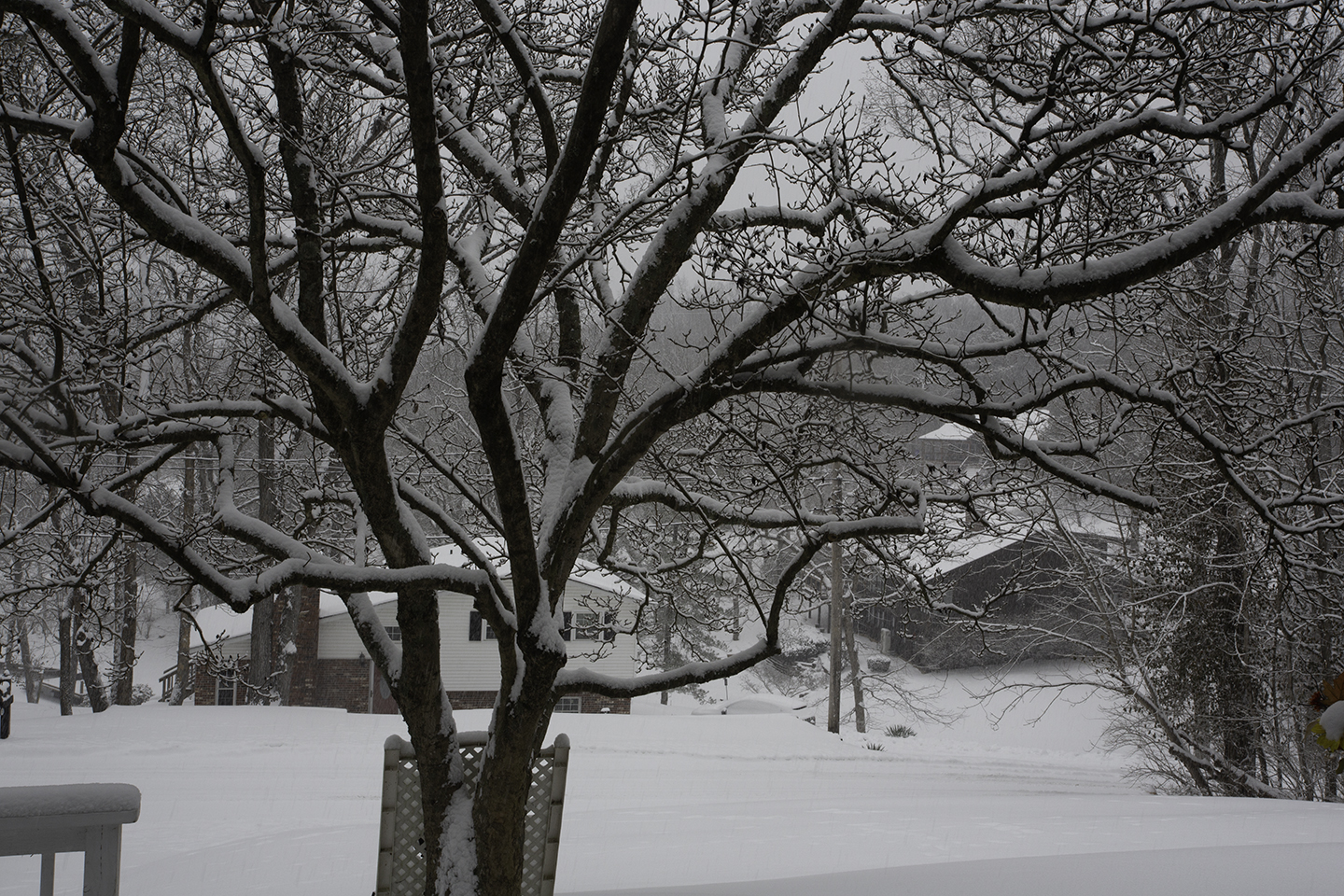
In the last couple of weeks, the St. Louis area has suffered through some strong, at least for here, winter storms. During the first, we were on the border between snow and ice. At our home, southwest of St. Louis, we spent the first two days of the initial storm as a target for freezing rain and sleet. Only the final night gave us some of the snow that had been seen north of us.  As a result, we had a layer of ice on the ground, on streets, and on driveways which was then covered by snow.  A few days later, another blast of winter weather added several additional inches of snow.
While many others, like my nephew who lives a short distance from Grand Traverse Bay and Lake Michigan, have far worse winter weather and far more snow, they are better prepared for what that brings. Still, I wonder if they sometimes laugh about our weather woes or have sympathy for those who rarely have this type of weather.   

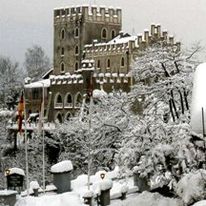
I will admit that I probably have difficulty understanding the reactions to winter weather myself. I grew up in northeast Arkansas. As school aged children, we were usually happy when we had more than one “snow day” in a year. More often, we had none. My second Army assignment was in Germany. There, and like in this photo from Austria, we had much more snow than in Arkansas, but I don’t remember it ever bringing things to a standstill. Instead, communities and drivers there seemed to be prepared for snow and took it in stride. I saw this in multiple assignments in Europe and in the U.S.
But the recent days have made me wonder, why do we not prepare for winter weather and why do react the way we do? Preparation, at least on the surface, seems fairly simple. We should keep enough basic food and other necessities in our homes in case we cannot visit stores for a few days. Instead, it seems that purchasing these basics, particularly food, is never thought about until the last minute. Store shelves are emptied where there should be simple items like bread, eggs, and other everyday items. Little or no thought is given to what will happen if we lose power or if our roads cannot be cleared as rapidly as snow or ice falls.   

Perhaps our businesses should have plans in place to either operate with limited staff or to close for a few days if necessary.  Schools seem to be able to do this, so why not others? Also, our stores should have enough supplies like snow shovels and salt or other ice melting chemicals on hand to meet the needs of the community. This clearly did not occur during our recent bad weather as people needed to call or visit multiple locations, some miles away, to simply get enough salt to clear their sidewalks.

During the first part of our recent bad weather, I had a great deal of sympathy for our HOA president who was receiving email and other complaints in the middle of the storm asking when the streets would be cleared so that someone could go to work or visit a store. He tried to explain that clearing the roads while the snow and ice continued to fall would be of little value. Still the complaints kept coming (along with a variety of reasons for why the roads needed to be cleared immediately). Yet after the main part of the storm had passed and the roads were first plowed, because of the ice the roads rapidly covered over again and driving conditions were no better. Others decided that warnings from area police and highway departments to travel only in emergency did not apply to them so they could travel as usual and create danger for our first responders and others.

All this occurring even after multiple warnings over several days before the storms. I had to wonder, “What would have happened had the winter weather been worse? And how are we teaching our children to be prepared for similar events in the future?”

Waterfowl

As the first cold snap of 2025 approaches, it reminds me of the days of my youth. My hometown was in the middle of farmlands where the summers saw rice and soybeans growing if fields large and small. In the autumn was harvest leaving bare fields behind. In the winter, it was a stop along the Mississippi Flyway, a traditional migration route for waterfowl and other birds from breeding grounds in Canada to wintering grounds along the Gulf Coast.

Depending on the weather, both in the north and along the Flyway, waterfowl became abundant in our area from mid-October until sometime shortly after the start of the new year. The waterfowl, mostly ducks, could be seen could be seen in huge V-shaped flocks passing high over in the sky or in smaller feeding groups in the recently harvested fields. Perching ducks could be found along bayous and rivers while puddle ducks were more often seen in lakes and ponds.

Our town had a moment of fame just before Christmas in 1956 when ducks on Claypool Reservoir were highlighted on the Wide World of Sports. A clip of this show can be found on the web along with images of a picture and poster showing thousands of ducks taking to the air.

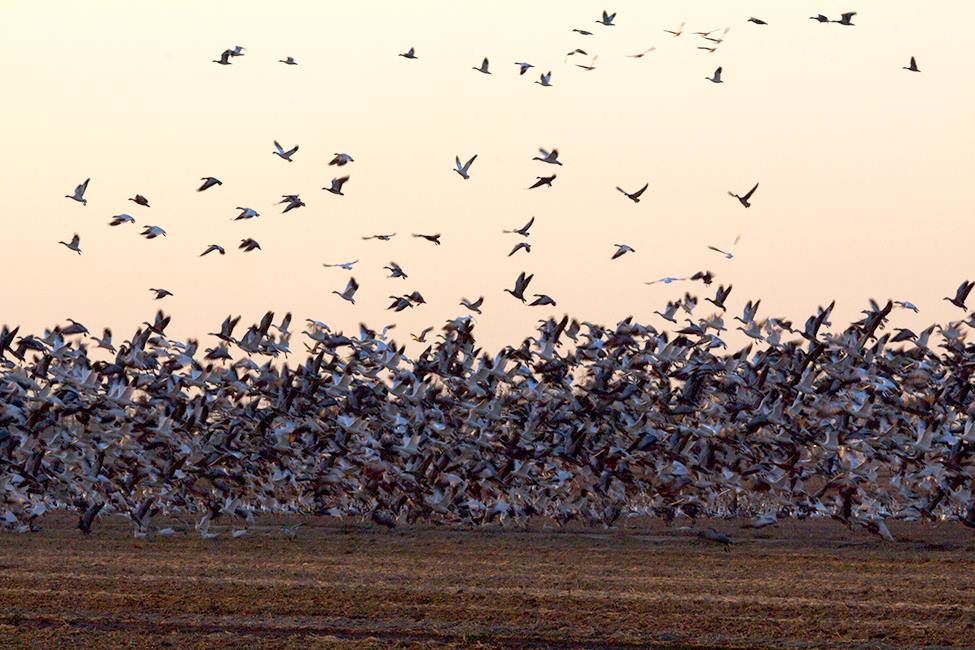
While geese were sometimes seen, ducks were far more common. This has changed over time as has the number of waterfowl seen passing through each year. If you compare the Claypool photo from 1956 and it to these from 2013, you can still see large numbers of waterfowl on the Flyway, just different types.

When I read of “advances” in farming today, I often wonder if we learn from the past. In the early 1900’s waterfowl were much more abundant. Over hunting and habitat destruction reduced populations to dangerous levels. Only through wildlife management and conservation efforts were waterfowl and other wildlife protected and even restored. But then man stepped back on the scene. There were rains and storms that cause short term flooding, so we drained and cleared bayous and woods replacing them with straight ditches. Again, habitat was lost. Habitat that could not be replaced. But even today, the flooding still occurs. Now I read of how farm equipment is so much more “efficient”. There is no “waste”, no residue left behind. But if this is true, what will our waterfowl do for food?

I wonder who the advances and efficiency have benefited. The costs of farming today are unbelievable, so it would seem there has been little gain for farmers. Food prices continue to climb so I don’t see much benefit for the consumer. So, the advances appear to only serve the manufacturers and their investors who care only for the dollar.

I live in a semi-rural area today. Not in the city yet not in a farm community. I wonder how many of those around me appreciate what life hear offers. We share our community with deer, squirrels, and rabbits. In winter we see ducks on our lake, not lifetime residents but those passing through. I’ve even taken photos of wild turkey in my backyard. Yet there are those who complain about wildlife eating their flowers. If it is so bad I want to ask, “Why did you move here? The wildlife was here first. If it is so bad, why do you stay?”  But, perhaps, my thoughts are straying.  

My memories are of enjoying seeing the waterfowl and appreciating their beauty. Mornings in freezing cold duck blinds sharing great time with others. Contributing to conservation groups like Ducks Unlimited or the Rocky Mountain Elk Foundation who protect waterfowl and wildlife for future generations to enjoy. I hope that you have enjoyed similar times and that we humans can learn to share with our wildlife neighbors who were here before us.

Grandpa

He was never Grandfather, or Grandpop, or Gramps, or even Papa. To me, and my many cousins I assume, he was always Grandpa. My paternal grandfather outlived my grandmother by a few years, passing away when I was thirteen years old. He was the only grandfather I had since my maternal grandfather had died before I was born. He had been born in eastern Illinois in the late 1800’s and moved to Arkansas sometime after my father was born in 1908.

As was the case with my grandmother, I don’t remember a great deal about his life. Perhaps this is because almost all the men in our family didn’t talk much about their past. Or, maybe, it was because I was too young to believe that the past was important. The few things I remember are experiences we shared or that I saw him share with others.

My grandfather was a farmhand after he moved to Arkansas. He was not, as far as I know, a sharecropper but simply someone who worked on a local farm for some unknown wage. At that time, the work was hard. There was little mechanization but lots of manual labor. He did this work until he was unable. In my early life, I remember only couple of things. The first was that he worked from early morning until late in the evening – work hours defined by dawn and dusk. When he came home at night my grandmother would have supper ready to eat and then he would often sit on his front porch until time for bed. In the summer, this was often with my father and uncle as they listened to St. Louis Cardinals baseball on the radio. I never remember my grandfather saying a cross word in those days. About the only time I remember him being at home during the day was when the weather prevented farm work. One clear memory I have was sitting on his porch one day as he sharpened his shovel for the next day’s work. I don’t remember what we talked about, if anything, but sitting with him was important to me.

As he became older and no longer worked on the farm I spent a bit more time with him, especially during the summer. I remember walking to the Post Office with him each morning (about a half mile each way) where we waited for the mail to be delivered. Then walking back home where he worked in his garden. The garden was important because it kept him busy and supplemented the family’s food. The garden was small when compared to many but the care it was given could not be compared.

After my grandmother died, his health went downhill. With no one able to provide daily care he moved to a nearby nursing home where many of his friends also lived. My father and I went to visit every two weeks or so as did my uncles who lived nearby. Unfortunately, his time there was short and soon he was laid to rest, by my grandmother’s side and near other family members. He and my grandmother had few of the things that we take for granted these days. They heated their home with an old wood burning stove. A four-room house that was home to their sons, at times very crowded I’m sure. And for many years, on an unpaved street. Still, I believe they were happy and hope they are still together and happy now.

Bart and the Cabin

This is a work of fiction. Names, characters, places, and incidents are either the product of my imagination or are used fictitiously. Any resemblance to actual persons, living or dead, businesses, companies, events or locales is entirely coincidental.

All rights reserved. No part of this story may be used or reproduced in any manner without written permission except in the case of brief quotations embodied in critical articles and reviews.

Though now in his late sixties, young Bart he is still called. He was named for his great-great-grandfather, Bartholomew. Those who have heard tales or seen photos of both say young Bart is the spitting image of the old man. This is definitely true in their love for the cabin. Bart and his wife now share the cabin with his father Bradford who is now nearing one hundred but still loves the place especially each year as the holidays approach.

In early autumn, the preparations for Christmas begin. All the rooms are made ready with a deep cleaning and new linens all around. Followed by the Christmas lights both indoors and out. Then come the wreaths, small artificial trees in many rooms, and other decorations. Food and drinks are purchased, much more each year. Some will be made soon while more can wait for the arrival of family. His wife enjoys the baking of cookies for family and friends, some delivered ahead of the holidays and others carefully stored for the first to arrive for the family celebration. The main tree selected to go in the main room but left uncut until right before Christmas to ensure it is fresh.

While this may seem too early to some. Bart’s work may keep him on the road for some of the time. But he ensures that his calendar is kept open from Thanksgiving ‘til New Years so all can be done. Bart loves the cabin and wants to be sure that it will be ready for all who will join together at least this one time each year. Bart sends reminders to all family members and asks them when they expect to arrive. That way none will feel they are intruding or staying too long.

Christmas cards are prepared and mailed early so none will be missed. Some contain the formal invitations to stay or to visit. And yet it never fails that some arrive unexpected but even so will be welcome with a place of their own.

Bart asks each family member what their children or grandchildren enjoy. And with the list given he selects and purchases some of these and makes sure there is plenty of space for play. The hope is always for a white Christmas so snow can be seen, especially for those coming from warm places afar.

Then comes the day when the first family arrive. Bart goes out with the adults and older children to harvest the tree and move it to the cabin. Decorating may wait a day or two but all who have arrived can help. The little ones add small ornaments to the lower branches while those older climb ladders to decorate the top. And once the tree is almost ready, Bart holds a drawing to see who gets the honor of placing the angel up on the top. Carefully assisted by all to ensure they are safe.

Once all have arrived, Bart takes a moment to rest and look back hoping all has been done right. While each year seems better in so many ways, Bart always thinks more could be done. Until Dad Bradford congratulates his son.

And though not mentioned earlier in this story, Bart’s son Barry looks forward to the day he and his family can move to the cabin. He, too, knows the cabin is where he should be, to carry on the traditions of his ancestors and family. Barry’s children too know the cabin is special for all who come and so the traditions look to go on.

More About the Cabin

This is a work of fiction. Names, characters, places, and incidents are either the product of my imagination or are used fictitiously. Any resemblance to actual persons, living or dead, businesses, companies, events or locales is entirely coincidental.

All rights reserved. No part of this story may be used or reproduced in any manner without written permission except in the case of brief quotations embodied in critical articles and reviews.

As earlier told, the old cabin had been expanded and improved over its life but by the late 1940’s Benjamin decided that it was time for replacement rather than further improvement. He knew some men who, after returning from the war, had started a business to build homes and cabinets around the lakeshore. His ideas were bit strange but fit the location, a new home from logs rather than bricks or stone. And to retain a connection with the past, he wanted to somehow incorporate the old cabin into the new. This could be done with small parts and pieces, but his biggest hope was to retain the original one room shack as part of the new home.

Much to his surprise, the new large cabin was completed in late 1949. Even the old cabin had a place in the home as an office for Ben attached out back. This meant that a family tradition, Christmas at the Cabin, could be held that year. On that day and the evening before the entire family celebrated with feasting and fun. The children, grandchildren, parents, and more gathered together from far and wide. Although members of the family were welcomed all year, Christmas at the Cabin was not to be missed.

Ben knew that his remaining days were not too long, he wanted this tradition to live on and on. So, he visited his attorney and asked what to do. And the lawyer said, “I have an answer for you.” Let’s take the cabin and the surrounding land, put them in a trust with a few small demands. While some of the demands were not very big, two stood out as ways to ensure the traditions would remain. The first, and most important, was that all of Ben’s heirs were expected to visit on Christmas each year. Failing to do so would mean the loss of any claim to all or a portion of the trust and estate. But Ben also recognized that some things might make this impossible some exceptions were added in exceptions to this rule. If family members were serving the country in times of war, they could be excused from the celebration. Similarly, the birth of a child on or near Christmas was a reason for missing as was the death of a close relative of one or their spouse. Ben and the attorney that these rules could be tested for Ben’s remaining life and changed if needed which ever occurred. And these rules remain in place to this day. As do the traditions of the family gatherings.

Each year as the family gathers, other traditions continue as they had in the past.  The gathering starts on Christmas Eve with food and drink served buffet style and no formal meals. In the evening all go to the local church to celebrate with family and friends old and new. Returning to the cabin there are stories and memories from the days past and the evening concludes with a reading of “the night before Christmas” for all to enjoy. The younger children are all put in bed to await Santa’s visit during the night. The older children are allowed to stay up longer with the adults to ensure Santa’s visit goes smoothly and all is in place for early Christmas morning. As the dawn breaks the next day someone is posted close to the stairs so no child awakens early, and no child is late to see what gifts from Santa for them may await. After presents are opened and there is some time for fun, then off to breakfast for everyone. As the day goes on, some start to drift off to homes of their own. Others may stay for a day or two. But they all begin planning for what next year may offer when all gather at the cabin next year. The cabin has changed from Barthlomew’s day but it still remains in the hearts and lives of all.

The Cabin

This is a work of fiction. Names, characters, places, and incidents are either the product of my imagination or are used fictitiously. Any resemblance to actual persons, living or dead, businesses, companies, events or locales is entirely coincidental.

All rights reserved. No part of this story may be used or reproduced in any manner without written permission except in the case of brief quotations embodied in critical articles and reviews.

It was on a lake. A beautiful lake in a northeastern state. Deep in some places, shallow and rocky in others. No one knew how it came to be. Some scientists said it was created by retreating glaciers at the end of the Ice Age. Others said it was created by underground springs and erosion combining to fill the ends of the valley and then subsequent flooding. Others said God created the valleys, the mountains, and the lakes. The lake ran north to south, about nine miles long and no more than two miles wide. The water was cold and usually calm. It was often covered by ice eight or nine months each year. There is a small town at the southern end and cabins were spread along each shore. Depending on your perspective, the cabins are close or far apart. If you judge distance from the line of the crow, each may be only a few hundred yards apart but by road this distance may change to a mile or two. And if travelling by boat the distance may be a bit less or even more. So while you have neighbors, each cabin can be a place solitude, privacy, or celebration with others.

One of these cabins is the heart of our story. A cabin that dated from the early 1800’s. Originally built by a person unknown, it was no more than a one room log shack with a sleeping loft. In the 1820’s the cabin and the surrounding land were purchased by Bart’s great-great-grandfather, Bartholomew, a bachelor from a nearby large city. He used it only for fishing in the summer, hunting in the autumn, and an occasional visit at other times of the year. After his marriage, visits to the cabin became fewer although he tried to bring his son, Bradford, at least once each year.

Bradford inherited the cabin around 1870 and made a few improvements hoping to make it move comfortable for his future family.  While visits were not often, it became a place to call their second home. A kitchen and bedroom had been added and a well installed along with a shed to store a small sleigh and a rowboat. Bradford married a local girl around 1880. Their son, Barkley, loved the cabin. He swore that he would one day call it his home and would never leave the cabin by the lake.

True to his word, Barkley found work in a small town growing at the southern shore of the lake. After a few years, he was able to purchase a small general store and later became postmaster for the town and the cabins around the lake. This wasn’t that difficult thing since the town still had few residents and most of the cabins were occupied only a few days each year. But not Barkley’s cabin which became the family home. But like the small town, the cabin expanded. Electric service was added along with indoor plumbing, something seen in only a few local homes and cabins. With each new child, a room was added. The two oldest children were very attractive young girls. While they loved their family and the cabin by the lake, they would marry young men and someday move away.

But the third child, Benjamin, much like his father, loved the cabin and its place by the lake. It suited quite well his ambitions as a writer and photographer. He wrote books about life growing up by the lake and took great photos of families and friends. As his work expanded, he incorporated both into books about the local scenery with pictures and more. He became very successful but still helped with his father’ store. A marriage came early, and his family grew with three strong sons and daughters two. But times had changed, and the cabin grew old. It no longer met the family needs. So, with some regret Ben decided that a new cabin was needed where his family could live. But the location would not change. This was the new family home. Logs were retained and often reused, and a new home arose where the old home had been. It was a great change from the original cabin, but the old shack remained, attached as a room in back. Most of the children are now grown and gone. But young Bart, named for his great-great-grandfather, remains in the home. Like his ancestors before him he has pledged to make the cabin, much as it has changed, a home for his family from this day on.

Future posts will look at life at the cabin and what it means to family and friends.

The Path Not Chosen

I will admit it – no denial. Today’s post is a rant! I look around and see things that worry me. I care about our country, our people, and, yes, about myself and my loved ones. I see a divided country and media stars and celebrities who benefit by encouraging this divisiveness. I would like to change this and maybe this post can help. You don’t need to agree, but try to give it some thought.  

I’m not sure this is true for everyone, but as I have become older, I look back at decisions I have made in the past and wonder how things might have changed had I taken a different path. Some of these choices were made in my youth and some as an adult. Yet choices, whenever made, always have an impact because there are always multiple options with multiple results.

I say that some choices were made in my youth and when I look back at those, I think that perhaps I should not have needed to make an important choice. Our childhood, and even our teens, should be a time for learning and even experimenting. We should not need to make choices or decisions that cannot be reversed as we age. At the same time, we should have this time to try different ideas and learn from the results. Unfortunately, it seems that today’s youth, even those in their very early years, are expected to make choices with no opportunity to change as they age. And we, the supposed adults, continue to push our children to make important choices at earlier ages. Have we taken away childhood in our efforts to control the future? And are our children forced into choices not based on their thoughts or beliefs but instead imitating those of their parents?

Things have changed, for both better and worse, since my youth. Those of my generation faced war in Viet Nam, the increasing prevalence of drugs, changes in culture as power moved from WW II veterans to the Baby Boomers. Those who believed like their parents were often ridiculed while the counterculture did not offer a strong strategy for the future. We faced the draft and associated choices to avoid the risks associated with war. We demanded, and were given, an earlier voting age. Yet we were not willing to take out choices seriously. Still our country survived and moved forward. Can we say this today? Or is the divisiveness we face today our fate? No one can say for sure, but we probably cannot go back to the past.

Our youth of today, and even those who are a bit older, no longer have the need to think. They can get all the information they need from their electronic devices, from unreliable sources, and from political pundits and media stars who are more interested in an attention-grabbing sound bite than the truth. People with multimillion contracts and eighth grade educations who claim to be “working class Americans”. People who, over a month after the recent elections, are still whining at every opportunity and suggesting they know more than the majority of American voters. And politicians who refuse to accept any blame for their losses and not recognize that their candidate had never received a single vote before the election.

For our future, when us old folks are no longer around, one must hope that the path chosen is the best. That it is chosen carefully, not because someone told us it was “cool” or “woke” or “progressive”. And not because it was “the way we have always done things” or because it is “convenient” or driven by “politics” or “money”. We can’t all be rich or superstars or have those million-dollar contracts. Nor can we all be losers. There should be a balance. And there should be opportunities. Let’s not force decisions on our successors but instead let’s teach them how to make good decisions. And then, let them make those decisions. We have been successful doing this in the past and can do so in the future.

Hopes and Fears for Christmas Yet to Come

As I lay in bed this morning, wide awake far to early, I was visited not be the ghost of Jacob Marley nor of one of Dickens’ spirits but instead by one of our cats. Usually, he lies beside me in the bed, my wife says from love while I say to keep warm. In this case, I was snuggled next to my wife and he decided to lay on top of me and stare at the two of us. Could he be jealous or can cats even have such human feelings. After a short time, he left to do other more important things like using his litter box, having a drink, and making sure his food bowl was empty. One wonders what goes on in the mind of a small, furry creature like this and why they can become such an important part of our lives.

As you my have noticed, I again borrowed a part of the name of a Dickens’ spirit again today. I thought this appropriate since Dickens inspired both this and the previous two posts. When I think about Christmas, I feel the need to look at it not just from the way it is today, or even when I was a child or when Dickens published “A Christmas Carol” just over two hundred years ago, but also what Christmas in the future. The present and the past seem easy to consider but the days yet to come present a much greater challenge. There are hopes for things good and fears of things that may be bad. While I may be here for part of the future, it goes far beyond that time and many changes can and will occur.

When we think about the meaning of Christmas, we must recognize that it is a religious holiday. While it serves the Christian faith, does not have the same meaning to others who also have religious or cultural observances like Hannukah and Kwanza. Yet even these others, even those who profess no faith, often celebrate Christmas with us.

Family – As families and friends, Christmas has served draw us together and make us closer. A time of celebration and a time to put differences aside. Yet today, there are those – editors, opinion columnists, broadcast media, celebrities, and others – who would like to use Christmas as a time to drive wedges between us. They do this not for the benefit of anyone other than themselves; to create an elite class which uses others only to serve them and comply with the views and beliefs. If we allow these “elite” to succeed, then the need for the familial unit will disappear. As suggested by some of these “elites” we should cancel holidays because they allow or even encourage sharing amongst those with differing views. This is a great fear for me.

At the same time, I have great hope for Christmas Yet to Come. Why do I say this? It is very simple. If one looks at history, something seemingly unimportant today, efforts to drive wedges between people, friends and families, have occurred many times in the past. Often these efforts have led to battles and wars. No one should say that war is good, but at the end of war, or even the end of arguments, we humans seem to be able to put aside our differences and the world moves forward. This can even be seen in the lives of the very young where schoolyard arguments seem so important but are often forgotten within a few minutes. So, hope should exist. Those who attempt to drive wedges, as an “elite” or with their support, should be shunned and pushed aside. Let us have hope for the days yet to come.

Santa and His Helpers – Santa and his helpers are, perhaps, a fantasy. They exist in the world of children. Children who should not, at an early age, need to be faced with all the challenges of adults. While Santa’s origins may be clouded in mystery but there seems to be at least two common threads. First, is the celebration of Saint Nicholas. This is a day celebrated more in Europe than elsewhere which honors the work of St. Nicholas. If one reads more about this day, one can find things that have resulted in our Santa of today. The giving and the sharing, the need to be good, and even Santa’s name. Second is a poem published anonymously in 1823 titled “A Visit from St. Nicholas”. This poem, later attributed to Clement Clarke Moore, is what we now refer to as “The Night Before Christmas”. It provided us with the little old man, so lively and quick, along with the description of his mode of transport (the sleigh), and the names of his eight tiny reindeer. Santa still deserves a place in our lives today and should be there for times yet to come. This is hope. The fear is that the “book banners” and the “realists” will eliminate fantasy from the world, much as they have eliminated parts of history that are “inconvenient” or might “insult” those who have differing views. This is the fear.

Trees – I really have no understanding of how or why the tree has become an important part of Christmas. I can only hope that it remains important in the future. I recognize, however, that the tree faces much controversy. The biggest threat to the Christmas tree is the survival of families and friendship. If these things do not survive, then the need for a Christmas tree will no longer exist. Such as loss would be devastating. The second threat to the Christmas tree is a more subtle change to society. As we move toward environmental awareness, we face challenges in how we retain tradition. On a small scale, almost insignificant in my view, the use of Christmas trees threatens our environment. To use live trees, we take away their ability to provide the benefits of trees left to grow. If we use artificial trees, we waste resources in their creation and create trash to be dealt with when the trees are no longer needed.

The Christmas tree really presents both hope and fear. Hopefully, we as humans can face and resolve the need to balance this challenge.

Gifts or Presents – Much like Christmas trees, gifts and presents in the times yet to come present challenges. Sometimes I think that my generation has failed our children. We did not create the world, but we seem to have changed it in a way that has caused irreversible problems. How did we do this? We created the world of entitlement. A world where there were no winners or losers, ignoring the fact that to have a winner you must also have a loser. A world where a person deserves something simply because another has it. A world where can live in a castle, travel without financial cares, and be unlimited in their desires. Such a world seems wonderful, almost Eden-like. But is it realistic?

This has led to a world where the value of a gift is no longer judged by the love or caring it represents but instead by the cost. I am realistic enough to recognize that we cannot return to the time that a gift of a few pieces of candy was treasured as much as one of a pricy toy. At the same time, I hope that we can return to a time where it is recognized that we cannot always have what we want. If this means that gifts are a fear, so be it.

Trains – I suspect that the time of trains at Christmas has come and gone. Much of the romanticism of trains which was common in my youth no longer exists. My hope here is that our future can replace the trains of the past with something as valuable to our future. While it may seem strange, as someone who worked for many years in the technology field, I do not believe our electronics can fill this role. My hope is that we can replace trains with something which contributes to the days yet to come. Perhaps a replacement might be to plant a sapling and helping it grow or sharing our heritage and emphasizing the positive rather than concentrating on things gone wrong. There is hope but there is also the fear that the time and opportunity for this to happen has passed us by.

Parades – There will always be a place in my heart for parades. Much like Santa, they provide us a moment of fantasy. Could the things on that float ever become real? Could I ever play music like that band? What other fantasies do parades offer others?

In my childhood, I could not imagine a time where there were no parades. Yet today and in the future, parades face many challenges – cost, time, convenience, safety, the list goes on. Parades are not limited to Christmas time. I recently read where a large city was cancelling there Fourth of July parade next year; a parade that has been held in one form or another since the late 1800’s. Will the same fate await the Christmas parade. I hope not, but I fear so. Not because of the reasons above but instead because of political correctness. Because of things that may have happened over 200 years ago and not even in this city It is a shame. Something that will probably never be returned if it is lost.

Snow – Snow is the one thing that we cannot control. My hope is that climate change will never stop the snow. I hope we can always wish for a white Christmas. I fear that here, the environmentalists may be right. Let us hope not.

As I end this short series of posts, I want to thank Charles Dickens for his inspiration. I thank Ebenezer Scrooge, at least after his enlightenment, and Jacob Marley. I thank Dickens’ spirits. And I thank my wife and those around me. I thank our two cats, whether they are trying to show their independence or their love. I hope that you, too, will think about your Christmases – past, present, and yet to come. And, I hope that they will be merry both now and in the future.