Can You Train a Cat?

As I sit here on this New Year’s Eve morning watching our cats play with their Christmas toys, I couldn’t help wondering it you can ever really train a cat. While training a dog seems relatively easy, our cats no matter their age seem much more independent. It seems rather than allowing us to train them, they are far more likely to train us to meet their needs and fit their personalities.
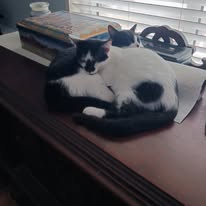
When I visit other sites across the web, I often see links to humorous pages. They often say in a joking manner that this is the cat’s home where they allow us to stay and others to visit. This, at first, draws a laugh but when you really think it may be true.

A dog may learn its name and come when called. A cat, on the other hand, may learn its name as well but will respond when it wants and more often at not simply ignore us or turn away. A dog can be taught to sleep in its bed, yet a cat may more often give us a few inches in our bed or even use us as a bed. If given a new toy a cat may play with it for a few minutes and then hide it for later but just like a human forget where it was hidden. Our cats decide when we should sleep and when we should arise, even at 4:00 AM although we would sleep until seven if given the choice.

It seems that no matter how hard I try to teach otherwise, my cats seem to think that my keyboard is a good resting place. And a small spinning screen icon while a program tries to load is to be stared at and swatted and blocked from view.

So maybe our cats are probably smarter than me. They almost have me trained now but there is still much to be learned. I need to understand if they can see even a small part of the bottom of their bowl then the bowl is empty. And their litter box must be emptied every time that they go. And I only get a small space on the bed trapped between them and the floor.

But even with all this, we love our cats and would be sad if they were not here. So, no matter who trains who, our cats are an important part of our lives. We hope that we make them content to be with us and never want to leave.

And I still wonder, “Can you train a cat?”.

On this New Year’s Eve, I hope that everyone has a wonderful evening. If you are driving, stay safe. And starting tomorrow have a very happy 2025.

Grandpa

He was never Grandfather, or Grandpop, or Gramps, or even Papa. To me, and my many cousins I assume, he was always Grandpa. My paternal grandfather outlived my grandmother by a few years, passing away when I was thirteen years old. He was the only grandfather I had since my maternal grandfather had died before I was born. He had been born in eastern Illinois in the late 1800’s and moved to Arkansas sometime after my father was born in 1908.

As was the case with my grandmother, I don’t remember a great deal about his life. Perhaps this is because almost all the men in our family didn’t talk much about their past. Or, maybe, it was because I was too young to believe that the past was important. The few things I remember are experiences we shared or that I saw him share with others.

My grandfather was a farmhand after he moved to Arkansas. He was not, as far as I know, a sharecropper but simply someone who worked on a local farm for some unknown wage. At that time, the work was hard. There was little mechanization but lots of manual labor. He did this work until he was unable. In my early life, I remember only couple of things. The first was that he worked from early morning until late in the evening – work hours defined by dawn and dusk. When he came home at night my grandmother would have supper ready to eat and then he would often sit on his front porch until time for bed. In the summer, this was often with my father and uncle as they listened to St. Louis Cardinals baseball on the radio. I never remember my grandfather saying a cross word in those days. About the only time I remember him being at home during the day was when the weather prevented farm work. One clear memory I have was sitting on his porch one day as he sharpened his shovel for the next day’s work. I don’t remember what we talked about, if anything, but sitting with him was important to me.

As he became older and no longer worked on the farm I spent a bit more time with him, especially during the summer. I remember walking to the Post Office with him each morning (about a half mile each way) where we waited for the mail to be delivered. Then walking back home where he worked in his garden. The garden was important because it kept him busy and supplemented the family’s food. The garden was small when compared to many but the care it was given could not be compared.

After my grandmother died, his health went downhill. With no one able to provide daily care he moved to a nearby nursing home where many of his friends also lived. My father and I went to visit every two weeks or so as did my uncles who lived nearby. Unfortunately, his time there was short and soon he was laid to rest, by my grandmother’s side and near other family members. He and my grandmother had few of the things that we take for granted these days. They heated their home with an old wood burning stove. A four-room house that was home to their sons, at times very crowded I’m sure. And for many years, on an unpaved street. Still, I believe they were happy and hope they are still together and happy now.

Donuts or Doughnuts, if you prefer

When we hear about doughnuts today most of us probably think of the sweet treats sold at stores like Dunkin’ D, or maybe DD, or even at our local grocery in the bakery section. They are sold singly, or by the dozen, with so many toppings you often feel that you often have more frostings or stuffings than you have actual doughnut. Many only have them with coffee or hot tea.

But these are not the donuts that I’m talking about. My donuts are those made on occasion by my late paternal grandmother many years ago. My grandmother, Martha Jane Truitt Fryman, passed away in 1962 when I was ten years old. We lived next door to my grandfather and her for about seven or eight of my young years and she babysat for me when my parents weren’t home. Even so, my memories of her are quite few.

Two of the fondest and most clear were that if I wasn’t a good boy (fat chance) she would get out her black belt and use it on me and the donuts she made a few times each year. She never needed that black belt. In truth I never saw it as often as I searched. The threat was enough to keep me in line.

But the donuts were different, and I loved them each time. Even though I was young and had no interest in cooking or being in the kitchen, when donuts were fixed, I watched and waited intently. Even today, I often wonder if the method has been lost to our demand for convenience and sweetness.

The recipe was simple. One opened a can of simple biscuits from the local store. Each biscuit was stretched in to bit larger circle and then the thumb or a finger was used to make a hole in the center. They were then deep-fried in a large pot of hot lard (never cooking oil or butter) until they were browned. Then the browned donuts were dropped in a brown, paper grocery sack which held a mixture of sugar and cinnamon, the only coating ever used. The sack was shaken quite well giving the donut a slightly sweet coating, all that was needed. The finished donuts were then placed on a plate to cool.

For me as a child the cooling took far too long, but the one donut treat I received was always a great reward for the wait. I always remember that the fresh donuts never came often enough but the memory of them sounds great even today.

Why she made these donuts, so good, I never knew. I suspect they were for my grandfather to have with his lunch when working on the nearby rice farms. I’m sure they were much appreciated in those days when farm work was largely manual, not mechanized, and summer temperatures were high.

I wish that I could have told my grandmother how much these donuts meant to me, how hard it was to wait for the next batch, and how I remember them so many days later. Perhaps she can look down on me from her final home and see this short memory of things so simple yet so wonderful.

Christmas at the Cabin

This is a work of fiction. Names, characters, places, and incidents are either the product of my imagination or are used fictitiously. Any resemblance to actual persons, living or dead, businesses, companies, events or locales is entirely coincidental.

All rights reserved. No part of this story may be used or reproduced in any manner without written permission except in the case of brief quotations embodied in critical articles and reviews.

Even as Christmas Eve ran late, Christmas morning started very early. The first three awake that morning were Ben, Bart, and Barry. Their role was quite simple and required little work, yet it played an important role in the day. First up was starting a nice pot or two of coffee along with getting hot ready for tea drinking family. Then they moved to strategic places to protect the gifts and the trees so no early risers could spoil the fun.

Following them soon were several of the ladies for last minute preparations of the buffet food and ensuring things were in place for the younger diners. It was always a difficult decision to know which should come first, breakfast or gifts.

But by around seven, the excitement became too great, and the children started wandering down toward the tree. Ben, Bart, and Barry had their hands full – making all wait for that wonderous moment when surprises and gifts were shared and opened by all. No visions of sugar plums were too be found. Instead, eyes were filled with delight and expectation of what awaited. While parents oft’ wanted the children to have breakfast first seldom could the wonderful aromas compare to the beautiful ribbons and bows.

Once all were awake, they were allowed into the room where the tree could be found. By tradition, the first gift was to Ben. Once it had been opened Bart and Barry had a new role – to distribute the gifts for all to open. This seemed so simple, but it really wasn’t. Care was taken to ensure that everyone received at least one gift before anyone received a second.

When gifts were opened the thoughts of breakfast disappeared. Instead, there was playing with toys and games, comparing new clothes, and many other things. The adults started taking advantage of the buffet and Christmas movies started to play. Friends and neighbors might stop for a visit while others might only share a phone call.

Sometimes the early risers might take a short nap and other family members might visit a neighbor to renew old acquaintances and make new ones. While a white Christmas had been a thing of hope, others wished they could get out in a boat. Adults planned future visits, always welcome. And they worried about who might not be there. While it was always a bit sad, some had to leave early and could not stay.

And at the end of the day, those staying a bit longer helped Bart and his family clean up the house for the next visit. Photos had been taken and soon would be shared. A good time by all so seldom together.

So as these posts about the old cabin may end. They have been shared to say Merry Christmas my friends. May your new year be bright, your wishes come true, and may you have some traditions that you can share, too.

Skipping Christmas

As I was scrolling through posts on Facebook a few minutes ago I saw a post from author, John Grisham. It was about a book he had originally published in 2010 titled “Skipping Christmas”. I suspect I read the book at that time since I was an early fan of Grisham’s work although I no longer have a copy. The book was not politically focused nor was it even published in the year of a presidential election. Instead, it was about a family that decided to skip Christmas and take a cruise instead. They found that skipping Christmas was much easier said than done.

Unfortunately, since 2010 things have changed greatly in our country. I wish I could say this was for the better but I’m do not think this is true. I find it unbelievable that here we are, almost two months after the election and celebrities and so-called media experts continue to pound us with how the country is doomed and the majority of American’s are stupid (along with multiple other insults) because of the person who was elected.

Even today, I read an opinion article on the front page of USA Today’s online edition where the writer stated he still believed in Santa Claus. While the title seemed positive, even there he could not put aside political opinions although he claimed he was doing so. I, too, believe in Santa Claus or at least the spirit of Christmas, whether Santa Claus, St. Nicholas, or any of the others recognized at this time of year.

A few weeks ago I asked on line if for the holiday season we could put our differences aside and try to unite as a country. I guess that is too much to ask of the self-appointed experts with access to the media. But one can always hope. So instead, I ask again that instead of skipping or cancelling Christmas can we put aside our differences and try to act like the “United States” for just one day – tomorrow, Christmas Day.

And to do my part, I want to wish everyone, even those celebrities and media experts, a very Merry Christmas (or whatever holiday you celebrate) and a Happy New Year.

Bart and the Cabin

This is a work of fiction. Names, characters, places, and incidents are either the product of my imagination or are used fictitiously. Any resemblance to actual persons, living or dead, businesses, companies, events or locales is entirely coincidental.

All rights reserved. No part of this story may be used or reproduced in any manner without written permission except in the case of brief quotations embodied in critical articles and reviews.

Though now in his late sixties, young Bart he is still called. He was named for his great-great-grandfather, Bartholomew. Those who have heard tales or seen photos of both say young Bart is the spitting image of the old man. This is definitely true in their love for the cabin. Bart and his wife now share the cabin with his father Bradford who is now nearing one hundred but still loves the place especially each year as the holidays approach.

In early autumn, the preparations for Christmas begin. All the rooms are made ready with a deep cleaning and new linens all around. Followed by the Christmas lights both indoors and out. Then come the wreaths, small artificial trees in many rooms, and other decorations. Food and drinks are purchased, much more each year. Some will be made soon while more can wait for the arrival of family. His wife enjoys the baking of cookies for family and friends, some delivered ahead of the holidays and others carefully stored for the first to arrive for the family celebration. The main tree selected to go in the main room but left uncut until right before Christmas to ensure it is fresh.

While this may seem too early to some. Bart’s work may keep him on the road for some of the time. But he ensures that his calendar is kept open from Thanksgiving ‘til New Years so all can be done. Bart loves the cabin and wants to be sure that it will be ready for all who will join together at least this one time each year. Bart sends reminders to all family members and asks them when they expect to arrive. That way none will feel they are intruding or staying too long.

Christmas cards are prepared and mailed early so none will be missed. Some contain the formal invitations to stay or to visit. And yet it never fails that some arrive unexpected but even so will be welcome with a place of their own.

Bart asks each family member what their children or grandchildren enjoy. And with the list given he selects and purchases some of these and makes sure there is plenty of space for play. The hope is always for a white Christmas so snow can be seen, especially for those coming from warm places afar.

Then comes the day when the first family arrive. Bart goes out with the adults and older children to harvest the tree and move it to the cabin. Decorating may wait a day or two but all who have arrived can help. The little ones add small ornaments to the lower branches while those older climb ladders to decorate the top. And once the tree is almost ready, Bart holds a drawing to see who gets the honor of placing the angel up on the top. Carefully assisted by all to ensure they are safe.

Once all have arrived, Bart takes a moment to rest and look back hoping all has been done right. While each year seems better in so many ways, Bart always thinks more could be done. Until Dad Bradford congratulates his son.

And though not mentioned earlier in this story, Bart’s son Barry looks forward to the day he and his family can move to the cabin. He, too, knows the cabin is where he should be, to carry on the traditions of his ancestors and family. Barry’s children too know the cabin is special for all who come and so the traditions look to go on.

More About the Cabin

This is a work of fiction. Names, characters, places, and incidents are either the product of my imagination or are used fictitiously. Any resemblance to actual persons, living or dead, businesses, companies, events or locales is entirely coincidental.

All rights reserved. No part of this story may be used or reproduced in any manner without written permission except in the case of brief quotations embodied in critical articles and reviews.

As earlier told, the old cabin had been expanded and improved over its life but by the late 1940’s Benjamin decided that it was time for replacement rather than further improvement. He knew some men who, after returning from the war, had started a business to build homes and cabinets around the lakeshore. His ideas were bit strange but fit the location, a new home from logs rather than bricks or stone. And to retain a connection with the past, he wanted to somehow incorporate the old cabin into the new. This could be done with small parts and pieces, but his biggest hope was to retain the original one room shack as part of the new home.

Much to his surprise, the new large cabin was completed in late 1949. Even the old cabin had a place in the home as an office for Ben attached out back. This meant that a family tradition, Christmas at the Cabin, could be held that year. On that day and the evening before the entire family celebrated with feasting and fun. The children, grandchildren, parents, and more gathered together from far and wide. Although members of the family were welcomed all year, Christmas at the Cabin was not to be missed.

Ben knew that his remaining days were not too long, he wanted this tradition to live on and on. So, he visited his attorney and asked what to do. And the lawyer said, “I have an answer for you.” Let’s take the cabin and the surrounding land, put them in a trust with a few small demands. While some of the demands were not very big, two stood out as ways to ensure the traditions would remain. The first, and most important, was that all of Ben’s heirs were expected to visit on Christmas each year. Failing to do so would mean the loss of any claim to all or a portion of the trust and estate. But Ben also recognized that some things might make this impossible some exceptions were added in exceptions to this rule. If family members were serving the country in times of war, they could be excused from the celebration. Similarly, the birth of a child on or near Christmas was a reason for missing as was the death of a close relative of one or their spouse. Ben and the attorney that these rules could be tested for Ben’s remaining life and changed if needed which ever occurred. And these rules remain in place to this day. As do the traditions of the family gatherings.

Each year as the family gathers, other traditions continue as they had in the past.  The gathering starts on Christmas Eve with food and drink served buffet style and no formal meals. In the evening all go to the local church to celebrate with family and friends old and new. Returning to the cabin there are stories and memories from the days past and the evening concludes with a reading of “the night before Christmas” for all to enjoy. The younger children are all put in bed to await Santa’s visit during the night. The older children are allowed to stay up longer with the adults to ensure Santa’s visit goes smoothly and all is in place for early Christmas morning. As the dawn breaks the next day someone is posted close to the stairs so no child awakens early, and no child is late to see what gifts from Santa for them may await. After presents are opened and there is some time for fun, then off to breakfast for everyone. As the day goes on, some start to drift off to homes of their own. Others may stay for a day or two. But they all begin planning for what next year may offer when all gather at the cabin next year. The cabin has changed from Barthlomew’s day but it still remains in the hearts and lives of all.

The Cabin

This is a work of fiction. Names, characters, places, and incidents are either the product of my imagination or are used fictitiously. Any resemblance to actual persons, living or dead, businesses, companies, events or locales is entirely coincidental.

All rights reserved. No part of this story may be used or reproduced in any manner without written permission except in the case of brief quotations embodied in critical articles and reviews.

It was on a lake. A beautiful lake in a northeastern state. Deep in some places, shallow and rocky in others. No one knew how it came to be. Some scientists said it was created by retreating glaciers at the end of the Ice Age. Others said it was created by underground springs and erosion combining to fill the ends of the valley and then subsequent flooding. Others said God created the valleys, the mountains, and the lakes. The lake ran north to south, about nine miles long and no more than two miles wide. The water was cold and usually calm. It was often covered by ice eight or nine months each year. There is a small town at the southern end and cabins were spread along each shore. Depending on your perspective, the cabins are close or far apart. If you judge distance from the line of the crow, each may be only a few hundred yards apart but by road this distance may change to a mile or two. And if travelling by boat the distance may be a bit less or even more. So while you have neighbors, each cabin can be a place solitude, privacy, or celebration with others.

One of these cabins is the heart of our story. A cabin that dated from the early 1800’s. Originally built by a person unknown, it was no more than a one room log shack with a sleeping loft. In the 1820’s the cabin and the surrounding land were purchased by Bart’s great-great-grandfather, Bartholomew, a bachelor from a nearby large city. He used it only for fishing in the summer, hunting in the autumn, and an occasional visit at other times of the year. After his marriage, visits to the cabin became fewer although he tried to bring his son, Bradford, at least once each year.

Bradford inherited the cabin around 1870 and made a few improvements hoping to make it move comfortable for his future family.  While visits were not often, it became a place to call their second home. A kitchen and bedroom had been added and a well installed along with a shed to store a small sleigh and a rowboat. Bradford married a local girl around 1880. Their son, Barkley, loved the cabin. He swore that he would one day call it his home and would never leave the cabin by the lake.

True to his word, Barkley found work in a small town growing at the southern shore of the lake. After a few years, he was able to purchase a small general store and later became postmaster for the town and the cabins around the lake. This wasn’t that difficult thing since the town still had few residents and most of the cabins were occupied only a few days each year. But not Barkley’s cabin which became the family home. But like the small town, the cabin expanded. Electric service was added along with indoor plumbing, something seen in only a few local homes and cabins. With each new child, a room was added. The two oldest children were very attractive young girls. While they loved their family and the cabin by the lake, they would marry young men and someday move away.

But the third child, Benjamin, much like his father, loved the cabin and its place by the lake. It suited quite well his ambitions as a writer and photographer. He wrote books about life growing up by the lake and took great photos of families and friends. As his work expanded, he incorporated both into books about the local scenery with pictures and more. He became very successful but still helped with his father’ store. A marriage came early, and his family grew with three strong sons and daughters two. But times had changed, and the cabin grew old. It no longer met the family needs. So, with some regret Ben decided that a new cabin was needed where his family could live. But the location would not change. This was the new family home. Logs were retained and often reused, and a new home arose where the old home had been. It was a great change from the original cabin, but the old shack remained, attached as a room in back. Most of the children are now grown and gone. But young Bart, named for his great-great-grandfather, remains in the home. Like his ancestors before him he has pledged to make the cabin, much as it has changed, a home for his family from this day on.

Future posts will look at life at the cabin and what it means to family and friends.

“The Evening Before Christmas”

This is a work of fiction reflecting my thoughts and opinions. All rights are reserved. It was inspired by the work of Clement Clarke Moore (or perhaps that of Henry Livingston, Jr.) and his “A Visit from St. Nicholas”. I salute him for the long-lasting impact of his work which is as important today as when it was originally published anonymously in 1823. There have been many changes since that time and will be many more in the days to come. Please read and enjoy.

‘Twas the evening ‘fore Christmas at Mom and Pop’s home,

None were about to jump, play, or roam,

The dog and the cats all snuggled in bed,

So much earlier cuddled, watered and fed,

The children all gone with lives of their own,

Even the grandchildren all older and grown,

Mom and Pop in the bedroom looking out at the tree,

While watching holiday movies playing on the tv,

Slowly sipping some wine and enjoying a snack,

They wondered if time could ever go back,

Thinking of holidays long, long ago,

When family gathered wishing for Christmas with a cover of snow,

Children dreamed of dolls, games, and toys,

And having much fun with other girls and boys,

But days and years have passed by so fast,

That it may be too hard to regain the past,

Families are scattered so far and wide,

Do we no longer want to be side by side?

Texting is easy but can we still talk?

And computers are good, but I’d like to go for a walk,

While with my words you may not agree,

My fond hope is that your holidays are happy!

“My Three Dogs, Love will find a way home” By W. Bruce Cameron (A Book Review)

If you are an animal lover, no matter what type, this is a book that will find a way into your heart. It is extremely difficult to assign a genre – it could be an adventure, a pet story, a love story, or any of several other types. It could even be reclassified from a novel to a non-fiction book with a few minor changes and a disclaimer or two. After much thought, I think it best falls into the realm of a love story or, actually, several love stories in one.

There are many types of love included, sometimes only briefly while others throughout the book. There is brotherly love. There is also the more common love between a man and a woman. We see love between people and animals. And we see love between the animal members of the pack as well as the human members. There is also love from Teme at the animal shelter, Georgia, a police officer, and Ron, a man who seems to love and feed homeless dogs on the street. Each of type of love is faced with challenges. Can love survive or will the challenges be too great?

The story focuses on the dog pack of Riggs, Luna, and the newest member, Archie along with their human pack members, Liam and Sabrina. While Liam and Sabrina seem to be in love, their relationship is challenged because Liam seems to sometimes forget to include Sabrina in life changing decisions. As a result, Sabrina decides to take a break, move in with her sister and decide if their relationship can continue. When she moves, she must leave the dogs with Liam because her sister is a “cat person”.

Liam is unhappy but struggles to keep going and take care of the dogs. This works well until an unfortunate accident makes it impossible for Liam to continue. Brad, Liam’s brother, steps in to help which he has done since they were both teens and lost their parents. Since Brad does not like Sabrina, his only solution is to take the dogs to an animal shelter, not a no-kill shelter. The ideal solution would be for all to have a new home together, but this does not happen.

The book follows the adoption of all three dogs and the efforts of Riggs to bring the pack, both animal and human, back together. Along the way Riggs and the other dogs meet new friends, and enemies.

Read the book to find the answers. But be prepared to shed a few tears along the way and question whether we, the two-legged members of many packs, have done the best we can for our non-human family members. Have we earned the unconditional love that they give us and do we do all we can to protect them, especially if something unexpected happens?