On Monday I saw a photo online of an old barracks building on the grounds of Fort Chafee, Arkansas. This building, like others on military bases across the country, was erected before or after the beginning of World War II. These barracks (like the one behind my father in this photo) 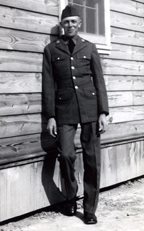 provided housing for soldiers during their initial training and before they were deployed throughout Europe and the Pacific. Later they would serve the same purpose during the Korean and Viet Nam conflicts and even in peacetime.
A typical barracks had two floors and could accommodate about 40 soldiers on each floor. Privacy was non-existent. The soldiers were provided a bunk and a locker, typically a footlocker, for their possessions. The buildings were erected quickly with limited insulation, minimal heating or cooling, and either wood or asbestos floors.
Along with the barracks buildings, a number of single-story support buildings were erected. These buildings might house hospitals, mess halls, supply rooms, or other administrative operations.
Most were built in the early 1940’s and were designated as “temporary buildings”, a term never clearly defined but thought by many to mean until the end of the war. Many of these buildings not only survived but were in use in the 1970’s or 1980’s, and even rarely into the 1990’s on some military posts. They were not luxurious by any stretch of the imagination. They were utilitarian – designed to house and train our military. Civilians arrived here by train, bus, and automobile. A few weeks later trained soldiers, sailors, and marines departed. For most, these were the best places they would live until the end of their service. Many of the thousands who passed through would never return to our country. These temporary structures were also used for housing immigrants after the Viet Nam War and, unfortunately, as internment camps housing people because of their place of birth or names. I, personally, lived in one of these temporary buildings at Camp Forsyth, Fort Riley, Kansas, in 1973. Our mess hall was also in one of the single-story buildings.
In 1974, many of these buildings were still in use for housing soldiers during basic and advanced training after enlistment. Some of the administrative buildings are shown in this photo from Fort Polk, Louisiana in 1974. 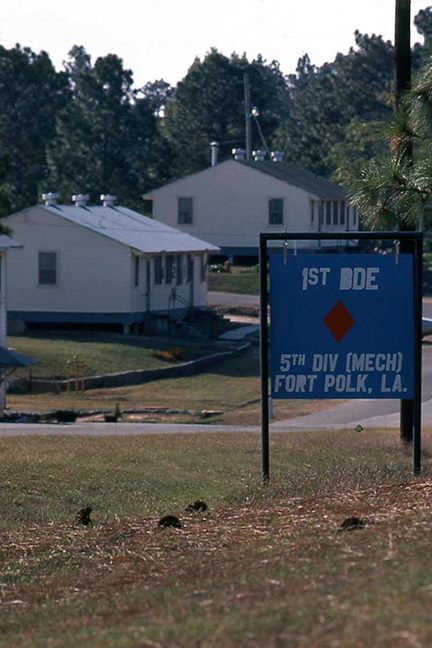 Many of these buildings and barracks on South Post were torn down and replaced with new, “permanent” buildings in the mid-1970’s as the 5th Infantry Division (Mechanized) was activated. At the same time, many of “temporary” buildings on North Post were retained for training of new soldiers. Similar things occurred at forts and bases across the country.
In some locations, forts and bases were turned over to the National Guard to meet training and other needs. This happened at Fort Chafee, Camp Shelby, Mississippi, and Fort McCoy, Wisconsin, among many others. In some cases, the “temporary” buildings were demolished, in others sold, and sometimes abandoned. Some may still exist today.
When I think about these “temporary” buildings today, I wonder if those who were involved in erecting them ever believed that their work would continue in use for so long into the future. When new soldiers passed through the buildings on their way to war, did they believe the buildings would remain if or when they returned? Were these “temporary” structures better or worse than the homes they left behind to fight for our country?
I also wonder if builders today were tasked to create temporary structures to rapidly meet the needs of a country going to war, not just smaller engagements but war on the scale of World War I or World War II, could today’s builders meet the demand. If so, what shortcuts would be taken? How could we do this fast? And would today’s temporary structures still be usable 30, 40, or even 50 years in the future?
I have no answers for these questions. They are just food for thought. What could, would, or might happen?
 An Old Man's Thoughts, Memories, & Opinions