“Where the Deer and the Antelope Play, The Pastoral Observations of One Ignorant American Who Loves to Walk Outside” by Nick Offerman (A Book Review)

Previously posted on Facebook.

A rather wordy title for what I found to be a surprisingly interesting read.

Offerman described himself at different points in his book as a writer (with several books in print), a television actor (both in prime time and in movies), a producer and behind the scenes worker in theater, a boat builder (wood canoes), a craft furniture builder (check his website), a husband, and without really saying so, a traveler. A lot of things in, when compared to mine, a relatively short timeframe.

The book is officially divided into three parts:

A weeklong trip with two friends to Glacier National Park where they took several day hikes throughout the Park along with one day of river rafting.

An extended visit with another friend, a sheep farmer in the rural United Kingdom.

And, a road trip across half of the United States with his wife, actress Megan Mullaly in their travel trailer, Nutmeg, visiting friends and family across the country.

Some might also say there is a fourth, unofficial part of the book which focuses on Offerman’s political and environmental viewpoints or observations. While some may find these views a bit overbearing, they are scattered throughout the book and can be skipped over without losing the value of his writings.

Glacier National Park

The book opens in Montana where Nick and his friends are meeting with their guide to enjoy several days of hiking different trails, both in length and difficulty.  I found this part of the book very enjoyable.  While I often read fast, this section of the book made me want to take a break – read a few pages and the take the time to think about what I had read. Then sit back and ask myself why things happened in the way they did along with how things might have been different.

This section was an excellent way to open the book and to welcome the reader into a part of the world that some may never see in person. In addition to some serious thinking one can open their imagination and feel like they are there.

The United Kingdom

The second part of the book is was spread over a much longer period.  It describes how Nick was able to visit a local countryman, a fellow writer and a sheep farmer, while working in the United Kingdom. While not specifically mentioned, it also seemed to open Nick’s eyes to how someone not living and working in the entertainment field lived and spent their daily lives.

Early in this part, Nick participated, probably to his surprise, in the rebuilding of old, possibly ancient stone fences used to manage sheep on the farm. Definitely hard physical work which gives lots of time for thinking and reflecting on life but also a good deal of mental work since these stone walls are not held together by concrete. Instead they are constructed by selecting stones and fitting them together piece by piece, and creating a fence that will last a lifetime or longer.

While Nick was raised in a relatively rural area of Illinois I am fairly certain that he had never done anything like this, or purchasing livestock or participating in every day farm life.

Across the United States

Nick was back in the United States for Part III. He and his wife were planning a trip across the country during the pandemic. After seeing some small recreational vehicles, they began looking at recreational vehicles and ultimately purchasing an Airstream trailer (named Nutmeg – LOL) for their trip.  After the purchase, they experienced many of the same challenges seen by other beginning campers – learning how to connect the trailer to the tow vehicle, finding that parking a trailer was not the same as parking a car, and discovering that not all campgrounds worked in the same way.

But after a few false starts, their travels seemed to go well. Once they reached his childhood home after leaving Nutmeg in Oklahoma Nick found some strained relationships with family members. This ultimately led to something he called “Bubbles”; a recognition that if people live in different environments they may not share views or opinions. This can often lead to disagreements, hurt feelings, and sometimes even separation.

After a short family visit, the trip back to their California home began with additional information on their travels along with the fun, and challenges, of travelling in a recreational vehicle.

All in all, a very enjoyable book.  A book that makes one think. Not everyone will agree with everything in the book nor is that expected. I would highly recommend this book to all readers and strongly encourage to take time for thinking and imagining. And remember that even if there are chapters or parts that you disagree with, the book is still enjoyable.
Election Day 2024

Today is Election Day 2024. Today we have the opportunity to do something that only happens once every four years – cast our vote for President of the United States. This election has been described in many different ways by the media, the candidates, and others more than willing to share their “expertise”. Until the last few years, votes would be counted within a few days and then we would know the winners and the losers. Unfortunately, recent elections have shown this not to be the case.

In my memory, the desire to challenge election results first arose, at least on the national level, during the Gore campaign’s challenge to results based on “hanging chads” or possible errors due to the method used to record and count votes on computer cards. The next big challenge was during the last election where the Trump campaign challenged the validity of results based on how election officials counted votes and the procedures that were applied inconsistently or correctly.

Interestingly, in neither case were the challenges upheld but in one case the challenges were applauded while in the other state and local officials used the challenges as a reason to bring legal charges against the candidate. One can only hope that neither the challenges nor the court cases are needed this year.

It also seems that this year citizenship is no longer important in our elections. Instead, it seems that we have an effort to allow voting by anyone in the country – whether they are citizens or not, whether they have entered our country legally or not, whether they actually reside here or somewhere else.

Our country was founded on the right of citizens to elect our government officials. I’m not sure that is still the case. Instead, officials are selected by a few “select” individuals who are not bound to support the desires of the average citizen. This was made clear this year when one of the two presidential candidates did not face a single general election prior to be named as the party’s candidate by these “select” individuals.

All of this is only to say all citizens should get out and vote today. Vote not on what some celebrity or media expert has recommended but instead on their personal beliefs and knowledge consider important. And, hope that our country can move forward as it has since the first elections and provide our children a safe and happy place to live.

“The God of the Woods” by Liz Moore (A Book Review)

Previously shared in Facebook.

For me, this was an interesting book from many aspects. It was extremely difficult to read. Each chapter was told from the viewpoint of differing characters. Some appearing only once or twice while some appearing multiple times. This differs greatly from the fiction I normally read which tends to flow from one chapter to another. On the other hand, I never wanted to put the book down. I wished for enough quiet time to read the book from cover to cover without interruption. There was always something that made me want to continue reading although I was never able to figure out why. Perhaps by writing down my thoughts I will be able to identify the lure.

The story itself had many things typically seen in smaller numbers in other mysteries I have read – a castle, or maybe more accurately, a mansion on the hill; a highly dysfunctional family; the disappearance of a main character; the disappearance of her older brother some fourteen years earlier; a wrongly identified defendant in the earlier disappearance; an escaped prisoner returning to his home for a final visit; two investigators – one new and one who has been a part of both investigations. Who could ask for more? Or, does this make things too complex?

The Van Laar estate is divided into two areas. The first being the family mansion which is far more luxurious than any home in the surrounding area. The estate is the employer most residents of the surrounding countryside. It has existed through several generations of the family since its construction. The second is a series of old farmstead buildings along with several cabins which host a youth camp each summer. The camp is divided into two areas, one for boys and one for girls but the staff works with both groups.

In 1975, Barbara Van Laar is one of the campers. Not just any camper but the 13-year-old daughter of the owners. From her description, she seems a bit rebellious not a troublemaker but instead doing things simply to irritate, or assert her independence from, her parents. Things like repainting her room with a mural, somewhat punk or perhaps Goth, on the walls and in a color that one would not expect in the mansion and padlocking her door when she goes to camp. Another camper is a shy girl who is there only to mollify her parents. Surprisingly the two become close friends at least until Barbara disappears.

The police are called in an effort to locate the missing girl and the real mystery begins. Before the camp is closed for the rest of the summer a variety of stories arise – staff parties with drinking and possible drug use. Mysterious nighttime departures from the cabin by Barbara. The background of some members of the camp staff and their families. Investigations by newer investigators seemingly stifled by the senior investigator, the same investigator who has been involved in both the disappearance of the daughter and the son some fourteen years earlier.

As readers follow these sometimes conflicting themes the only person who is able to put it all together is a junior investigator on her first big case. After much research and talking to the main camp counselor she develops a theory which she alone can investigate. What she finds will surprise most readers and leaves the story with an ending that could provide an excellent opportunity for a sequel.

I strongly recommend this book to all readers but especially those who love mysteries. To those who may initially find the plot difficult to follow as I did, I can only suggest that they stay with the story to see where it may lead them.

Castles

When I was a child we did not have castles in the United States, something that is still true today. For most of us, castles were something that was read to us in fairy tales, fables, and, later, in a few books. A castle might be this beautiful building in the clouds or high on a mountain top. Or they might be strong fortresses built for protection or battles. Castles often had evil queens and beautiful princesses. They had a strong king and a handsome prince. There were gorgeous and glamorous ballrooms and dark and dirty dungeons. And every castle had two common features – a large moat surrounding the castle and a huge bridge and door to protect each entrance. We could only use our imaginations to see these castles. A lucky few might have been able to see the “castle” at Disneyland while most of us only saw it on television with Tinkerbelle in the foreground.

When I reached my mid-twenties I was lucky enough to live in West Germany for a few years. There I was able to see several actual castles there along with an opportunity to actually stay in an Austrian castle for a few days. I saw my first castle when a fellow soldier invited me for a day of photography of a castle near Stuttgart. I don’t remember much about the castle other than it was a bit of a disappointment – nothing like the fairy tale castles of the past. In fact, it was only the ruins of an ancient castle. It was perched on a small hill overlooking a German village. I’m not sure why it was in ruins – age, a victim of war, or some other cause. But there were enough ruins that you could tell what it was and get some reasonably good photos.

My next opportunity was far better. I was able to see two of King Ludwig’s castles – Schloss Neuschwanstein and Schloss Linderhof. Neuschwanstein is said to be the model for the Disneyland castle and there are many similarities. It is posed on a wooded mountain in the Bavarian Alps. A beautiful white castle with golden roofs on its towers. It is within sight of Ludwig’s boyhood home, Schloss Hohenschwangau. Linderhof on the other hand, has a more subtle beauty. There are no huge towers and it is not posed on top of a mountain. It has wonderful gardens and fountains but is built lower to the ground. One of the best parts is in Ludwig’s bedroom where the windows open to a fantastic view of a cascading, man-made, waterfall that looks like it could flow directly into the room. There is also a grotto where swan shaped boats rest. Both Neuschwanstein and Linderhof have tours for the public on most days.

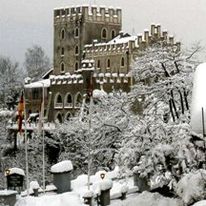
In the winter of 1977-1978 I was able to take a ski trip to Austria with the base recreation services department and other soldiers. One of the best parts of this trip was the opportunity to spend a night in Schloss Itter pictured above, near the village of Itter in the Austrian Alps. At that time, the Schloss had been converted into a hotel. It was decorated with artifacts of the past including suits of armor, weapons, and other things which we seldom see today. Given that it was winter, the snow highlighted both the Schloss and the village.

While I was near several other castles during my time in Germany, duty other demands did not allow visits to them all. I was also unable to visit castles in other countries like France and the United Kingdom which I now wish I had done

There were two things missing from all of the castles I visited or even viewed from a distance – there were no moats nor any huge gates and doors. I wonder where they went.

“Starter Villain” By John Scalzi (A Book Review)

Originally posted November 3, 2024

This is a “must read”. Whether you are a fan of science fiction, humor, fantasy, or mystery you will find something here for you. From the cover of the hardback book to its end cat lovers will also find it fascinating. I found this book easy to read but difficult to put down.

Poor Charlie. A young man with no real job, no career hopes, barely enough money to live day to day. Charlie’s only dream is to purchase a local pub and have a future in the community.  But Charlie has no assets other than his share of a trust. Then, out of the blue, an uncle who has only contacted him once since he was five years old dies and leaves Charlie an unbelievable fortune. But it comes with strings attached.

This is the story of Charlie’s move from outside the poorhouse door to wealth so great one cannot imagine it. Along the way he meets thugs and killers, typing cats, talking dolphins, death, either real or faked, and whales that are spies. Charlie also sees his home explode and burn to the ground, is nearly the victim of a huge explosion, and sees The real question is can, or will, Charlie become a villain? Or will the other villains outsmart, outthink, or even kill Charlie?

While much of the book focuses on things that we may find unbelievable today, it also makes you wonder whether these things are either real today but hidden from us or if they are predictions of the future. Interspersed with this are occasional glimpses of reality such as a discussion of why war exists that is included in Chapter 15.

Do villains exist? Or could the name “villain” be misused? Each of these questions must be explored as you read Scalzi’s 2023 novel. And, at the end of the book, will Charlie become a “villain” or will he, instead, somehow become the owner of his local pub?

Sand Boxes

Originally posted in June 2024.

Today’s youngsters have lives filled with technology.  What started with simple things like Atari games has grown into cell phones, iPads and iPods, and all sorts of new and more complicated technology. Don’t think of me as anti-technology.  I have worked in the field for over thirty years, more if you count the “data processing” years in the military.  At the same time, I wonder if all of these new “toys” have caused today’s youth to miss out on things that are important – things like sand boxes.

While this may not be true in large urban areas, in rural America almost every family had a sand box if they had young children.  The sand box could be as simple as four boards nailed together into a square or rectangle or as complex as a metal square with seats on the sides, an umbrella over the top, and a way to drain any water from the bottom.  The only common feature was they were all filled with sand.

Sand boxes were places where one could play alone or one could play with family, friends, or neighbors.  They were places where the only limit to play was imagination.  Children could have toys like trucks, tractors, dolls, or almost anything in their sand boxes.  Sand boxes were places where we learned sharing, cooperation, and how to deal with others.  Perhaps most importantly, they were places where we learned that disagreements were not the end of the world.

Sure, there were arguments.  We got mad at those who didn’t say or do what we wanted. We yelled at each other. We occasionally had fights. Sometimes we were so mad that we took our toys and went home.  Even so, after we calmed down, we usually ended back in the sand box playing with the same friends again. No one needed to go home and get a gun to shoot someone. No one needed to tear down a beloved sand box. No one had to prove that he or she was better than everyone else.

Perhaps that is what is missing today. Our technology has taken away the need to work and play with others.  We can live in an isolate world where we make the rules and not care about anyone else. Violence is the answer to everything.  Personally, I have problems with this. Bring back the sand boxes.

Today’s youngsters have lives filled with technology.  What started with simple things like Atari games has grown into cell phones, iPads and iPods, and all sorts of new and more complicated technology. Don’t think of me as anti-technology.  I have worked in the field for over thirty years, more if you count the “data processing” years in the military.  At the same time, I wonder if all of these new “toys” have caused today’s youth to miss out on things that are important – things like sand boxes.

While this may not be true in large urban areas, in rural America almost every family had a sand box if they had young children.  The sand box could be as simple as four boards nailed together into a square or rectangle or as complex as a metal square with seats on the sides, an umbrella over the top, and a way to drain any water from the bottom.  The only common feature was they were all filled with sand.

Sand boxes were places where one could play alone or one could play with family, friends, or neighbors.  They were places where the only limit to play was imagination.  Children could have toys like trucks, tractors, dolls, or almost anything in their sand boxes.  Sand boxes were places where we learned sharing, cooperation, and how to deal with others.  Perhaps most importantly, they were places where we learned that disagreements were not the end of the world.

Sure, there were arguments.  We got mad at those who didn’t say or do what we wanted. We yelled at each other. We occasionally had fights. Sometimes we were so mad that we took our toys and went home.  Even so, after we calmed down, we usually ended back in the sand box playing with the same friends again. No one needed to go home and get a gun to shoot someone. No one needed to tear down a beloved sand box. No one had to prove that he or she was better than everyone else.

Perhaps that is what is missing today. Our technology has taken away the need to work and play with others.  We can live in an isolate world where we make the rules and not care about anyone else. Violence is the answer to everything.  Personally, I have problems with this. Bring back the sand boxes.

Introduction, Prologue, or Whatever…

Introduction, Prologue, or Whatever…

I’ve been posting my thoughts online recently and decided to move to a blog rather than individual posts. These are the thoughts of an old (my feeling) man. Someone who has lived in two centuries, 8 decades, over 70 years, and too many days to count.  I initially thought of titling them “A Grouchy Old …” or “A Grumpy Old Man’s …” But after some consideration I decided to leave the grouchiness or grumpiness to your interpretation.  After all, there are things in the world that are good and even an old man can see those as well. These thoughts are often come to me in the middle of the night and are in no order, just shared as ideas, memories, or opinions come to mind (and can be remembered the next morning). Some relate to others and some stand alone. I will also share some personal reviews of books I have read on occasion.

You can feel free to agree with these thoughts, disagree with them, or not really care.  Feel free to share the link to my blog or share these thoughts with others. My only wish is that you remember they are my thoughts, and you are free to have thoughts of your own and share them as you wish. The whole idea is to simply share things and perhaps to encourage others to think and share as well.